
Best Practices in Copilot Adoption in Banking

Many banks have chosen Microsoft 365 Copilot as the centerpiece of their AI strategy to improve banker productivity. Bank executives must have an adoption strategy that balances innovation and widespread usage with the governance and compliance rigor. In this article, we detail what we have learned from our own experience and from other banks when it comes to Copilot Adoption in Banking.
Gain Traction with Pilots, Then Build
It is tempting to distribute Copilot to all bankers and let them experiment. This approach might work, but it is luck if it does and likely will only work at the smallest banks. What usually ends up happening is an immediate usage spike and then a sharp drop off in durable adoption.
This past year has proven that a better approach is for banks when it comes to Copilot adoption is to first identify departments or personas where Copilot can deliver clear value and risk is manageable. Here many banks start with marketing, compliance, finance and IT. Business development officers have also been another source of “power users” that have consistently proven to be quick adopters.
Once these champions are established, banks now have a core group to render peer support and help evangelize through the organization. Banks can demonstrate quick wins before scaling, reducing disruption and support burden.
Invest More in Training Than You Anticipate
Whatever you think you need to train sufficiently for change management, it is likely not enough. Almost every bank we talk to continues to struggle with underestimating the effort it takes to train enough around Copilot to permanently change behavior. The first 20% of your workforce is easy as they are your early adopters. The next 20% of the workforce typically adopts at a more moderate pace. The remaining 40% typically requires more deliberate enablement.
To help with that last 40%:
- Basic training: Provide basic training for all, but that 40% often needs tailored, in-person training on Copilot fundamentals and limitations. Webinars and self-paced trainings can be the primary delivery channel for the easier 60%, but for the last 40% they should be considered support to in-person trainings.
- Work Training Into Every Meeting: Find ways to showcase quality AI work in everyday meetings. Call out the part AI played in the production of presentations, graphics, content and workflow. This showcases AI use and normalizes the effort.
- Role-Specific Training: Take your power users and then have them teach role-focused training using generative AI, agents and customizations for specific tasks.
- Communicate The Background: It is tempting not to spend time educating users on licensing tiers (Copilot Chat vs. premium M365 Copilot), capacity constraints, and feature changes. However, educating users on the platforms helps explains many limitations in the future.
- Use Copilot to Teach Copilot: One overlooked tactic is for banks to train on how to use Copilot to teach Copilot. This meta training approach helps give bankers a tool to leverage Copilot to optimize their own Copilot use. Ask Copilot the steps on how to set up a dashboard to manage all your various projects, and Copilot will provide a detailed list of how to incorporate your project status updates into an executive PowerBI dashboard. Once you learn, then you can have Copilot to build the agents that will ingest, analyze and present various data sources to create a bank-wide dashboard.
Governance Before Deployment
Similar to above, while it is tempting to rush for deployment to feel like you are “doing something,” know that you are stacking the odds against you. For Copilot adoption, banks need go slow before going fast. Delaying governance until after a pilot deployment usually results in the inability to scale effectively while generating an array of costly security incidents.
When it comes to Copilot governance, banks should, at a minimum:
- Governance: Standup separate cross-functional AI strategy and AI oversight committees to manage and monitor the Copilot program.
- Access Audit: Audit data oversharing and access permissions across Microsoft 365 before enabling Copilot
- Focus on Agents: Identify sensitive data and workflows where autonomous agents (Copilot Cowork) require human-in-the-loop checkpoints
- Risk: Collaborate with compliance and security teams to ensure any AI models meet regulatory requirements.
- Support: Establishing dedicated IT support teams, clear ownership, and service catalogs for Copilot use cases. Banks with more formalized governance often appear better positioned to realize value from Copilot.
Focus on High ROI AND Strategic Use Cases During Copilot Adoption
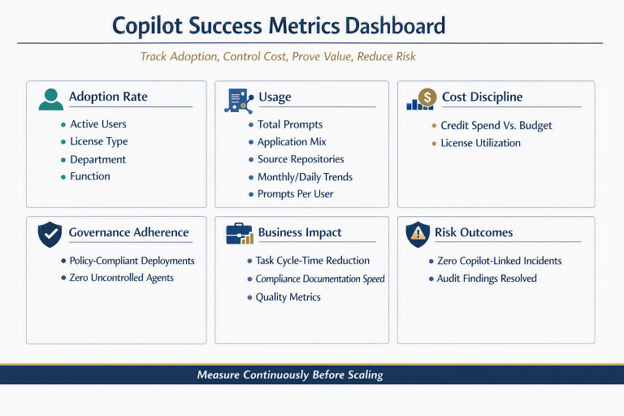
While it is tempting to focus on the use of AI around general productivity, banks should pick specific use cases with strategic value to drive ROI. Examples include automating repetitive compliance documentation, enhancing treasury risk analysis, or streamlining customer communications. Success metrics should be established before deployment, such as tracking the reduction in manual task time, improved decision quality, or compliance cycle time.
With regard to the ROI of Copilot adoption, it is helpful to track consumption-based licensing metrics continuously plus lay the groundwork for ROI early. While these charges come when you go beyond the capabilities afforded through a standard premium license, these token charges can escalate quickly. Worse is the fact that Microsoft changes the structure and amount constantly. This doesn’t seem like a priority to start, but the cost of credits sneak up on you quickly as usage becomes exponential if your adoption plan is working.
To help manage this, banks may want to set up a weekly brief via email from Microsoft that highlights the changes of these agentic consumption charges.
It is helpful to have executive management on the same page with regard to the level of investment, the strategy of who gets premium licenses, usage guardrails, and the cost of ownership models (do you centralize the cost center or charge the business line?) before the Copilot effort results in budget overruns.
Phase Licensing For Agents
While many banks have had success with the introduction of the basic features of Copilot, managing agents has become the next challenge. Treat the Copilot Agent Store like an enterprise application hub. This means limiting “production ready agents” to only approved agents, managing who can publish enterprise agents and proactively deciding on your agent sharing structure (instead of relaying on the Microsoft default settings). This path will help prevent fragmented agent adoption and unclear agent ownership.
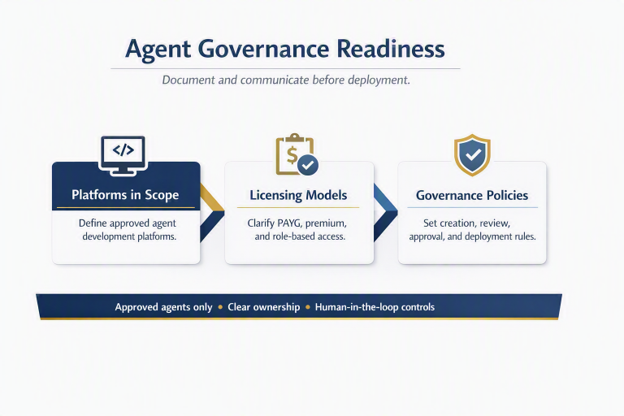
When it comes to licensing, banks may want to start with the pay-as-you-go (PAYG) structure for pilots to test capabilities at minimal cost and then broaden access to premium M365 Copilot ($30/user/month) only after validated success metrics are met. Further, segment users by role and application usage intensity, assigning appropriate licenses based on functional needs and AI maturity helps with the efficient distribution of controls and costs.
Speeding Copilot Adoption
As most banks figured out by now, establishing a Community of Practice (CoP) for Agents is almost a requirement to address the challenges of technology adoption, change management, and governance. CoPs and banks are voluntary, collaborative groups organized around shared interests, function and expertise, enabling banks to support innovation, drive strategic goals, and foster professional development. In the context of AI, such a community becomes a critical enabler for bridging adoption gaps and accelerating innovation.
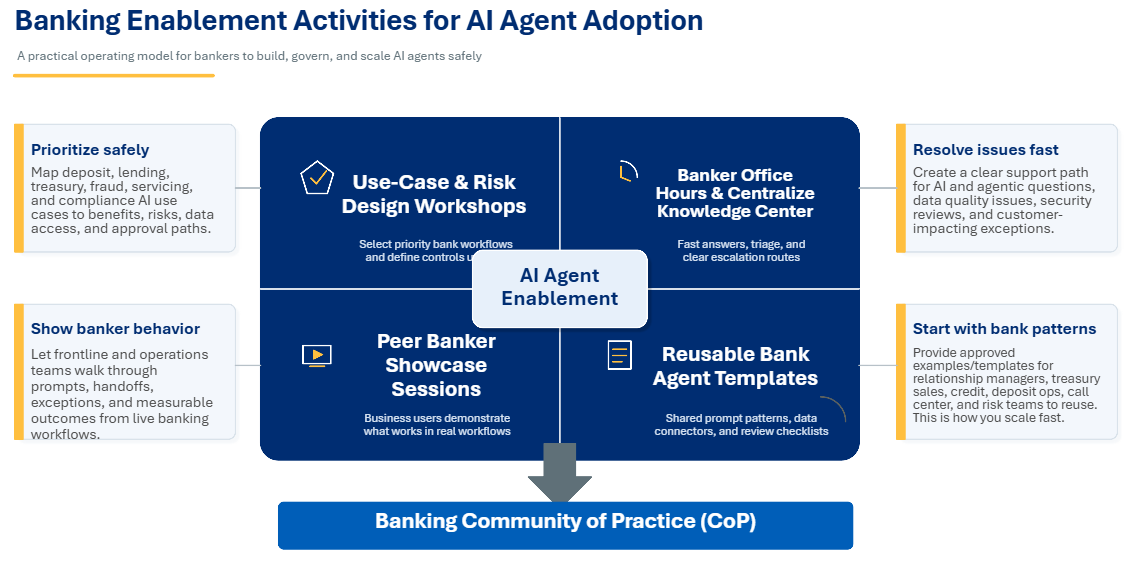
The CoP should offer hands-on banker enablement:
- Training on Agent Creation: Conduct regular workshops on agent creation, prompt engineering, and governance best practices, using common scenarios such as building agents connected to SharePoint, Power BI sites or other key bank tools to demonstrate practical value.
- Office Hours & Knowledge Center: Office hours provide hands-on assistance for developing agents and establish a clear support path for resolving technical or operational issues, ensuring participants have access to expert guidance throughout the development process. Establishing a knowledge center, or central repository of templates, prompts, best practices, training videos and policies allow information to be found fast.
- Showcases and Peer Support: Host showcases “How I built it” of successful agent deployments, and provides a space for sharing lessons learned. Encourage peer mentoring and Q&A forums to accelerate skill development, and ensure managers and leaders actively participate in these sessions to reinforce organizational commitment and drive broader engagement.
- Prebuild Templates and Reusable Components: In the knowledge center, maintain a repository of agent samples and reusable components to accelerate adoption and ensure consistency. This includes clear instructions, starter prompts, naming guidelines, and evaluation frameworks. For Copilot Studio, the community can provide reusable components and agents that can be integrated into new agent solutions for common scenarios, such as applying company branding and style.
Some banks may choose to integrate their agents CoP within a broader Microsoft 365 or GenAI Community. The approach will depend on how the bank aligns agent adoption with wider digital workplace and AI initiatives.
Managing Copilot Risks
Microsoft’s rapid release cadence can create operational and governance challenges for banks, particularly when new features, settings, or agent capabilities are introduced faster than existing risk review, communication, and change-management processes can absorb them. To keep pace, banks should establish faster intake, evaluation, approval, and communication routines so business, technology, risk, and compliance teams can assess changes before they materially affect users or workflows
For sensitive banking functions (e.g., regulatory filings, customer communication), validate Copilot outputs and maintain human review checkpoints, especially given hallucination risks.
It Is Not All About Microsoft
As banks mature, many realize that the Copilot strategy should call for some agent diversification. Plan for a portfolio approach including agents from other vendors to avoid one-size-fits-all constraints and capture best-of-breed capabilities for specific use cases.
Putting This Into Action
For banks, success depends on moving deliberately by making sure strategy, governance and risk management come first and targeted pilots are second. All this comes from measured deployment. Rushing to broad deployment without foundational controls is the most common failure pattern banks have observed.
Interested in how we handle Copilot? Check out our latest podcast with Walt Wear (also on Apple and Android).