
Better Managing Service As Your Value Proposition

Ask a community banker how the bank will beat margin compression, aggressive pricing from larger competitors and a shortage of stable deposits, and the most common answer is the same: “We’re going to compete on service.” The trouble is that the bank down the street says it too, and so does the regional bank, and the credit union, and the fintech advertising on the borrower’s phone. When every competitor makes the same claim, the claim stops being a differentiator.
Service can still win business for a community bank, but it only works when the bank defines precisely what its service is, decides who receives it, measures whether it is delivered, and accepts the trade-offs that come with focus. The best place to see why is inside a single lender’s portfolio.
The Base Case: One Lender, 146 Accounts
We analyzed the portfolio of a typical commercial relationship manager at a bank who managed 146 accounts contributing about $1.67 million to overhead over twelve months, measured as total relationship revenue minus cost of funds. The average relationship contributes about $11,500, but median contributes about $2,800. The top eight accounts contributed 49% of the net revenue, and the bottom half of all accounts (73 accounts) contributed 3% of the net revenue.
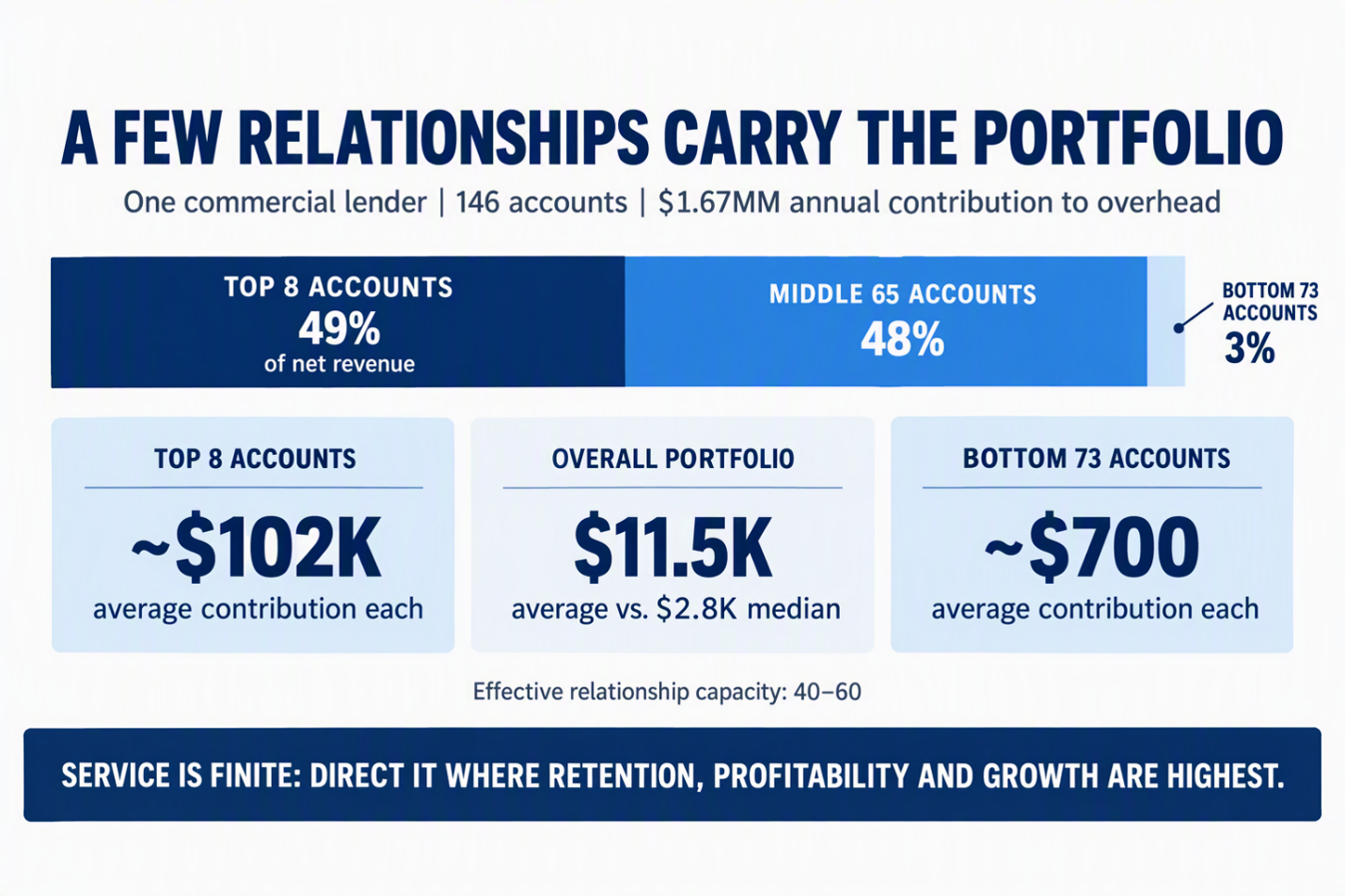
Our and other industry research suggests a lender can effectively manage 40 to 60 relationships. If the bank’s strategy is “better service for everyone,” the top eight, who generate $102,000 each on average, receive the same rationed calling time as the 73 who generate $700 each. That is not a smart service strategy but a subsidy flowing from the most valuable clients to the least. It is crucial for each relationship manager to know what each client contributes to the bank based on a RAROC calculation before any service strategy is defined.
Why “Better Service” Is An Empty Promise
In our conversations with hundreds of bankers each quarter, the service claim breaks down in three predictable places. Most bankers cannot define what better service is. Most do not measure the service they deliver. And almost none are held accountable for service the way they are for ROA, revenue or asset and deposit growth. A bank will run cash flow, margin and credit through rigorous committees, then treat service as a feeling.
The gap between what companies believe and what customers experience is well documented outside banking. When Bain & Company surveyed 362 firms, 80% believed they delivered superior customer experience, yet customers said only 8% did (Bain, Closing the Delivery Gap). More than 95% of those management teams described themselves as customer focused. Bain found that only about half tailored their offerings to customer needs, and fewer than a third organized their functions or feedback loops around delivering a superior experience. Intention was universal but design was rare. The firms that do stand apart do something hard that competitors are unwilling or unable to do, such as specializing in one industry or publishing original research, and every one of those strategies requires a sacrifice, but saying that we give great service requires no sacrifice at all, which is exactly why every bank can say it.
What Great Service Firms Do
Harvard Business School professors Frances Frei and Anne Morriss studied service leaders across banking, aviation, health care and retail for their book Uncommon Service. Their central finding is uncomfortable for any bank promising excellence to everyone: to be great on the dimensions customers value most, a firm must deliberately underperform on the dimensions they value less (HBS Working Knowledge). Excellent service firms do four things well. They pick the service attributes they will compete on, decide how excellence will be funded and measured, build management systems that let ordinary employees deliver it, and teach customers how to use the service.
The payoff for getting this right in banking is retention, and retention compounds. In a study called “Zero Defections,” Frederick Reichheld and W. Earl Sasser found that cutting defections by 5% raised profits by 25% to 85% across the firms studied, with the largest gain, 85%, in a bank branch system (summary). For our lender, one avoided payoff in the top eight is worth about $162,000 a year in revenue, the equivalent of roughly 24 new middle-tier relationships, each costing $6,000 to $16,000 to acquire.
Define The Value Proposition Honestly
A credible service strategy starts by admitting where the community bank does not win. A community bank must measure its service against market competition. A community banker who leads with “we’re faster” or “we understand your credit better” is making a claim the borrower may soon disprove.
Many community banks may hold four genuine advantages. Each advantage must also pass a cost test: value equals service divided by the cost of delivering it. For example, Saturday branch hours fail it. Roughly three in four customers say they want them, yet most would not use them. Approving under-collateralized credit for a capital-intensive borrower fails it too, because the bank’s cost exceeds the client’s benefit.
Four Attributes Where Community Banks Can Win
There are four specific service attributes that most community banks can deliver better than their competitors. All four are highly valued by commercial borrowers, inexpensive for a community bank to provide, and difficult for larger or non-bank lenders to copy. These are the attributes a lender should name, benchmark and repeat in every client conversation.
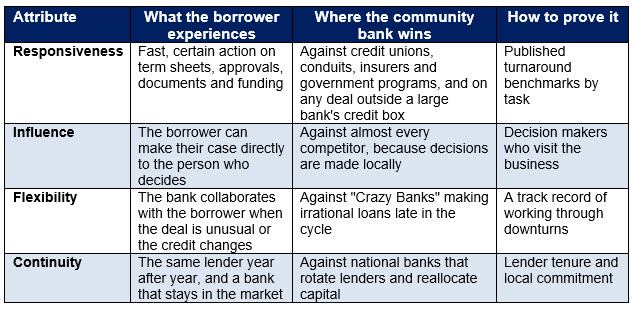
Responsiveness is the time the bank takes to complete any action that affects the client: producing a term sheet, underwriting the credit, drafting documents or funding the loan. Borrowers value certainty and a quick decision. This attribute needs care, because large banks are fast on loans that fit neatly into their box.
Influence describes how well the borrower can advocate for their own credit needs. When a business owner can sit across from the decision maker, explain the plan and walk the credit officer through the plant, influence is high. This is the community bank’s largest structural advantage. Lenders should say so explicitly: “You will meet the person who approves your loan.”
Flexibility is the bank’s willingness to work with a borrower whose relationship does not fit the model perfectly or whose credit changes along the way. The competitor to watch is what we call the “Crazy Bank”: an institution making non-rational loans with high leverage, thin debt coverage and no recourse late in a credit cycle. However, those lenders look generous in good times and disappear when conditions change. A community bank that underwrites soundly up front earns the room to be flexible in good times and in downturns, and it should not squander that advantage by matching irrational terms.
Continuity is the consistency of the relationship between borrower and lender. Borrowers do not want to educate a new relationship manager every two years because the bank rotates staff or loses people to turnover, a frequent complaint about national banks. Continuity also operates at the institution level when a regional economy weakens, national banks, insurers and conduits can move capital to other markets, while community banks remain tethered to the community. That certainty is most valuable to borrowers precisely when times are difficult.
None of the four attributes requires a price concession. Each is a choice about where the bank invests time and people, and each is meaningless as a claim until the bank defines it, measures it and holds lenders accountable for delivering it.
Direct Bank Service Where It Pays
Service is a finite resource, and the profitability curve tells a lender exactly where to spend it. A methodical approach follows five steps.
- Tie service to a measurable result. Pick the outcome, such as retention of the top 8 accounts per lender, deeper product penetration in the middle, or lower attrition at maturity, and track it like any other performance metric.
- Segment by profitability and potential. Rank every relationship by contribution to overhead or RAROC and growth potential. The top eight relationships warrant a different service model than the bottom 73.
- Ask clients, not just staff. Frontline employees tend to assume clients value whatever the bank already does well. Use interviews, panels and surveys of current, former and competitors’ clients to find what drives satisfaction.
- Test expectations against cost. Fund only the attributes clients value more than they cost to deliver.
- Measure, reward and repeat. Report service results alongside credit and production and pay lenders for relationship profitability rather than loan count.
Applied to our lender, the plan is concrete. The top 8 relationships get proactive calling, a prepayment-exposure review, longer hedged fixed-rate terms and early conversations about liquidity events, which is durability delivered as service. The middle 43 get a structured relationship review that leads with treasury management, operating deposits and right-sized facilities. The tail is offered the full relationship; clients who decline are repriced or released.
The four attributes should be rationed the same way. The top eight receive all four at their highest level: guaranteed turnaround times, direct access to the credit decision maker, flexibility in structuring, and a dedicated lender who stays. The middle receives responsiveness and continuity as the platform for deepening the relationship. The tail is reviewed for potential migration or exit from the bank, but service is minimized if no potential exists for a full relationship. Moving toward the 40-to-60 relationship standard means letting some transactional borrowers go to the competitor with the lowest rate. The calling time recovered is what pays for exceptional service to the clients who generate 80% of the contribution.
Bank Service as a Strategy, Not a Slogan
Every community bank can say it competes on service, but winning on service is not easy. The banks that can win define the few attributes where they are genuinely better: responsiveness, influence, flexibility and continuity. Those banks fund higher service by accepting trade-offs elsewhere and measure it as seriously as credit quality.
For the typical lender, a few clients carry half the book. Make sure that you have the tools to measure the RAROC per relationship and serve these clients in a way competitors are unwilling to match, and a service promise becomes a competitive advantage.