
How To Optimize The 1031 Exchange In Banking

We work with many banks across the country, and we get to see hundreds of different client scenarios weekly. We recently worked with a bank that held a loan with a client who was using a 1031 exchange, but instead of paying off the loan with that bank, the customer retained the economics of the loan to use for the newly acquired property. This is a case study in client retention that we would like to share.
The Payoff You Can See Coming
A 1031 exchange is a tax deferral for the borrower and, for most banks, a payoff notice. The client sells an appreciated property, a qualified intermediary takes the proceeds, and the clock start. The client has 45 days to identify a replacement property and 180 days to close. Annually there are thousands of like-kind exchanges representing on average $34Bn in principal. This is a meaningful share of annual commercial real estate transaction volume in most markets.
In talking with community bankers across the country, we see the same pattern. The exchange is treated as a loss event because the loan pays off, the relationship manager sends a congratulatory note, and six months later the bank re-competes for the replacement property against every other lender in town. The competition frequently leads to worse spread, looser credit structure, and often losing outright. That is a self-inflicted wound that can be avoided. The 1031 exchange is the single most predictable payoff in a commercial portfolio, and on a hedged loan it does not have to be a payoff at all. The rate economics can be carried across the exchange and attached to the replacement property.
Bank 1031 Exchange Case Study
Our client bank held a loan secured by a retail center with an outstanding balance of approximately $5mm. The borrower locked the rate in early 2026 at what is now considered an attractive rate with a 2031 maturity (the borrower was enjoying a sub 6% rate on a 300-month amortization).
In late August 21, 2026, the borrower’s advisor wrote to the relationship manager seeking approval for collateral substitution for the new loan using two industrial/flex buildings under consideration. A third acquisition was identified for a full absorption and increase to the credit facility.
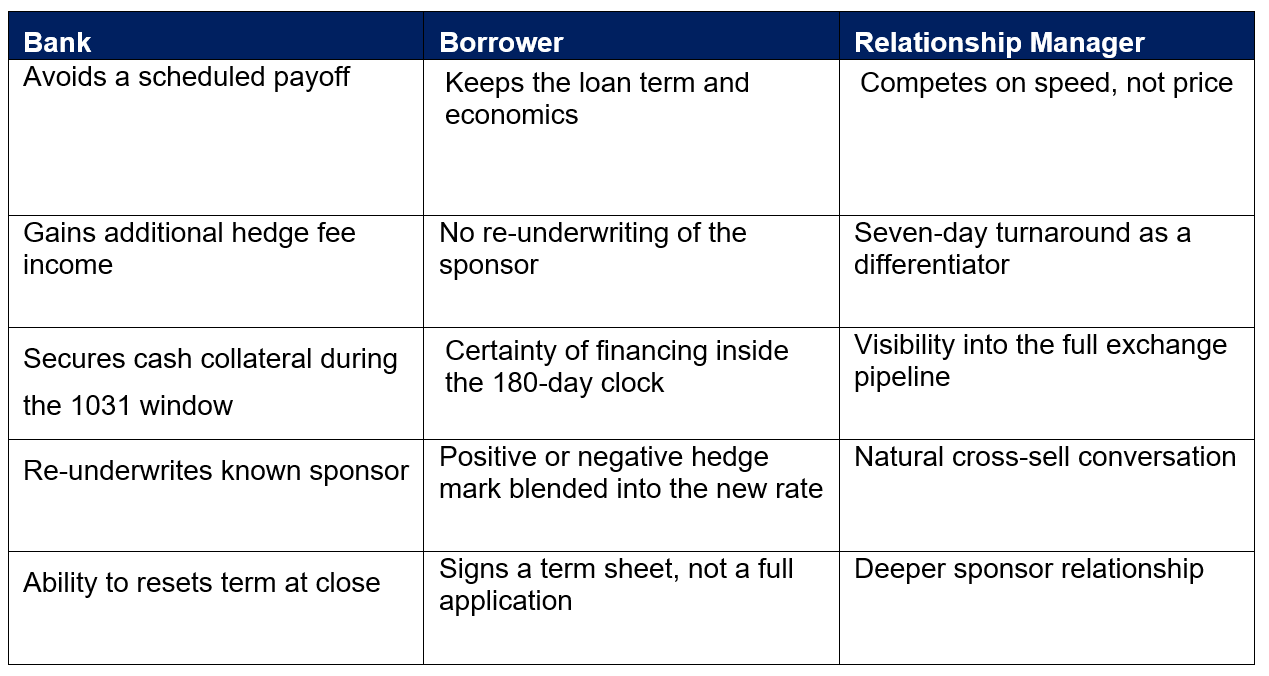
The property sold before all the replacements were identified, so the bank ran the payoff-first sequence. Credit was asked to approve two things: that the hedge remain outstanding for a six-month window with no loan and no real estate security in place, with interim hedge exposure secured by proceeds of the sale. The senior credit officer approved the request the same day. The regional president approved the loan credit spread pricing subject to conditions the next business day. Within a week the bank issued a Rate Hold Term Sheet for $5mm, up to six months, holding the hedge rate and credit spread. The commitment will expire in February 2027. The borrower signed it on his phone six minutes after it hit his inbox.
Seven days from the borrower’s first email to an executed rate hold. The bank kept the client, kept the hedge, kept the fee stream, and pinned down the cash collateral securing the interim exposure. When the new loan closes, the hedge notional will be increased to match the new loan, with the option to extend maturity, reset amortization, or adjust the credit spread (depending on underwriting criteria), and the prevailing market value of the hedge is blended into the new rate. The borrower’s loan economics is not stranded but becomes part of the economics on the replacement loan.
How A 1031 Exchange Drives ROE on Both Sides of the Balance Sheet
The math on retention is not subtle for the bank. Booking a commercial real estate loan costs a bank roughly $6k to $20k on average once you amortize the applications that are never funded. Against thin margins, a loan’s ROE does not turn positive until it has seasoned substantially. A 1031 payoff at year one, two, or three resets that clock to zero and forces the bank to spend the origination cost twice to end up with the same balance.
Retention also compounds in four directions. Amortization builds collateral cushion slowly because on a 25-year amortization schedule, only 1% of the loan is repaid in year one and 2% at the end of year two, but 15% by year ten and 28% by year fifteen. Cross-sell requires time and proximity; the bank that holds the exchange proceeds and the replacement loan is the bank that gets the treasury management and the next credit. And prepayment behavior is where hedging separates itself: the average community bank commercial portfolio prepays at 20% to 40% per year, while hedged portfolios consistently show between 2% and 6% per annum prepayment speeds, which is roughly six times slower, stretching expected average life from two or three years to eight to twelve. Those hedged loans earned higher risk-adjusted returns on capital. Finally, a hedged 1031 exchange stacks another important profitability mechanism. The borrower is not shopping the replacement financing, because shopping means abandoning a below-market locked rate. The additional switching cost for the borrower avoids the bank needing to compete against aggressive local lenders.
A summary of the outcome is shown in the table below.
Conclusion
Banking is the business of keeping loans, not making loans. A 1031 exchange is a moment when a good client is contractually required to hand you back your best asset, and most banks let them. The rate hold term sheet is a modest document: two pages. What it does is convert an exchange from a payoff into a continuation. The requirements are a hedge that can be modified rather than terminated, a credit function willing to approve an interim exposure against cash collateral, and a relationship manager who picks up the phone when the borrower is still evaluating buildings rather than after the wire clears.