
Use This Secret for More Profitable CD Renewals

At our recent Deposit Conference, Nomis Solutions taught us a handy trick leveraging their CD performance data from their machine-learned model. In this article, we are going to take a look at a case study that compares two methodologies for CD renewals and see which one outperforms. The one that outperforms comes with two tactics that 98% of the banks don’t do.
The CD Renewals Test
In this A/B test, Nomis analyzed 3-month CD renewals for a medium sized community bank that is moderately insulated from larger institutions. For the control group, the bank offered to roll the CD over for another 3 months. This is what most banks do.
To get better performance, Nomis tested asking the customer if they would like to roll the CD into a longer, 12-month maturity (keeping the spread to SOFR the same but at a higher rate) AND cross-selling wealth management services.
The Result of the CD Test
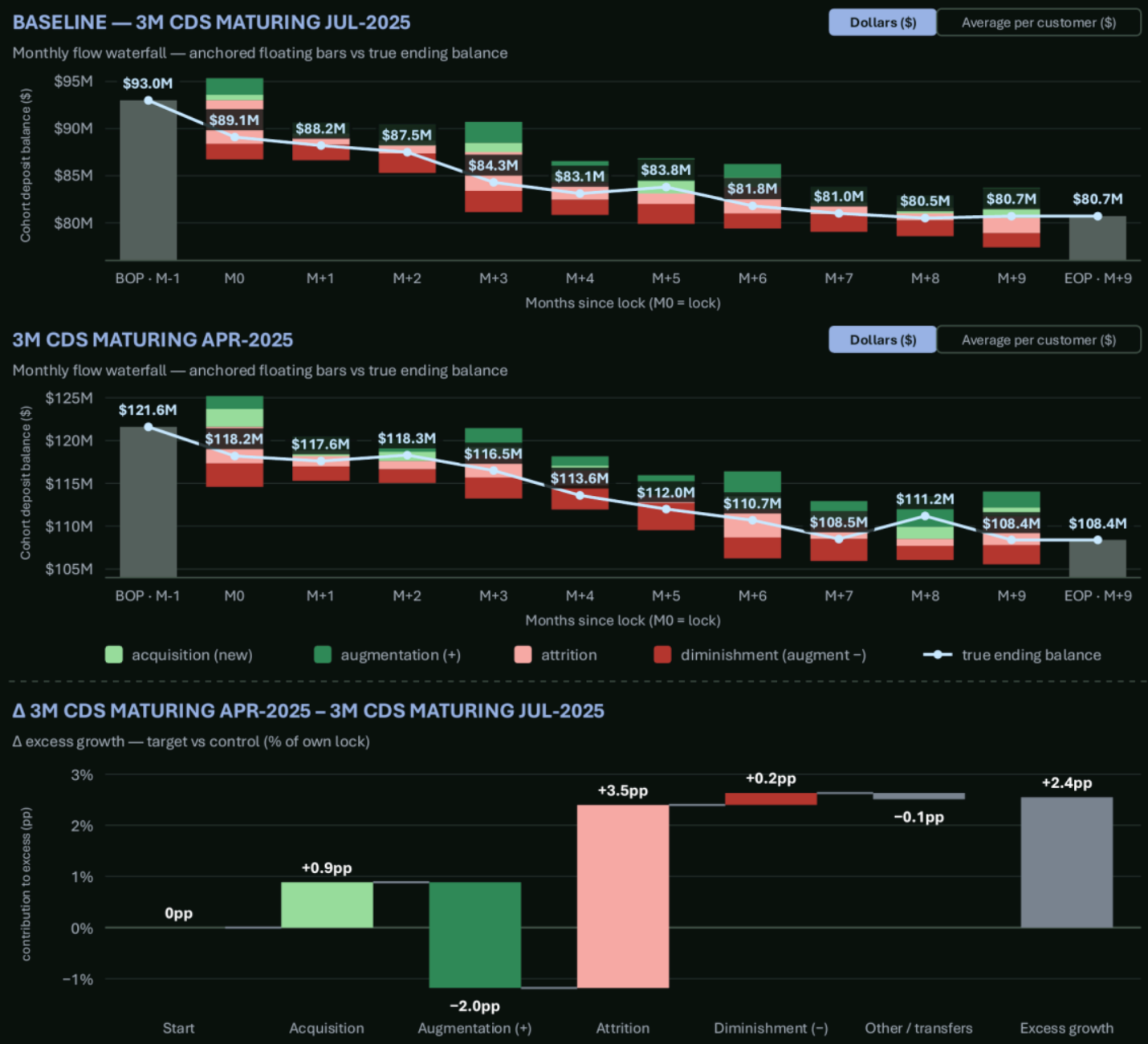
The results of the A/B test are below. The July cohort was asked to renew the CD term, while the April cohort was asked to extend their term and offered wealth management services. At the end of 9 months, 89.1% of the April balances were retained vs. 87.8% for the July cohort with the standard 3-month rollover. In this case, which is a dollar difference of almost $3mm for the one maturity based on a $121.6mm starting point. In today’s rate environment, which is a savings of $1.5mm annually that this bank would have to presumably replace with wholesale funds.
Why This Works
Oftentimes, CD customers don’t have a clear rate or liquidity view and are highly open to advice. Smart banks train their staff to have a conversation about liquidity needs, and if the customer doesn’t need liquidity, then bringing them out longer is likely to everyone’s benefit, especially in a rising rate, and highly volatile environment.
Often the 12-month or 18-month maturity is optimal for both the bank and the customer. The customer gets to take advantage of the steeper yield curve and achieves a greater return while reducing the maturity decision every three months.
For the bank, it now has a longer duration liability on its books, while slowing attrition with each rollover, plus reducing cost. Taking a customer out 12-months, also provides better performance on the money market account as customers that choose not to rollover, get swept back into their transaction account, with some of the money going into the higher yielding money market account where the bank has a higher relative cost (on a spread basis) for less liability duration.
By cross-selling wealth services, banks now gain an additional fee income stream increasing cumulative lifetime value, while showing the customer another point of engagement.
For banks without wealth capabilities, cross-selling into other products, to include savings or lending products, would also help performance.
Putting This CD Renewals Tactic Into Action
This may or may not work for your bank, but the important point here is to experiment to constantly test the market and test various deposit tactics. While Nomis is available and used an AI model, banks can track and manage this on a simple spreadsheet.
To put this CD renewal tactic into action, train your staff to have the CD extension and cross-sell conversation and then track what happens to new fund acquisition, attrition, product movement, transfers, and fund reductions.
While 2.4% per month might not seem like much, gaining superior deposit performance is the art of doing a lot of little things right.