
How to Use Forward Rate Locks in Commercial Lending

A forward rate lock is one of the few products a community bank can offer that protects the borrower, strengthens the credit, and adds fee income at the same time. A year ago, we made that case in a flat-curve market. Today the case is stronger, because the risk a lock removes has stopped being theoretical.
In 2025 the question borrowers asked was “why lock if rates might fall?” In October 2026, with the Fed hiking again and the 5 and 10-year Treasury touching its highest level since 2002, the question has flipped. One of our partner banks put it plainly this month: does it make sense to lock 12 months forward when rates are rising? Our answer is that a rising-rate market is exactly when a forward lock should be used.
How We Got Here: 2025 to 2026
Long-term borrowing costs are up roughly a full point in twelve months, but the path was not a straight line. Through 2025 the Fed cut short rates and long rates drifted, which lulled many borrowers into waiting, but rates have climbed in 2026.
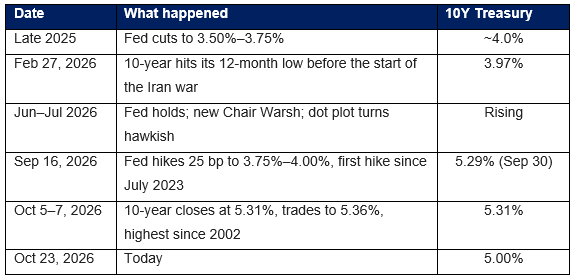
The curve has changed shape – last year it was flat; today the 3-month bill yields 4.22% and the 30-year 5.33%, so a 12-month forward now costs a few basis points more than a spot start. That premium is small next to a 100bp move in the underlying rate.
The Risk a Forward Lock Removes: Reprice Risk on DSCR
When the rate rises and NOI does not, coverage falls fast. Our workbook models a $1 million, 25-year loan at 7.00% and holds NOI fixed at four starting coverage levels, from 1.10x to 1.29x.
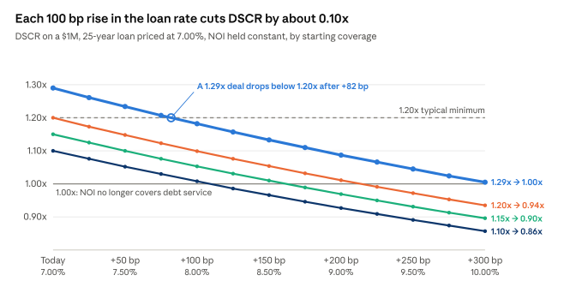
A project underwritten at a healthy 1.29x slips below a typical 1.20x minimum after about 80 basis points. That is less than the 5 and 10-year swap rates moved in the last twelve months. At +200 bp the 1.20x deal barely covers its payment, and the 1.10x and 1.15x deals are underwater. The building may be finished and leased, yet the takeout no longer sizes and that loan structure becomes un-bankable.
Forward Lock Case Study
A recent borrower was asking for $4.95 million financing: 12 months of construction followed by a 20-year fixed rate on a 20-year amortization, forward locked through ARC at closing.
- One note, two payment streams. Stream 1 runs 12 months, likely interest-only, at whatever construction pricing the bank sets. Stream 2 runs 240 months of P&I at 1-month Term SOFR + 2.00%.
- The bank floats; the borrower is fixed. The bank earns its construction pricing, then SOFR + 2.00% for 20 years. Through the Rate Conversion Agreement, a rate-fixing addendum to the note, the borrower pays one fixed rate on Stream 2: indicatively 7.06% as of October 2026.
- The bank is paid a fee up front. A 20 bp hedge fee comes to about $75k on this size and structure, earned before the borrower breaks ground.
The bank’s chief banking officer asked the right question: does a 12-month forward lock make sense when rates are rising? The ARC team’s reply was that nobody knows where rates will be in a year, so both sides want the number fixed now. The borrower removes the risk of a higher payment. The bank gets a credit enhancement, because it can underwrite to a known debt service.
Here is what that certainty is worth. Assume the project is sized at a 1.25x DSCR on the 7.06% lock, which implies about $578,000 of stabilized NOI against $462,700 of annual debt service. If the borrower had waited and rates rose at conversion:

A 100 bp move leaves a $361,000 hole in the takeout; 200 bp leaves $683,000. That gap lands a year from now, on a newly constructed building, when the borrower has the least room to find new equity. The lock is not free in the other direction. If rates fall, the borrower keeps paying 7.06%, and exiting early carries a breakage cost. That is the trade a borrower makes for certainty, and it should be disclosed plainly.
Value on Both Sides Of The Desk
The forward lock is a service first because the borrower gets a known payment for term, sized today, without paying an upfront premium. That certainty helps them win the deal with their own investors and sleep through the next Fed meeting.
For the bank, the same structure pays in four ways:
- Stronger credit. Underwriting a known P&I payment removes the single largest unknown in a construction takeout.
- Fee income now. Hedge and commitment fees arrive at closing.
- A floating asset. Through ARC the bank earns SOFR plus its spread and carries no fixed-rate interest rate risk on its balance sheet.
- A longer relationship. Booking construction and perm together keeps the national lenders from refinancing the client away at stabilization.
The curve is no longer flat, so forward starts now cost a few basis points more than spot. Banks are using forward locks to:
- Close construction and permanent financing in a single note, with extra interest-only months for lease-up.
- Win clients from other banks by matching their existing rate for a period, then earning a market spread on the forward term.
- Extend an existing customer whose below-market loan matures, locking the new term today.
- Hold negotiated pricing through title, appraisal and documentation, typically a few weeks to a couple of months.
The one rule has not changed. The bank should not take rate risk it is not paid for; the hedge carries it instead.
Conclusion
In a rising rate market the forward lock stops being a nice extra and becomes the thing that keeps a project bankable. The borrower trades the hope of lower rates for a payment they can plan around. he bank collects fees, floats its assets, and underwrites a credit it can actually predict. National and regional lenders already offer this; community banks can too, without putting the rate risk on their own books. If your lenders are fielding this same question, we are glad to walk them through how SouthState structures it through ARC.