
Higher For Longer and Why Every Bank Needs Hedged Loans

In January 2022, we published an article called “Loan Hedging May Save Your Bank” (you may search for it here). At the time, Fed Funds rate was near zero and much of the industry still believed inflation was transitory. We argued otherwise and stated that inflation would erode the real value of fixed-rate loan margins, and that banks would need new sources of fee income as PPP fees disappeared. We also made a specific recommendation that community banks that offered a seamless loan hedging program would gain a competitive advantage, and banks without one would be at a disadvantage. Silicon Valley Bank and First Republic Bank failed (neither bank adopted a hedging program) and many surviving banks without a loan hedging program spent the next two years absorbing net interest margin compression from fixed-rate loans and securities booked at the bottom of the cycle.
Banks that had converted borrower fixed-rate demand into floating-rate assets through a hedge fared differently. Their loan yields repriced with their funding costs, their borrowers kept the payment certainty they wanted, and the bank kept the hedge fee income. The thesis held: hedged banks outperformed.
We Didn’t Predict Rates
No one forecasts interest rates reliably (we don’t claim we can). Economists, the FOMC’s own dot plot, and futures markets are routinely wrong, and their precision falls sharply beyond one quarter. At the start of 2025, markets priced two to three cuts, we published another article in January 2025 stating that all forces were pointing to rate hikes and the first came on September 16, 2026. We cannot tell you where rates will be next year, but long-term forces are leaning toward higher for longer.
Persistent inflation, AI capital spending, persistent large deficits and debt, and deposit tokenization all point to both higher rates and deposit sensitivity. It means that community banks booking 5, 7, and 10-year fixed-rate loans on balance sheet are making a large, uncompensated bet that these forces will fade – it is a poor bet with asymmetrical outcomes.
Three Loan Structures Every Bank Needs
A borrower financing a long-term asset has three basic choices. Each one shifts interest rate risk to a different party, and only one gives both sides what they want.
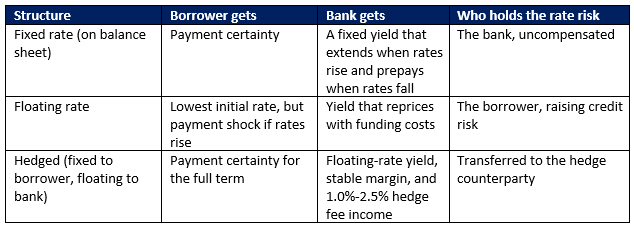
The on-balance-sheet fixed-rate loan is the most popular structure at community banks. Unfortunately, most banks either omit a prepayment provision, use a soft one, or waive it for an important client. The result is a loan with negative convexity: it prepays when rates drop and extends when rates rise. The bank gets the worst outcome in either direction. A community bank cannot give up on this structure, but it must manage term, prepayment structure, and overall volume based on balance sheet parameters. The floating-rate loan protects the bank’s margin, but it moves the risk onto the borrower. When rates jump, debt service coverage deteriorates, and interest rate risk quietly becomes credit risk.
The hedged loan resolves the conflict – the borrower pays a fixed rate for five, seven, ten, 15, or 20 years and the bank earns a floating rate that moves with its cost of funds. Three benefits stand out:
- Removes forecast risk. The bank no longer needs to be right about the path of rates, which no one predicts reliably beyond a quarter.
- Generates fee income. Hedge fees of 1.0% to 2.5% of the loan amount are earned up front and retained even if the borrower prepays or refinances early.
- Delivers the yield the bank expects. A hedged loan does not prepay away the bank’s margin when rates fall or trap the bank in a below-market yield when rates rise.
This is why roughly seven in ten domestic loan dollars sit at banks that offer a loan hedging program. Measured by loan portfolio size, the bank without a hedging option is in the minority. Every community bank should have some hedged loans, not as a speculative position, but as the one structure that serves the borrower and the bank at the same time.
Why ARC Is the Better Loan Hedging Program for Banks
The benefits of hedging are not in dispute. The obstacle is execution as many community banks will have a small percentage of their entire loan portfolio hedged. The ARC program offers community banks the following advantages:
- A product lenders can explain. Our test for any commercial bank product is simple: an average lender should be able to explain it to an average client in a 5-to-10-minute conversation over coffee. Many hedge programs fail because they use ISDA documentation which runs 45 to 60 pages across multiple agreements in dense legalese. Lenders will not sell what they cannot explain, and borrowers will not sign what they do not understand. ARC is documented as a loan, so the conversation is about a fixed-rate loan, not a derivative.
- No new department. A viable loan hedging program requires inside expertise, typically three dedicated people: a senior sales specialist, a junior specialist for coverage, and an operations person for documentation, billing, compliance, and accounting entries. Add collateral, capital, legal, and reporting costs, and the break-even is usually 50 to 100 swaps. Most community banks never reach that volume. ARC requires no added staff and makes economic sense from the first loan.
- No burden on the borrower. Most other hedge programs bring monthly settlement statements, derivative accounting, and Dodd-Frank reporting to the borrower. The borrower wanted a fixed-rate loan, not a second financial instrument to manage. ARC keeps the derivative off the bank’s balance sheet and off the borrower’s books, with a single loan payment.
- Lower risk to the bank’s reputation. Selling a complex derivative to the wrong client invites disputes and lawsuits. A simple, concise agreement reduces that risk, and ARC structures can be tailored with prepayment options, amounts, and terms that fit the borrower’s timeline.
- It fits the bank you already run. Loan hedging is an adjunct to an existing product, the commercial real estate loan. Under the ARC program, the chief lending officer serves as product champion, the chief credit or risk officer as product risk manager, and loan operations handles billing. The sales force is already in place: your relationship managers.
ARC is a loan hedging program used by hundreds of banks across the country, including SouthState Bank. It delivers the benefits of a loan hedge without complex derivative documentation, derivative accounting, or monthly borrower settlements. We can put you in touch with a community bank just like yours that uses the ARC program to discuss why they chose this platform.
A Process for Choosing Hedge Candidates
Not every loan or borrower should be hedged. Each bank needs a written process that identifies which loans qualify, so lenders show the ARC option consistently rather than only when a competitor forces the issue. We recommend three screening criteria.
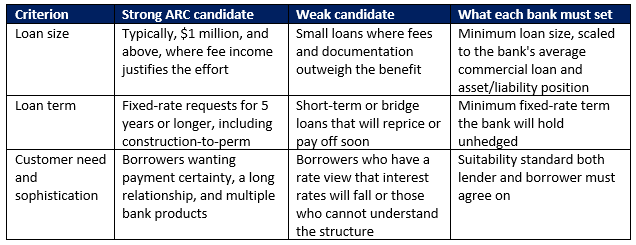
When a loan meets the bank’s thresholds on all three criteria, the lender should present a hedged option alongside the fixed and floating options and let the borrower choose. Presenting all three is good disclosure and good selling.
The thresholds will differ by bank. A $500 million rural bank may set a $750,000 minimum and a 10-year term, while a $5 billion metro bank competing with national lenders may set $2 million and five years. Four factors drive where a bank lands:
- Bank size. Larger banks with larger commercial loans have more qualifying credits.
- Location and competition. Banks competing with regional and national lenders that already offer swaps need the option defensively.
- Customer base. Commercial real estate investors and cash-rich operating businesses are natural candidates; consumer-heavy books are not.
- Balance sheet mix. Banks already long fixed-rate loans or securities, or funded with rate-sensitive deposits, benefit most.
In our experience, hedged loans should account for between 1% and 20% of total loans, depending on these factors. Even at 1%, the fee income, margin protection, and client retention are material. At 20%, hedging becomes a core part of how the bank manages its balance sheet.
Get This Loan Hedging Program
In 2026, the Fed is hiking again, and the 10-year Treasury is above 5%, and inflation, AI spending, and federal deficits all push against a quick return to low rates. Community banks should not take interest rate risk without compensation. A disciplined process for identifying hedge candidates, paired with a program lenders can explain and borrowers can live with, lets a bank offer the fixed rate its clients want while keeping the floating-rate margin, fee income, and credit stability the bank needs.