
Why Lenders Should Care About Symmetrical Yield Maintenance

If you are a commercial lender at a community or regional bank, the prepayment provision on your fixed-rate loans is probably the least-discussed and most valuable term in your credit agreement. Most banks either negotiate away prepayment protection entirely or rely on a step-down penalty that borrowers routinely force banks to waive at payoff. A symmetrical yield maintenance provision is used by many national banks and on almost all hedged loans – therefore, knowing what your competition is offering is crucial. This prepayment provision gives your bank real economic protection, but just as importantly, it is a provision your borrowers can genuinely accept as fair if properly explained. That combination lets you win more deals on pricing, keep relationships longer, and grow fee income, cross-sell, and deposits along the way. Most importantly, this provision can be structured to help your borrower obtain the right commitment term and loan structure.
What Symmetrical Yield Maintenance Actually Is
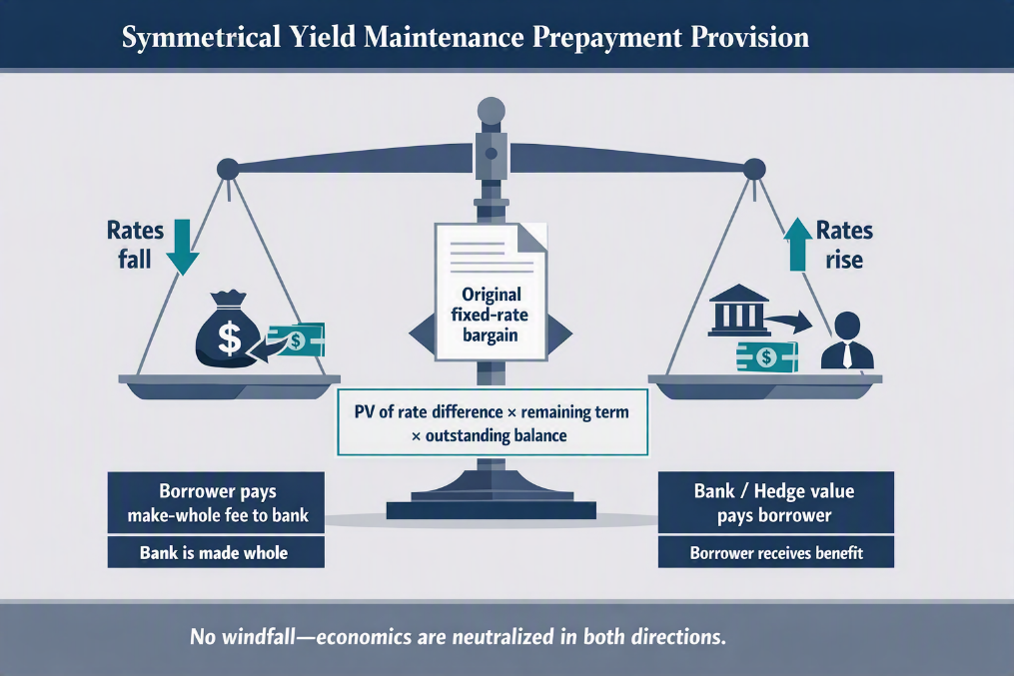
Symmetrical yield maintenance follows a simple formula based on two inputs: the term remaining on the loan, and the movement in the market hedge rate between closing and the prepayment date. The prepayment amount is the present value of the difference between the starting hedge rate and the current hedge rate, applied to the loan balance over the remaining term.
The defining feature is that the payment runs in both directions. If rates have fallen when the borrower prepays, the borrower pays a fee. If rates have risen, the borrower receives a fee. Either way, your bank is made economically whole – the provision transfers no windfall to either side, it simply holds both parties to the bargain struck at closing. Importantly, the borrower ultimately decides on the commitment term and the exit point.
Consider a $1,000,000 loan with a 10-year term, 25-year amortization, and a 6.00% fixed rate built on a 4.00% initial hedge rate. Reference the table below. Three years in, seven years remain, if the 7-year hedge rate has fallen 25 basis points, the borrower owes roughly $13,500 at payoff. If it has risen 25 basis points, the borrower receives roughly $13,300. Partial prepayments work proportionally. Columns show the prepayment hedge rate versus the initial hedge rate. Amounts in parentheses are paid by the borrower; positive amounts are received by the borrower. The pay and receive columns are nearly mirror images, and amounts decline as the loan seasons.
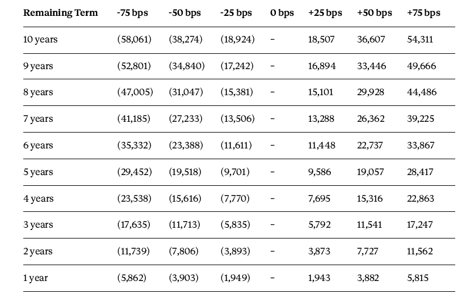
Because the fee tracks the true economics of the rate lock, it is a provision a lender can present to the borrower with a full scenario table – like the one above – and defend without embarrassment. Contrast that with insurance-company one-sided yield maintenance, or a step-down penalty that is not tied to the economics of the loan to the bank.
What’s In It for the Lender
Here is the pricing arithmetic every lender should internalize. When your bank writes a fixed-rate loan with weak or no prepayment protection, the bank is giving the borrower a free one-way option: they refinance when rates fall, and they sit on a below-market rate when rates rise. That option has a measurable cost. Capital-markets analysis shows the economic cost of excluding meaningful prepayment protection is only a few basis points on a one-year loan, but roughly 55 basis points at five and ten years.
A symmetrical provision on a hedged loan eliminates this cost. That means you can quote more aggressive rates than many of your competitors – or match the market rate and keep the difference as margin and hedge fee income. National and regional banks already price this way; symmetrical yield maintenance is what lets a community bank compete for the same long-term, high-quality credits without taking duration risk onto its own balance sheet. It also enforces pricing discipline: the loan’s economics no longer depend on guessing where rates go.
But it gets better for the bank and the lender. There are five additional benefits to this prepayment provision:
- Longer Relationships and Stickier Loans. Prepayment speed is the silent killer of commercial loan profitability. Origination costs are front-loaded, so a loan that leaves in year two rarely earns back its underwriting and closing expense. Hedged loans with symmetrical provisions consistently show prepayment speeds among the lowest of any structure because the borrower has no free option to refinance away when rates dip. The provision keeps relationships in-house even as the borrower’s needs evolve. Using the ARC program, SouthState Bank allows borrowers (with the bank’s underwriting approval) to blend and extend new money, new term, or new amortization without invoking a prepayment. The borrower can substitute collateral, complete a 1031 exchange, bifurcate the loan, or have a new borrower assume the loan and hedge via a simple amendment. Each of those events – which at another bank would be a payoff and a lost customer – becomes a renewal, an amendment fee, a new underwriting, and a deeper relationship at your bank. The borrower selects the term that fits their business plan upfront, and every subsequent change in that plan routes back through you, the lender. A 10-year hedged relationship simply gives you five times the touchpoints of a two-year mini-perm. And when rates rise and the borrower does sell, the fee the borrower collects is a goodwill event your competitors cannot replicate. The customer who receives a check at payoff comes back for the next project.
- More Fee Income. Longer relationships compound. Banks using hedging programs in conjunction with the symmetrical yield maintenance provision can generate hedge fee income between 50 to 250 basis points at closing, or $5,000 to $25,000 on a $1 million loan.
- More Cross-Sell. Treasury management and operating deposits grow with longer customer engagement. A borrower whose 10-year permanent financing lives at your bank naturally consolidates operating accounts, rent collection, and reserves there. Every year of additional loan life is another year of low-cost deposit balances that a two-year loan never delivers.
- The Full Wallet. Long-dated credit is the anchor product. Once it is in place, lines of credit, equipment finance, owner’s personal accounts, wealth management, and the next acquisition loan follow, because moving the anchor is neither easy nor economically attractive for the borrower.
- Better Borrowers Self-select. Sophisticated sponsors who intend to hold assets and value rate certainty are precisely the customers who accept symmetrical provisions readily. The provision filters for the long-horizon, deposit-rich relationships every bank wants, while rate-shoppers gravitate elsewhere.
Conclusion
Symmetrical yield maintenance succeeds where other prepayment structures fail because it can be positioned honestly to deliver benefits to the borrower and the bank. The formula is transparent, and economically equitable to both lender and borrower, and the scenario a table is disclosed before signing. If the borrower believes rates will rise or hold steady, the provision is an outright advantage to them. If rates fall and they exit, their fee is offset by refinancing the balance at the new lower rate –cost neutral financing event for the borrower. And if the loan is held to maturity, the prepayment consequence is nil.
For the bank, the result is a rare alignment: protection that is enforceable because it is fair, pricing power that wins deals rather than losing them, and a structure that encourages borrowers to stay with the bank. Add the hedge fee income at closing, the elimination of duration risk, and years of additional deposits and cross-sell, and the symmetrical prepayment provision that can be applied with a hedge becomes the most profitable provision in your loan agreement.