
Fixed-Rate Lending: The Options Banks Give Away for Free

Fixed-rate lending can create negative economic value for banks. That is, unless the bank upcharges credit spread and enforces meaningful prepayment provisions. Every fixed-rate commercial loan contains two options that the bank writes and the borrower owns. Neither appears on the term sheet as a line item. Neither is invoiced. Both are exercised at the borrower’s sole discretion, at the moment that is least convenient for the lender.
The first is the term option: the borrower chooses how long the rate is locked. The second is the prepayment option: the borrower chooses when to leave. Together they hand the borrower control of both endpoints of the loan’s economic life, while the bank retains control of neither. That bank has sold two options for zero and booked the proceeds as a credit spread that was never priced to cover them.
What the Options Are Actually Worth in Fixed Rate Lending
Assume a $1mm commercial loan, 25 due 5, priced at 6.50% fixed. Over the full five-year commitment, that 220 basis point spread generates $106,709 of gross revenue before credit costs, operating expense, or capital charge. Roughly $21k a year. Hold that figure – everything that follows is measured against it. The table below shows the economic value of the loan with parallel shift in the yield curve.
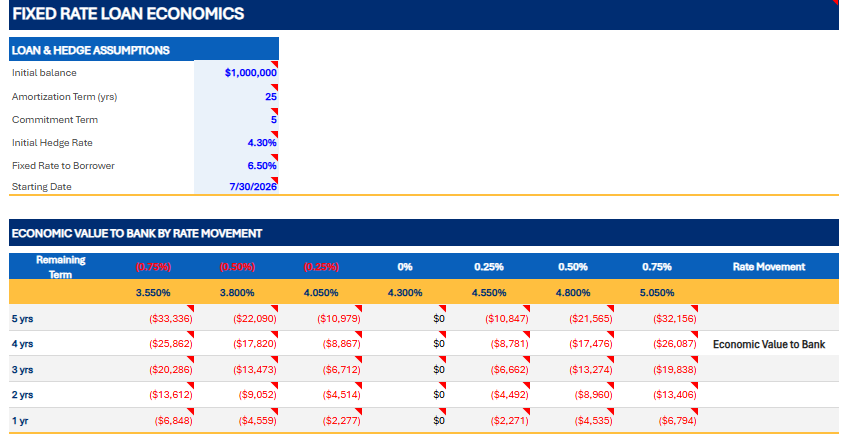
With five years remaining, a 75-basis point rally results in a negative $32,156 EVE. That is 3.2% of the original balance and 1.5 years of the entire gross credit spread on this loan – eliminated with a rate move that we have seen more than once in recent memory occurring in just one quarter. As interest rates rise, this fixed-rate loan hurts the bank’s performance with negative EVE. But what happens if rates decrease, does the bank gain economic benefit from this loan? Not that we have witnessed. Most fixed-rate loans in community bank markets are structured with minimal prepayment protection – meaning, the borrower’s cost to exit is well below the possible economic incentive to refinance and with many carveouts. Carveouts include prepayment that is permitted when the property is sold, if source of prepayment is cash flow from operations, or if the loan is refinance with the same bank. The result is that when interest rates decline, the bank loses the yield on the loan and again takes the economic hit.
The Borrower Exercises Always
The asymmetry is not a tail risk or a modeling artifact. It is the rational, observed, repeated behavior of commercial borrowers across every rate cycle. The more rapidly that rates change (up or down) the more negative impact on the bank. When rates fall, the borrower refinances and the bank loses an above-market asset. When rates rise, the borrower sits on below-market financing, and the bank carries a drag it cannot exit – this is called a “one-way floater.”
Note the direction of control. The borrower chose the term and chooses the exit point. The bank’s only right to force repayment is a credit event, which is to say the bank can call the loan precisely when the borrower is least able to pay and the collateral is worth least. The borrower’s right to terminate is unconditional and exercisable on the borrower’s timetable. There is no reciprocity here, and pretending otherwise is how negative value gets booked as relationship building. Sophisticated borrowers; the ones with a rate view, a treasury function, or a good advisor, take the long end, because that is where the free option is largest.
As a side note, the 2023 regional bank failures reflected this asymmetry at scale on the liability side: depositors held a free option to withdraw and exercised it all at once. The asset side version is slower and quieter, but it is the same trade.
The Solution For Fixed Rate Lending
Lever One:
If the option cannot be eliminated, it must be sold at the right price. Independent option modeling, using forward rates and the volatility surface of forward rates and credit spreads, puts the answer for a five-year commercial loan at 53 basis points of credit spread. That is the differential at which a bank should be indifferent between a loan carrying a strong prepayment provision and the same loan without one. Across commitments from one to twenty years, the average is 54 basis points (but can vary based on many factors).
An options model built from forward curves and volatility, and a deterministic termination calculation built from a payment schedule, arrive at the same number by completely different routes. The option is worth about half a percent of spread per year. That is not a debatable estimate.
Lever Two:
Here is where most well-intentioned pricing discipline collapses. A bank that upcharges the spread but writes soft prepayment language has still not solved the problem, because the two levers protect against different failures and neither substitutes for the other.
The upcharge (lever one) is collected over time, in monthly installments, contingent on the loan remaining outstanding. The option to prepay can be exercised at any point in time, at the borrower’s election, precisely when the loan is worth most to the bank (when rates decline). The upcharge is collected only on the loans that stay. The loss is handed to the bank on the loans that leave when rates are lower. Those are not the same population, and the correlation runs the wrong way.
Lever two is a meaningful and enforceable prepayment provision. Two structures do this practically and effectively:
- Symmetrical breakeven (yield maintenance). The termination payment trues up the interest rate movement in both directions, exactly as the table above computes it. Bank and borrower become indifferent to prepayment regardless of rate direction. These structures are common at larger institutions to help manage risks associated with offering long-term fixed-rate financing.
- Declining balance matched to term. For near-neutral option value, the schedule must start at a percentage equal to the loan term — 5,4,3,2,1 on a five-year fixed-rate, 3,2,1 on a three-year.
Banks routinely waive prepayment provisions for payment from internal cash flow, sale of the collateral, or an internal refinance. Each concession sounds narrow and reasonable in isolation. Collectively they negate most of the benefit of having the provision at all, because they cover most of the circumstances under which a commercial loan actually prepays.
The internal refinance carve-out deserves particular scrutiny. It reads as relationship protection – the borrower stays with the bank. In a falling rate environment, it functions as a free reset: the borrower returns, refinances at the new lower rate with no breakage, and the bank books a lower yield to retain a relationship it already had. The bank pays for the privilege of keeping a customer.
How Community Banks Should Respond
None of this requires treating borrowers adversarially, and the strongest version of the argument is not defensive. A borrower asking for prepayment flexibility is asking for something real and valuable. The correct response is not refusal. It is to offer the embedded option at the correct price.
A sophisticated borrower knows exactly what they are requesting. They are negotiating for economic value, competently, and they are frequently succeeding because the person across the table has not quantified what is being conceded and is treating the request as a customer service question rather than a trade. But once the option value is quantified, the lender can now say, accurately: this provision is worth X dollars, an increase in credit spread and a meaningful prepayment provision can offset that X dollar price. This offers the borrower a choice, take the option to prepay, but pay a higher rate and be subject to a prepayment provision, or take a floating rate (and possibly swap it to a fixed-rate) or a short fixed-rate loan.
Conclusion
A fixed-rate lending is a credit product bundled with two written options. The borrower selects the term, and the borrower selects the exit. The bank controls neither, nor can force repayment only in the one circumstance where repayment is least likely, a credit event.
There are exactly two defenses, and they are complements rather than alternatives: Upcharge the credit spread by approximately 53 basis points on a five-year commitment, scaled up for longer terms, so that the option the bank is writing is sold rather than given. The Bank should also enforce a practical and meaningful prepayment provision, without carve-outs that undermine its purpose.