
Winning Loans Against Your Competitors

When it comes to winning loans for commercial relationships, community bankers need to know who they are competing against. Understanding your competition allows you to better innovate your products, define your delivery channels, highlight your differentiation, and establish pricing methods (among other business strategies). Bank managers often believe that they can differentiate their service to create a sustainable competitive advantage – understanding who you are competing against is crucial. The best banking clients are being courted by community banks, credit unions, national banks, and non-bank financial institutions. Each week we price and help close hundreds of millions of commercial loans and relationships across the country for community banks, and we help community banks identify their most profitable use of capital. In this article we want to discuss how the competition analyzes the most profitable deposit and loan clients, and what community banks must do to remain profitable in the face of fierce competition.
Who is Your Competitor?
Very few community banks can truthfully say they compete with only local competitors. The internet, fintech’s, and less branch-focus allows clients to choose non-local financial institutions. If you are a small financial institution and compete in a small local and geographically isolated market, then you are in the minority and may have few competitors. But with market consolidation, your competition is not just another bank that might make a loan or take a deposit, but it could be a credit union, insurance company, retail store, a Chime or a Robinhood.
The graph below shows the concentration of domestic loans for all banks in the country, and it demonstrates that just a few banks control most of the loans. The same picture emerges for domestic deposits. The country’s national banks hold most domestic loans and deposits, and the smallest 4,000 banks barely make up 16% of all domestic loans and deposits.
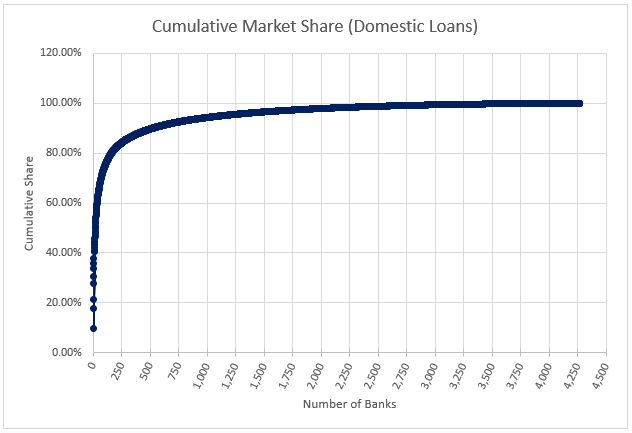
The largest 10 banks dominate the industry with almost 41% of the market share. The number of banks that control the domestic loan market is summarized in the table below.
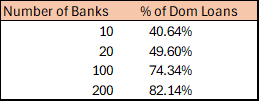 The data shows that a small number of banks control a significant majority of the loan (and deposit) market. Over the decades, the largest banks have continued to gain market share while the total number of banks in the industry has been declining. However, many community bankers dismiss larger competitors in their competitive analysis.
Many community bankers say that they do not compete against the country’s largest 100 or 200 banks. We feel that community banks overlook a vast percentage of profitable clients and prospects by excluding national and regional banks from their analysis. National and regional banks are vying for many of the profitable clients that community banks want or currently service. Community bankers must understand the products, services, delivery methods, and strategies that the largest 200 banks in the country use to gain market share and profitability.
The larger banks are not doing everything well, and community banks would be making a mistake if they imitate larger banks’ business models. However, community banks are competing for loan and deposit customers that are also customers of the largest four, ten, and 100 banks in the country.
Winning Loans: What National Banks Prioritize
Many national banks in the country focus on measuring profitability based on total relationship, lifetime value, risk-adjusted-return, prepayment speeds, and fund transfer pricing. Community banks may not be able to match national banks on this AI model analysis or information technology design and implementation, but community banks also have talent, off-the-shelf techology, and deep community connections that allows them to compete more effectively.
Community banks should not mirror the larger banks in their services, price, or delivery channels. However, there are some simple and inexpensive essential management tools that community banks can adopt that will allow them to become uber-competitive. Community banks should consider implementing the following management tools (all used by their larger competitors) because they are easy to adopt and can gain community banks significant advantages:
- RAROC – larger banks measure product profitability with risk-adjusted return on capital models. Loans, deposits, fee services, branches, product lines, and relationships can all be measured using a RAROC model, allowing for better capital allocation, product development decisions, and product pricing.
- FTP (fund transfer pricing) – larger banks, as a rule, deploy funds transfer pricing in RAROC measurements. This tool allows banks to understand the profitability contribution from various units and products. FTP allows banks to allocate profit to branch deposits, loan pricing, liquidity premium, duration risk, and optionality.
- Shareholder Value – larger banks consider shareholder value-added (SVA) pricing, which considers operating profits produced over that bank’s cost of capital. This helps banks understand the importance of size and scale to profitability. Community banks may still want to make smaller-sized loans, but understanding the impact on SVA helps banks determine how much of this business they want to do and at what cost.
- Measure lifetime value based on expected relationship life – most larger banks use big data and AI to estimate prepayment speeds and cross-sell opportunities based on loan category, client business model, product structure, and prepayment provisions. This analysis can create tremendous advantages in pricing loans and deposits. Community banks can use the same analysis in our Loan Command model.
- Emphasis on fee income – larger banks are adept at pulling income forward with products that allow fee cross-sell opportunities. Fee income is the largest driver of bank performance and community banks should focus on generating sources of non-interest revenue.
All five of the above measures/strategies are available to community banks without major investment in IT systems, personnel, and processes.
Conclusion
Winning loans takes intent. No matter which community bank you work for, some banks (including national banks) are doing things better than you, and some things worse than you. Good managers learn from competitors and position their bank to better solve customer’s challenges. Because of consolidation, fewer banks are controling more market share, but ccommunity bank have specific competitive advantages and can compete effectively against larger financial institutions with only modest changes in process and minimal investment in IT and people.