
A 502% ROI Direct Deposit Tactic Most Banks Are Ignoring

Every year, banks spend millions buying deposits they already have access to. What is often called a deposit campaign based on rate, is an unconscious reaction to a data problem that few bankers stop to think about. In this article, we provide the unlock of how banks can get deposit data and leverage it to drive deposit balance for their existing customer base. This tactic is built around direct deposit switching.
The Fight for Primacy
Across the industry, management teams continue to raise rates, launch promotional CDs, and offer teaser money market accounts to attract balances. Yet many of those same institutions already have customers who use the bank for checking, debit cards, mobile banking, and other services while sending their paycheck somewhere else.
Those customers aren’t prospects; they are customers that have their primary relationship at another bank. In many cases. In this situation, the problem is that while the customer is aware of your bank, your bank has failed to identify the problem and remove the friction to help them consolidate their account.
Solving the Account Switching Problem
While several companies offer this data and functionality, we will build a campaign, using one of our partners (since we have the data) to demonstrate the effectiveness of this tactic. MX’s analytics and direct deposit capabilities highlights this point remarkably well. Here a bank can first identify customers maintaining direct deposit relationships at another financial institution.
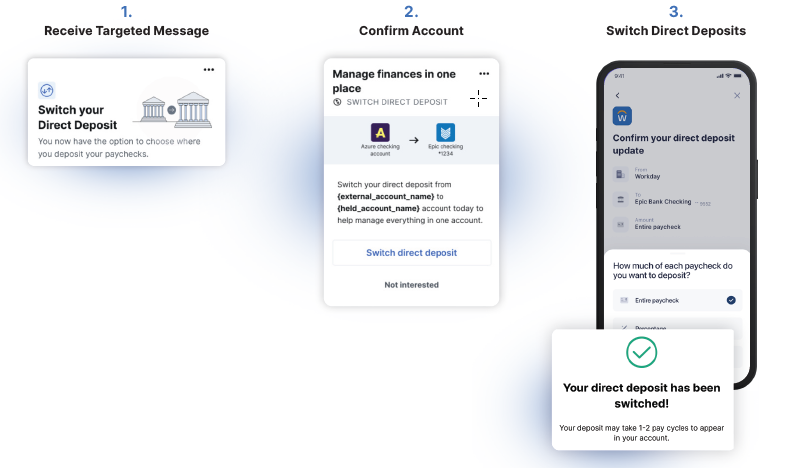
Then, it can make an offer to switch. In this case, it was a personal campaign urging customers to consolidate their financials by switching direct deposit simply through the digital banking experience. Here, the technology makes it easy to switch by not forcing the customer to find routing or account numbers, complete forms or go into a branch or contact their human resource department. Manual hurdles, search friction and time all get reduced.
The result was meaningful deposit growth without relying on promotional rates or cash incentives.
The Cheapest Deposits Are the Ones You Already Have
Often, banks have conditioned themselves to believe deposit gathering requires paying more than the competition. It is an understandable reaction since this is the easiest way to gather money. Unfortunately, what is easy for the bank isn’t the best for the shareholders as raising rates negatively impacts deposit performance both in the current period and into the future as these customers are likely to remain rate sensitive. The problem is that rate-based campaigns address symptoms, not causes.
Last week we discussed eight seasonal, non-rate commercial deposit campaigns to gather deposits (HERE). In this example, we leverage retail data and technology to build balances.
The Campaign
In this example, the financial institution gathered the data from other accounts the customer had at other financial institutions. From that subset, they identified those accounts that had direct deposit deposits at other financial institutions.
Then, a targeted, personalized message was delivered along the lines of – “Switch your direct deposit and get paid up to three days early.” This offer contained no rate and no upfront incentives. It was a simple pitch for consolidation, convivence and early access to their money.
Customers Don’t Want Deposit Accounts
Another common mistake are deposit campaigns that assume the customer wants to open yet another account for whatever purpose. While sometimes true, often it is the opposite. Customers don’t wake up wanting a new deposit account. Customers wake up wanting their financial life to be more efficient.
They want faster access to their paycheck. They want fewer financial hassles. They want convenience. They want simplicity.
The success of this campaign wasn’t that customers suddenly became excited about switching direct deposits. The success was that the institution identified customers who would benefit from a better experience and removed the friction preventing them from making a change.
That is a fundamentally different strategy from paying customers to move money.
The Economics Are Hard to Ignore
Banks often think little of paying up for whole funding yet bypass some basic functionality in their digital platform. If there is one data stream we believe every financial institution should have it is the data of where the customers bank and their financial position. Using this data we can drive a multitude of campaigns.
Let’s look at what this might mean for a bank serving 100,000 customers.
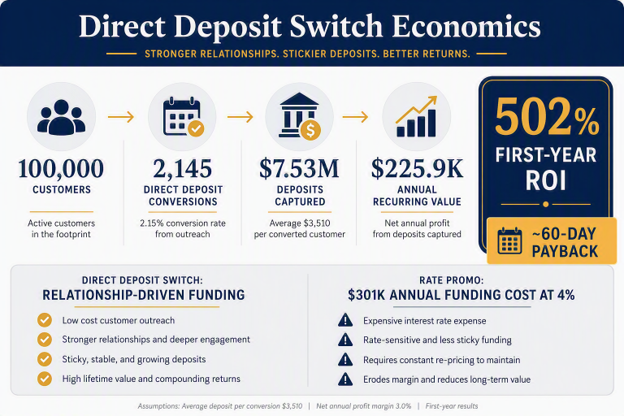
While the results will vary depending on the customer base, brand and products of the bank, banks should convert an approximately 2,145 direct deposits for every 100,000 customers for any single pitch.
Those conversions bring:
- Average direct deposit relationship balance: $3,510
- Total deposits captured: $7.53 million
- Annual value per relationship: $105.30
- Annual recurring value generated: $225,868.
Now let’s look at costs.
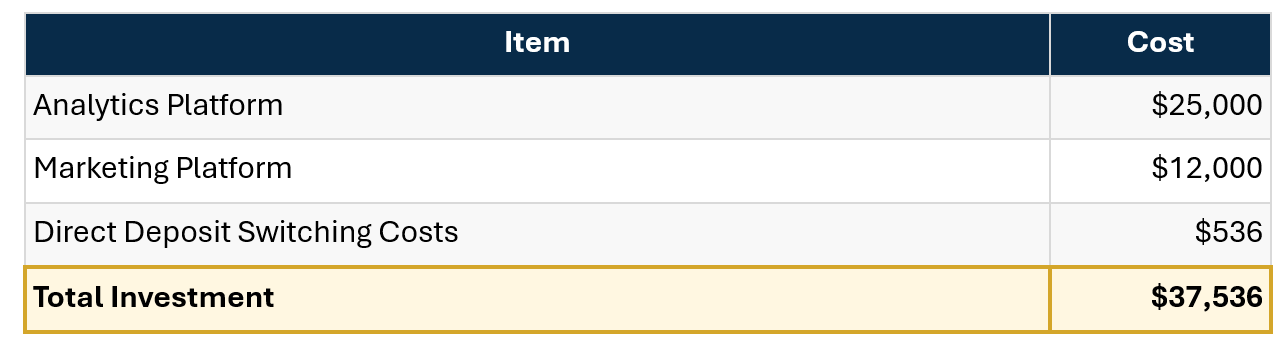
Financial outcome:
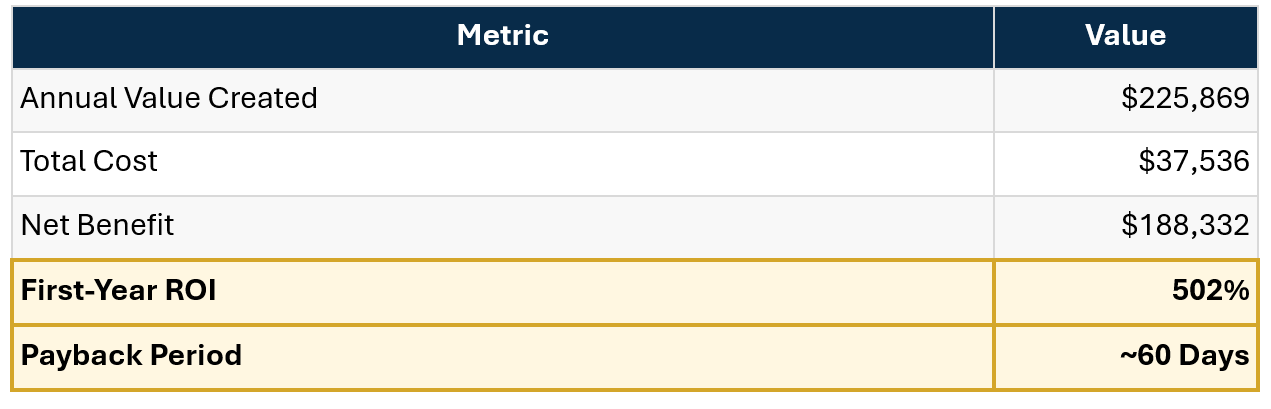
For every dollar invested, the institution generates approximately six dollars of return.
Those economics become even more attractive when viewed through a relationship lens.
The Real Value Isn’t the Deposit
Direct deposit is arguably the clearest indicator of a primary banking relationship. Once the paycheck arrives, everything else tends to follow. In this scenario, converting 2,145 held-away direct deposits effectively creates 2,145 primary banking relationships.
The relationship benefits extend well beyond balances:
- Relationship life increases from approximately five years to eight years.
- Debit card activity increases by more than 60%.
- Customers purchase an average of 1.25 additional products.
- Retention improves materially.
- Cross-sell opportunities multiply.
Viewed this way, the deposit is not the product. The deposit is the gateway into a fuller banking relationship. Since banks pride themselves on relationships, should a bank prioritize data and technology that supports the relationship?
The true value is the expansion of customer lifetime value that occurs once the institution becomes the customer’s primary financial relationship.
Compare This to Buying Deposits
Now compare this strategy to the traditional approach. Suppose a bank raises $7.5 million through promotional CDs or money market accounts costing 4%.
Annual funding cost: $7.5 million × 4% = $301,000 per year. And that expense continues every year the funds remain on the balance sheet.
Even worse, those deposits are often among the most rate-sensitive balances a bank owns. The customer came for yield and may leave for yield.
By contrast, the direct deposit strategy:
- Generates primary relationships.
- Deepens engagement.
- Increases product penetration.
- Improves retention.
- Produces a 502% first-year ROI.
- Does not depend on promotional pricing.
One approach purchases deposits while the other creates relationships.
This Is a Data Story
While technology enables the process, we want to point out that the real lesson here is one of data. As most banks are midway through their strategic planning cycle, having a strategy around gathering and using data has never been more important given the critical importance of AI and agentic AI.
The institutions that will win the next decade’s deposit battle are those that take the time to put the data, products and marketing acumen in place now. In past articles, we have shown tests where agentic agents can raise deposits more efficiently and effectively than humans. To prepare for this future, it is imperative that banks collect good data and then utilize marketing and product tools to monetize the data.
The MX data and functionality demonstrates this principle well: identify customers with held-away deposits, communicate with precision, and simplify the process of switching direct deposits.
The lesson for CEOs, Chief Deposit Officers, Heads of Retail Banking, and Digital Banking leaders is straightforward: Before paying more for deposits, determine whether you already have them.
Because in many institutions, some of the most valuable deposits are not sitting across town at a competitor, they’re already sitting inside your customer base.
You just haven’t found them yet.
Attending Our Deposit Conference on October 1st and 2nd in Chicago?
If you are, and you are interested in this tactic, be sure to mention this blog and we can provide you with more details on this, and other similar tactics.
A-List Member Interested in Getting This Data and Technology?
As a special promotion to our A-List Respondent Bank Members:
– MX will waive the implementation cost (min of $5k value, could be up to $25k)
– MX will also waive the cost to set up a custom engagement with our product & delivery teams to help build out the campaigns similar to the ones featured in the case study.
For more information, see the A-List Portal or contact us today.