
8 Winning Fall Deposit Campaigns

Last week we highlighted our Deposit Vulnerability tool (HERE) and briefly touched on how fall is the second best time, outside of the start of the year, to market for deposits. We also talked about the tailwinds of increasing M2 money supply and lower money market fund rates. Today, we go in depth on the details around our eight best fall deposit campaigns that we have found effective at raising high-performance, high-balance seasonal deposits.
The Backdrop to Fall Deposit Campaigns
The economic backdrop supports a “be prepared” message more than an outright defensive one. As the Fed raises rates, and the markets experience higher-than-usual volatility, banks should consider getting a little more defensive. From here, an assumption in our strategy is that deposit rates will increase and our goal is to limit the cost of deposits while getting more duration out of our liabilities.
Also important is that sentiment is negative, making it less likely for satisfied customers to switch banks. The NFIB’s Uncertainty Index reached 91 versus a historical average of 68.
Rising rates, greater market volatility, a slowing economy and uncertainty adds up to a defensive theme where banks market trust, reliability, community service and preparation over return.
For us, we like the theme “Finish Strong. Start Ready” as a lead into the new year. Underneath it, I would test the following eight promotions. The dollar amounts and balance thresholds are illustrative and should be calibrated to each segment’s economics.
1) “Refund Readiness”
This one is back from summer as the theme highly resonates to businesses that are still trying to claim their tariff refunds under eligible IEEPA duties. We wrote about this tactic HERE but suggest bank marketing departments keep investing in this area to not only gain the largest seasonal return, but for the fact that these deposits will not last forever. This is one of the best Fall deposit campaigns currently in the market as it not only helps your banks open new accounts and build balances, but it places your bank in a trusted advisor position.
While $115B has already been paid out, there is $51B remaining, and the next three months are expected to see around $10B of payout to bank customers before dropping for the holidays and picking back up in January.
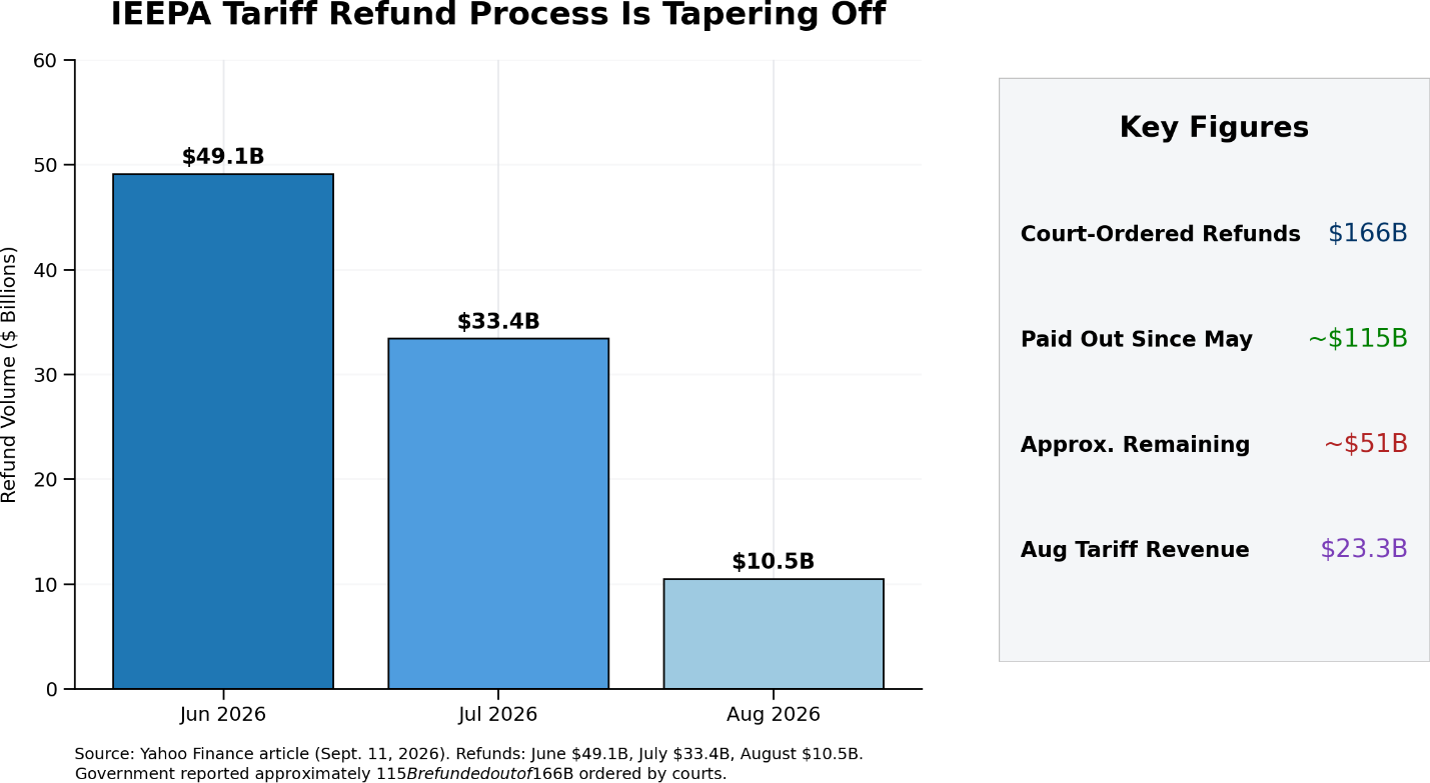
Goal: Capture tariff refunds and convert them into operating relationships.
Suggested message: “Your refund deserves a cash plan.”
Target Audience: Importers, wholesalers, manufacturers, and retailers with pending eligible refunds.
The Promotion: Offer a “refund readiness” cash-planning session, receiving-account support, and up to $1,500 in treasury implementation and service credits when a business brings in $500,000 of incremental average collected balances for 90 days and activates a recurring payables or payroll workflow. Work with customs brokers and CPAs for introductions, while leaving claim eligibility and filing advice to those professionals.
The Deposit Logic: Open or designate the receiving account before the refund arrives, then compete for the business’s ongoing operating activity. The behavioral hypothesis is that a distinct cash inflow creates a natural moment to reconsider where money belongs and what it will be used for. This is an excellent time to have an advisory conversation. While the refund is not automatically a durable deposit, it helps to understand its use (expected debt repayment, supplier payments, capital expenditures, or customer rebates) before assigning the balance, or account, a retention assumption.
2) “Protect Your Fall Profits”
Every bank should consider one last year-end push in Sept. and Oct. to acquire treasury-management customers before the holidays hit.
Suggested message: “Make fraud harder. Make cash management easier” or “Get better control of your money.”
Target Audience: Check-heavy contractors, distributors, property managers, and professional service firms. Promote in September for October activation.
Why Now: October is Cybersecurity Awareness Month. AFP’s 2026 survey found that 76% of responding organizations experienced attempted or actual payments fraud in 2025, with checks the most frequently affected payment method. That provides a stronger business reason for a conversation than a generic account-opening bonus. Instant payments, positive pay and new identity protections will all resonate. In addition to security, play up any other cash flow projection features or fiscal control capabilities.
The Promotion: Package a payment-control review, Positive Pay and ACH-control implementation, staff training, and 90 days of selected service-fee waivers. Take this time to move more customers to the instant payment rails given the low fraud track record. Qualify the acquisition offer with, for example, $100,000 in incremental average collected balances plus the migration of a genuine receivables, payroll, or vendor-payment workflow.
Make the educational review available to existing customers as well. Reserve the acquisition subsidy for incremental business.
The Deposit Logic: The behavioral hypothesis here is that protecting money already earned may motivate action more effectively than offering a modest additional yield. The lasting value comes from embedding useful controls and payment processes, not from the temporary waiver.
Disclose post-promotion fees upfront and keep controls in place after the waiver ends.
3) “Holiday Cash-Flow Head Start”
For banks with merchant capabilities or that actively bank retailers, this deposit campaign wins the accounts that receive a spike in holiday sales. This effort is built around making your bank a trusted advisor to those businesses that have seasonal cash flow variations. Helping retailers with data and analytics in this age of AI can go far. Bankers now can vibe code a variety of simple forecasting tools to help retailers avoid the three most common mistakes of overstocking, understocking and poor cash flow inventory timing (buying too early or too late). This is also the perfect time to have international service discussions with retailers needing currency support for purchasing goods overseas.
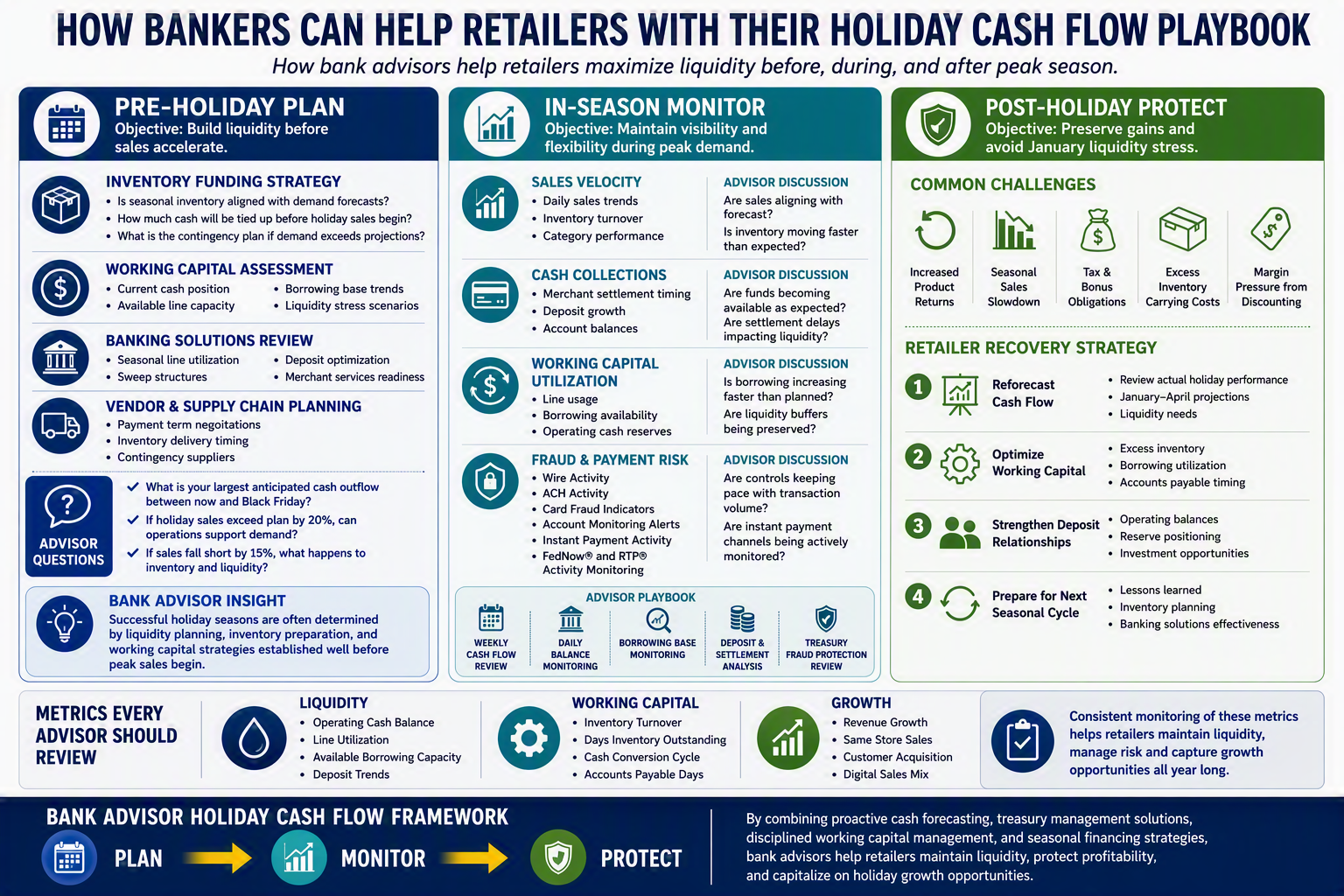
Suggested message: “Get your cash flow ready before your busiest time.”
Target Audience: Retailers, e-commerce businesses, restaurants, specialty wholesalers, and seasonal service businesses.
Why Now: September and October are usually the peak of holiday ordering season with approximately 45% of the inventory spend occurring in these two months. Banks can extend merchant services or inventory financing lines in exchange for the operating account, capturing deposits during the holiday season.
The Promotion: Offer up to $1,000 in documented onboarding or implementation credits for moving merchant settlements or recurring receivables into the bank and maintaining an agreed incremental average balance. Include a holiday cash calendar revolving line covering inventory payments, payroll, taxes, refunds, and supplier obligations.
Where supported by existing products, add customer-directed transfers into designated payroll and tax reserve accounts to help the business segment their cash flow.
The Deposit Logic: Holiday cash flow forecasting is the perfect time to show your bank as a trusted advisor. Customers without advanced cash flow forecasting appreciate leaning on their banker’s expertise.
4) “Ready for Whatever Comes Next”
This campaign plays on the political uncertainty in our current environment driven by this momentous election year. Many retail customers do not have a good feel for how this election impacts next year’s cash flow. Bankers are not only in an ideal position to be trusted advisors on this point but can help their businesses save for future uncertainty. Banks are urging their customers and prospects to keep funds accessible and segmented without implying that a shutdown, tax increase, or market disruption is inevitable.
Suggested message: “You do not need to predict November to prepare for January.”
Target Audience: Any business that may be thinking about postponing material expansions or hiring decisions until the election is a candidate for moving those earmarked funds into a segmented account or subaccount. This includes any government vendors, import-dependent companies, and organizations preparing 2027 budgets.
Why Now: The federal general election is November 3, 2026. Combined with elevated business uncertainty, it provides a timely opportunity for nonpartisan planning around alternative outcomes, without predicting a winner or assuming a particular policy change.
The Promotion: Offer a 13-week cash-flow review that tests practical scenarios, such as a major customer paying 30 days late or an unexpected equipment expense. Help the customer establish an appropriate liquidity reserve, then offer $750 in treasury credits for $250,000 of incremental average collected balances maintained for 90 days.
For an HOA, non-profit, or association whose budgeting occurs in the fall, adapt this into a board-ready operating and reserve cash calendar.
The Deposit Logic: The behavioral hypothesis is that a named, purpose-specific reserve makes the benefit of holding cash more tangible. The customer is buying flexibility, not making a bet on politics.
5) “Give Where You Live”
These next four months are an ideal time to help your non-profit clients set up for year-end giving. Our cash flow data shows that almost 40% of annual donations are received between September and December. December alone can account for 30% of tax-driven donations for some charities. As a sub-strategy, many retirees 70.5 or older must take an IRA distribution by the end of the year. Banks can help some of these funds be directed into charitable organizations where appropriate.
Suggested message: “More support for your mission. Less work managing the money.”
Target Audience: Qualifying local nonprofits and their business supporters. Begin onboarding in September–October; activate fundraising in November and December.
Why Now: GivingTuesday falls on December 1, 2026. There is also a specific new tax-related education opportunity: beginning in tax year 2026, eligible individuals who do not itemize may deduct qualifying cash charitable contributions up to $1,000, or $2,000 for joint filers. This is an individual-donor provision, not a blanket corporate deduction or a benefit available for every charitable vehicle.
The Promotion: Banks can help collect payments, set up segmented accounts or subaccounts and be trusted advisors. Waive donation-collection setup costs and offer marketing credit up to a certain amount. Pair the offer with establishing the organization’s operating account and recurring-donation collection process.
For business customers, a related test could offer a capped bank-funded contribution to an eligible local charity instead of a conventional acquisition bonus.
For banks thinking about tokenized deposits, be sure to reach out to us to see how we can help automate donation collections for your clients by early next year.
The Deposit Logic: Test purpose and community connection as the incentive, while competing for recurring collections and operating balances. This is a bounded way to apply the charitable-deposit concept you have explored without committing to a permanently elevated payout.
6) “Payroll Ready for Fall”
September is a time when every seasonal business starts thinking about their holiday hiring effort. Hiring and training creates a mismatch in cash flow timing and banks can help support by urging businesses to continue to save in a specialty account.
Suggested message: “Ready for your next hire. Ready for every payday.”
Target Audience: Retailers, healthcare practices, staffing firms, restaurants, trades, and expanding professional services businesses all have cash flow timing mismatches due to hiring.
Why Now: NFIB’s July survey showed a seasonally adjusted net 20% of owners planning to create jobs over the following three months, with hiring plans at their highest level since October 2022. That supports prospecting around payroll readiness rather than assuming all businesses are cutting back.
The Promotion: Provide payroll-file conversion support, a funding-calendar review, and up to $750 in documented transition-cost reimbursement after three successful payroll cycles and achievement of an incremental 90-day average-balance threshold.
The Deposit Logic: Businesses often need planning support around volatile payroll and hiring swings. For banks that don’t want to extend credit, helping business plan for cash flow gaps by saving now can help reduce the risk come December. Payroll volume alone is not the goal. An account funded immediately before each payroll run may generate little average balance. Measure the amount and duration of funding actually retained.
7) “Less Busywork. More Business.”
Many businesses have been planning to increase their treasury management tool usage for some time to include items like purchasing card, instant payments and positive pay. While this effort often occurs in 1Q after the books are closed, bankers can help their businesses get an early jump on the effort. Banks conversant in agentic AI and instant payments can have deep conversations about helping their customers move to an “always reconciled status” that permits a continuous accounting close.
Suggested message: “Bring us the banking. Take back some of the busywork.”
Target Audience: Businesses with lean accounting teams, especially distributors and professional service firms. This campaign also goes upscale to sophisticated middle market customers for regional banks.
Why Now: Census research released in May found that business AI usage hovered around 17%–20% during its December 2025–May 2026 observation period. That gives a current basis for an automation conversation, but not for assuming every commercial customer wants an AI product. Since that time, agentic finance has become popular helping CFOs auto reconcile their books.
The Promotion: Offer a 30-day “finance workflow reset” focused on one concrete problem: reconciling receipts, connecting accounting data, organizing invoice follow-up, or preparing a cash forecast. Use existing approved tools and integrations.
Provide a capped implementation credit when the customer brings incremental operating balances and activates the relevant collection or reconciliation workflow.
The Deposit Logic: Compete on the customer’s workload rather than solely on yield. The behavioral hypothesis is that solving an irritating recurring task can provide a meaningful reason to consolidate activity.
8) “Your 2027 Starts Here”
Similar to helping customers with treasury products and technology as in #7, this campaign captures the need to save for tax liability, bonuses, and capital-expenditure reserves.
Suggested message: “Finish the year with a plan for every dollar.”
Target Audience: Owner-managed companies, manufacturers, contractors, and CPA-referred businesses doing calendar-year planning.
Why Now: The tax changes restoring 100% additional first-year depreciation for eligible property create a reason to revisit investment and cash timing with a tax advisor. Importantly, the provision is permanent under the enacted law; it should not be marketed as a special deduction expiring on December 31, 2026. Helping customers understand these changes creates an ideal entry point to winning new customers and getting deeper ingrained into being a trusted advisor.
The Promotion: Offer a CPA-coordinated year-end cash review that maps anticipated taxes, employee bonuses, and capital expenditures. Provide a capped treasury credit when the business brings qualifying externally held reserves and its associated operating activity to the bank.
The Deposit Logic: The behavioral hypothesis is that a defined year-end planning task makes a banking change easier to initiate. The bank gets an opportunity to become the operating relationship before the next year begins. Money earmarked for an imminent tax or equipment payment should not be valued like a long-duration operating balance.
How These Campaigns Create Deposit Value
Each marketing campaign is targeted at helping your bank remain in the top three of your commercial customers’ trusted advisors. Each campaign either goes after new money that is held at other banks or helps the customer understand the value of building balances now, given the uncertain environment. In some cases, while it seems like existing customers will just be segmenting balances, the critical point is that your bank now understands the exact duration and convexity of those deposit balances to help in future liquidity planning.
It is also important to note that none of these fall deposit campaigns rely on rate. This is critical for improving your cost of funds performance both now and into the future. When an incentive is required, we are big believers that it should come as an upfront payment or credit. In this manner, your customers, and employees, become less interest rate sensitive.
If Nothing Else, Test
Most banks will read this and find deposit management too daunting. Hopefully, if your bank is reading this, it is worth having an executive management conversation and then decide to test one or two of these fall deposit campaigns so your bank will not be in the same position next year as needing costly deposits.
Getting the upfront payment right is often a function of accurate forecasting of deposit duration. Assuming $750 of actual incentive cost on $250,000 of incremental average balances, that is an additional cost of 30 basis points for balances kept a year, but 1.22% for balances kept 90 days. We would argue that both are beneficial compared to wholesale funding, but to get the duration right, nothing beats understanding your deposit data for your market.

What Metrics To Track for Fall Deposit Campaigns
To measure the effectiveness of your Fall deposit campaigns, track incremental average collected balances, 180- and 365-day retention, net treasury contribution, cannibalization, and subsequent pricing demands. Evaluate the tested relationship over a 36-month horizon, with separate runoff assumptions for refunds, holiday receipts, and ongoing operating balances. Have compliance and tax review the incentive, charitable-match, disclosure, and eligibility structures before launch.
Want to Learn More About Bank Marketing and Fall Deposit Campaigns?
If you were smart enough to sign up for our sold-out Deposit Conference, we will be covering many of these fall deposit campaigns and more.
If you want to learn how to better market deposits, be sure to attend the ABA Bank Marketing Conference where we will talk about using AI for some of these campaigns and how to advance bank product marketing in your organization. While registration is closed, there are still spots left (drop our name) if you come on site HERE.