
How to Gather Deposits With IEEPA

The International Emergency Economic Powers Act (IEEPA) is a 1977 U.S. statute granting the President sweeping authority to regulate foreign commerce and impose economic sanctions. In February 2026, the U.S. Supreme Court ruled in a 6–3 decision that IEEPA does not authorize the executive branch to unilaterally impose import tariffs without explicit congressional approval. This landmark ruling dismantled the legal justification for this Administrations emergency tariffs that had been put in place. As such, the Court ruled that government monies collected for the tariffs must be returned.
The IEEPA Deposit Opportunity
Last week, we highlighted our Deposit Vulnerability Tool (HERE). This tool showcases how vulnerable a bank, and a geography (below), is to deposit competition from the array of new banks that are being formed, the movement to stablecoin and tokenized deposits and competition from the money market funds. Vulnerable banks are looking for new ways to not only gather deposits but make deposits longer in duration.
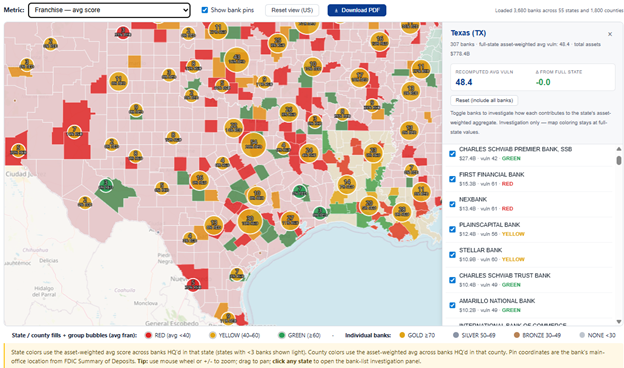
This IEEPA tariff refund creates another opportunity for banks to improve deposit performance. $21B is now flowing back into banks from Treasury accounts, much of which is hitting this month. These are tariff funds that were collected by the government and now can be claimed by businesses across the United States.
The IEEPA effort is an excellent opportunity for banks to not only collect deposits but to be a trusted financial advisor. The process of filing and getting the IEEPA refund is new and slightly complicated which is the reason why banks are perfectly positioned to play a trusted advisory role. In this article, we breakdown the details to help any bank looking to take advantage of this unique opportunity.
The IEEPA Refund
The IEEPA tariff refund program is a mass federal reimbursement initiative launched by U.S. Customs and Border Protection (CBP) on April 20, 2026, to return an estimated $165 billion to $175 billion in unlawfully collected customs duties to American businesses. These are tariffs that US companies paid, the US Government collected and now need to be returned.
The IEEPA program was established through a series of legal actions:
- In February 2026, the U.S. Supreme Court ruled in Learning Resources, Inc. v. Trump that the International Emergency Economic Powers Act (IEEPA) does not grant the president authority to impose tariffs.
- Following this decision, the U.S. Court of International Trade (CIT) ordered CBP to refund all duties collected under those emergency actions.
Banks can not only help their customers file their claims ($80B of claims have yet to be filed) but can help customers invest or save these funds.
The CAPE System
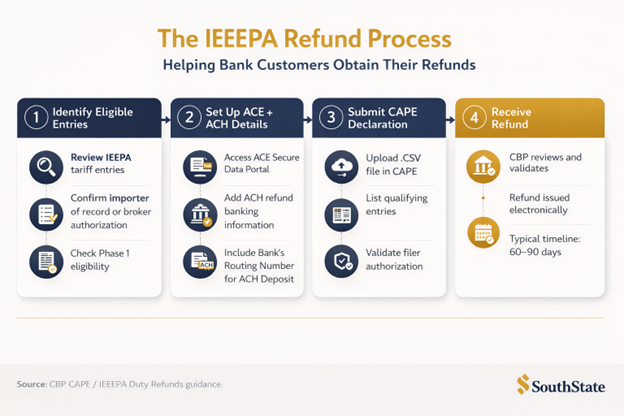
To handle the massive influx of claims across more than 53 million import entries, CBP developed a new electronic portal called the “Consolidated Administration and Processing of Entries (CAPE) system.” Rather than issuing automatic payouts, CBP requires importers to proactively submit digital claims through the Automated Commercial Environment (ACE) Secure Data Portal.
Program Phases & Entry Eligibility
CBP is managing the rollout in a structured, multi-phase approach. These phases break down to the following:
- Phase 1 (Active): Covers entries that are unliquidated (meaning the customs accounting is not yet finalized) or entries that were liquidated within a narrow 80-to-90-day voluntary reliquidation window.
- Future Phases: Designed to eventually cover complex cases and entries that have passed the standard protest deadline, though the exact rollout dates are still being finalized by CBP.
- Eligible Tariffs: Only applies strictly to emergency, “reciprocal,” “fentanyl,” or baseline tariffs enacted under IEEPA. It does not apply to Section 301 (China) tariffs, Section 232 (steel/aluminum) tariffs, or anti-dumping/countervailing duties (AD/CVD).
Key Filing & Payment Rules
- Who Can Claim: Only the Importer of Record (IOR) or their licensed customs broker can submit a CAPE declaration via a standardized .csv file upload. Everyday retail consumers are not paid directly.
- Tariff Code Qualification: To check if a specific tariff qualifies for the IEEPA refund program, companies can audit their past import records to confirm that the “Chapter 99” prefix matches the specific emergency tariff codes declared illegal by the Supreme Court. These can be found on past CBP 7501 forms. Alternatively, companies can generate an “ES-003” Entry Summary Report through the ACE Portal. Companies can then research with their professional or on the US Customs and Border Protection site for qualifying tariff codes.
- Payout Form: Refunds are strictly cash-back transfers made electronically via Automated Clearing House (ACH). This is a critical point for banks to drive home to make their ACH instructions easy to input into the portal. For companies that are using an importer to recover these costs, its important for banks to educate their customers around the importance of including their ACH banking details in the portal otherwise there are delays in processing with funds going to the importer directly creating an extra layer of risk and documentary complexity.
- Interest Included: Approved refunds include interest calculated from the initial date of the duty deposit up to the date of liquidation. For early 2026, the IRS-set overpayment interest rates sit at 7% for noncorporate entities and 6% for corporations.
- Processing Timeline: Once a CAPE declaration is validated and accepted, valid payouts are generally distributed within 60 to 90 days.
- Debt Netting: Before sending cash, CBP checks for any outstanding debts owed to the agency. The total refund will be reduced by any underlying fees or unpaid customs bills.
Putting This Into Action
U.S. companies have until November to file. Banks with customers in retail commerce, manufacturing, and trucking have above average refunds. This is the same for companies that purchased goods from India, Canada, Mexico, and Switzerland.
The above information should serve as a basis for banks to launch their education and to get the confidence to have a discussion with their customers about helping them get their refunds and to both capture and retain the refunds as deposits. Given that few banks will take the time to learn and apply these lessons, the IEEPA events present an exceptional opportunity for your bank to showcase their value.
If you are looking for other ideas on how to improve deposit performance and grow balances, be sure to attend the banking industry’s only deposit conference (HERE) coming up in October in Chicago.