
How to Use Grid-Based Loan Pricing To Increase Deposits

Grid-based pricing is typically used to set the applicable margin of a loan based on performance measures such as credit rating or cash flow coverage. But the same concept can be pointed at a different target: deposit balances. The average commercial borrower focuses more on their cost of borrowing and less on return on deposits on the economic value determined by funds transfer pricing (FTP). Community banks may capitalize on that asymmetry to maximize relationship profitability, grow loans, and – most importantly in the current environment – capture cheaper, longer-duration deposits.
Funds Transfer Pricing: The Foundation
FTP measures interest rate, credit, and liquidity risk and transfers those costs from the central treasury function to the bank’s products and business lines. Fundamentally, FTP divides a bank’s net interest margin into two sub-margins – one for deposit gathering and one for asset origination – so the economic value of each product can be measured separately. Grid-based loan pricing tied to deposit balances lets a bank deliberately trade a few basis points of loan margin for wider, more durable deposit margin, increasing the profitability of the total relationship.
The Liquidity Backdrop
As of August 2026, the Fed’s balance sheet stands near $6.75 trillion and the Fed has pivoted to modest reserve-management purchases designed to keep bank reserves “ample” as the economy grows, while mortgage-backed securities continue to roll off into Treasury holdings. Some bankers may read the end of QT as an all-clear on funding. It is not. The liquidity that left the system between 2022 and 2025 is not coming back through the front door, and the Fed’s stated intent is merely to grow reserves in line with trend demand and not to re-flood the system. Meanwhile, the fed funds target sits at 3.50%–3.75% after the 2025 cuts, and deposit costs have proven sticky on the way down: community bank cost of funds fell only about 24 basis points in 2025 despite three quarter-point rate cuts, as high loan-to-deposit ratios and intense competition from national banks, credit unions, and fintechs limited banks’ ability to reprice. Industry surveys confirm the pressure and bank executives entering 2026 named core deposit growth as the single greatest threat to their growth prospects, ahead of nonbank and bank competition. In short: the era of essentially free, abundant operating deposits is over, and every incremental core-deposit dollar must now be won on relationship economics.
Anti-Tying: Still Permitted
Grid-based loan pricing dependent on deposit balances is not new; banks have used it in prior periods of challenging liquidity. Properly structured, it does not breach the anti-tying restrictions of the Bank Holding Company Act Amendments of 1970. The statute expressly permits a bank to condition the availability or price of one product on the customer obtaining another traditional banking product such as a loan, discount, deposit, or trust service from the same bank. Deposits are squarely within the traditional-product exception.
Economics: Why Deposits Outperform Loan Spread
Under FTP, each incremental basis point of margin from a loan or deposit is roughly equally profitable to the bank. However, FTP-based ROE analysis shows that margins on most deposit products are far wider than those on loan products. Banks therefore have a strong incentive to give up some loan margin to capture more valuable deposit margin. Grid-based pricing also addresses the biggest weakness in deposit profitability: the lack of a defined contractual life. The old assumption that “deposits are for life” was undercut by the rising deposit betas and balance runoff of the last tightening cycle; cumulative non-maturity deposit betas at many banks exceeded 50% and have only partially reversed. A pricing grid turns a customer’s verbal commitment to maintain balances at the bank into a contractual, measurable condition of the loan rate.
An Example of Grid-Based Loan Pricing
Our model assumes a $1 million commercial loan priced at a 2.40% starting spread over SOFR (approximately the industry average), an FTP charge of 3.65%, a non-interest-bearing operating account with balances typical for the relationship size, and a business savings account with industry-average yields tiered to balances. The loan spread steps down 25 basis points at each tier as combined minimum average deposit balances step up:
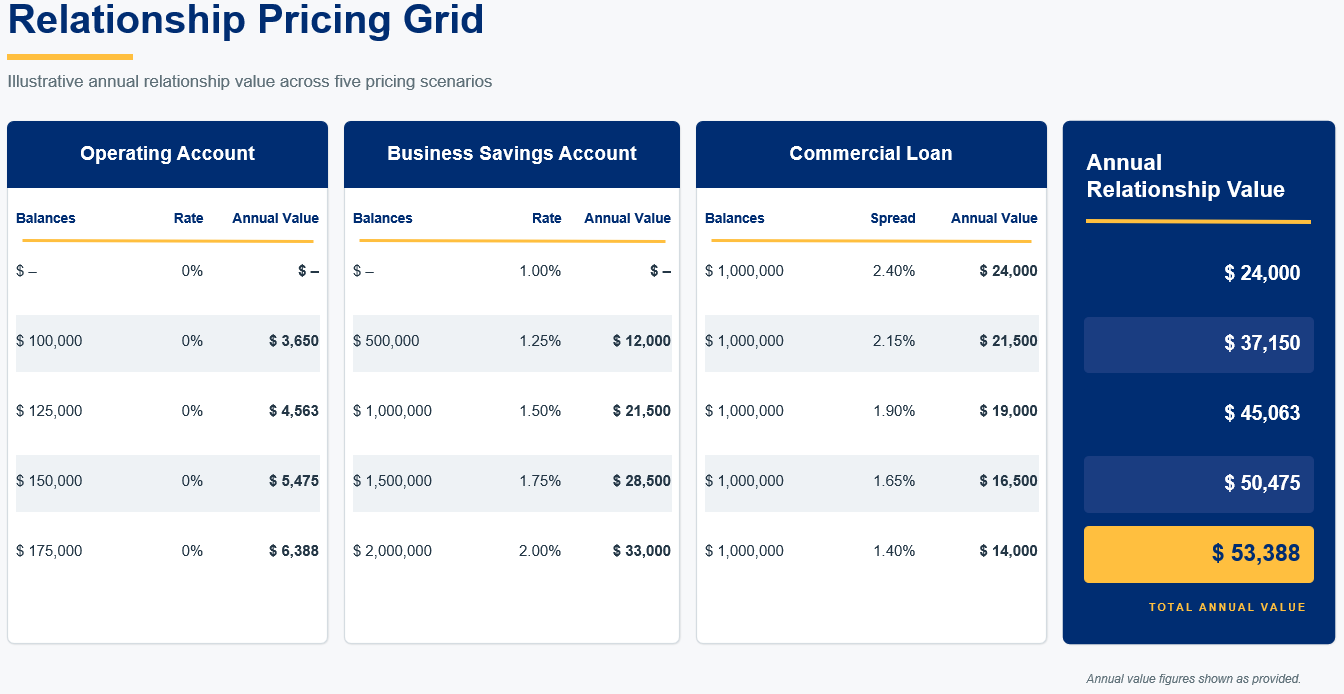
The key takeaways:
- Much of the value to the bank is created in the combined operating and business savings accounts – deposit value grows from $0 to over $39,000 across the grid, dwarfing the loan economics. Different grids, products and tiers can be structured for specific banks and relationships.
- The loan spread given up is worth less to the bank than the deposit value gained. Moving from the top tier to the bottom costs $10,000 of loan revenue but adds more than $39,000 of deposit value thereby driving the annual relationship value up from $24,000 to $53,388.
- The reduced spread applies only if minimum average deposit balances are maintained for the measurement period (monthly, quarterly, or annual, depending on the bank’s operational capabilities). The grid quantifies the economic value of deposits rather than relying on a borrower’s verbal commitment.
- Most customers overvalue the visible rate reduction on the loan relative to the yield they forgo on deposits. That behavioral asymmetry allows the bank to maximize total income even as the stated loan spread falls.
The concept scales to any mix of products, rates, and client needs. Our example uses a simple $1 million commercial loan with two deposit accounts, but the grid can be built around treasury management fees, CDs, sweep structures, or multi-loan relationships.
How to Apply Grid-Based Loan Pricing at Your Bank in 2026
The structural math favors deposit-led relationship pricing. Loan growth at community banks is expected to outpace deposit growth again in 2026, keeping loan-to-deposit ratios elevated and marginal funding expensive. Banks with larger, more stable DDA, checking, and savings books will out-earn peers regardless of the Fed’s next move. Grid-based loan pricing dependent on deposit balances gives your lenders a concrete, compliant tool to grow deposit balances and extend their duration and substantially enhance your bank’s performance while deepening the total relationship. In a market where core deposit growth is the industry’s top-cited constraint, banks that can contractually attract and hold operating balances will define the performance leaders of the industry.