
Smart Bankers Are Doing This To Adapt To A Quieter Fed
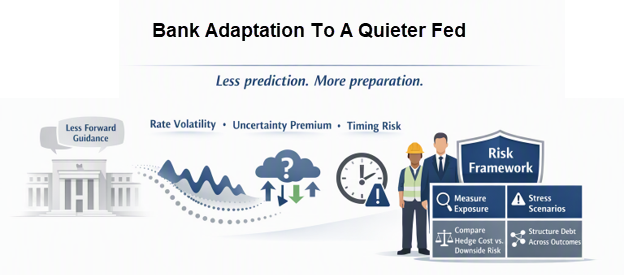
The July FOMC meeting is complete with no change in rates. Unfortunately, we don’t know much else. If Fed Chair Kevin Warsh’s approach to Federal Reserve communication can be reduced to one operating principle for bankers and borrowers, it is this: expect less help from the Fed in predicting the next rate move. A quieter Fed may be good for central-bank flexibility, but it changes the daily work of anyone who prices loans, manages interest-rate risk, advises commercial borrowers, or decides when to fix or float debt. When the Fed provides less forward guidance, borrowers lose a familiar reference point. Bankers lose some visibility into the policy path that influences funding costs, loan coupons, swap pricing, deposit betas, mortgage rates, credit spreads, and client behavior.
From the perspective of a banker or borrower, less guidance raises the price of uncertainty. The question is no longer whether the Fed will cut, hike, or hold. The more important question is how borrowers and lenders should make decisions when the Fed deliberately gives them fewer clues.
A Quieter Fed Can Help
The strongest argument for Warsh’s position is that it forces borrowers and bankers to stop pretending that rate forecasts are more precise than they really are. Commercial borrowers often ask whether they should fix now, float for another quarter, or wait for lower rates before refinancing. Bankers are expected to offer a view, and the Fed’s forward guidance can make those conversations feel easier, but not more accurate. If the Fed is leaning toward cuts, borrowers may postpone hedging or delay terming out debt. If inflation then proves sticky and rates move higher, the cost of waiting can be substantial.
Less guidance may therefore create healthier discipline. Borrowers must evaluate their own cash-flow sensitivity instead of relying on a central-bank road map. A highly leveraged borrower with thin debt-service coverage may not be able to afford the risk of waiting for a perfect entry point. A borrower with strong liquidity, low leverage, and natural offsets may be better positioned to remain floating. A banker’s job becomes less about repeating the market’s Fed-cut probability and more about helping the client understand exposure, tolerance, and downside scenarios.
For bankers, the practical benefit is that conversations become more risk-management oriented. Instead of asking, “What will the Fed do?” the better question becomes, “What happens to this borrower if the Fed surprises the market?” A borrower who can survive a 100-basis-point adverse move has different choices than a borrower whose coverage ratio breaks after 25 basis points. Less guidance makes that distinction impossible to ignore.
The Cost of a Quieter Fed
Less forward guidance can increase rate volatility, and volatility has a cost. Banks and borrowers do not live in the theoretical world of policy flexibility. They live in a world of loan commitments, construction draws, swap quotes, bond issuance windows, customer deposits, refinancing deadlines, and credit approvals. If Treasury yields and swap rates swing more sharply around inflation reports, employment data, or Fed meetings, borrowers may face higher all-in costs and less predictable execution.
Forward guidance has historically helped anchor expectations. By shaping market views about future short-term rates, the Fed can influence longer-term rates that affect mortgages, commercial loans, municipal debt, and corporate borrowing. With less guidance, the market must assign a larger uncertainty premium to future policy. That premium can show up in the Treasury curve, swap spreads, fixed-rate loan coupons, and cap pricing. For a borrower, the result may be simple: less clarity can mean a higher cost to lock in certainty.
This matters most when borrowers are making time-sensitive decisions. A real estate borrower deciding whether to refinance before maturity cannot wait indefinitely for a better rate. A manufacturer financing equipment may need to lock pricing before the project economics change. A bank offering a fixed-rate loan must decide whether the offered spread adequately compensates for funding and hedge risk. In each case, policy silence makes timing more difficult and debt more expensive.
Less guidance also complicates hedging. Borrowers often use swaps, caps, collars, or fixed-rate structures to reduce exposure to floating-rate debt. The decision to hedge is already difficult because it blends market view, risk tolerance, accounting treatment, credit terms, collateral requirements, and borrower psychology. A more opaque Fed increases the value of hedging but may also make hedges more expensive. If volatility rises, option-based protection such as caps can cost more.
There is also a client-communication problem. Borrowers expect bankers to have a view on rates. When the Fed says less, bankers lose guidance. Instead, bankers must explain probability, not certainty. They must distinguish between the base case, the risk case, and the borrower’s break-even point. That requires more education and more discipline. It also requires humility. The banker who overstates confidence in a less transparent regime may damage trust if the market moves the other way.
How Bankers and Borrowers Should Adapt
The best response to Warsh’s quieter Fed is not to abandon rate forecasting, but to downgrade its importance. Forecasting should inform decisions, not control them. For borrowers, the first step is to identify the true exposure: how much debt floats, when maturities occur, how quickly higher rates affect cash flow, and what level of rates threatens covenants or investment plans. A borrower with near-term maturities and limited cushion should not wait for the Fed to provide comfort. A borrower with excess cash flow and a natural hedge may have more flexibility.
Second, borrowers should compare the cost of protection with the cost of being wrong. If a rate cap, swap, or fixed-rate loan looks expensive, the borrower should ask what happens if rates rise further or stay high longer than expected. The best strategy is not always the lowest coupon today. The best strategy is the one that protects the business plan while avoiding unnecessary optionality costs. In a low-guidance regime, minimizing borrower cost means minimizing total risk-adjusted cost, not simply chasing the lowest initial rate.
Third, bankers should present rate decisions as a series of structured choices. For example: remain floating and accept volatility; fix a portion of the debt and leave the rest floating; use a cap to protect against extreme outcomes; ladder maturities to reduce refinancing concentration; or pair floating-rate debt with operating cash-flow offsets. This approach is more useful than a single prediction about the next Fed meeting. It gives borrowers a framework for action even when the central bank withholds its own road map.
Finally, bankers should be clear about what they do and do not know. They can analyze the yield curve, inflation trends, labor-market data, Fed rhetoric, market probabilities, and borrower sensitivity. They cannot know the next policy decision with certainty. In Warsh’s framework, that uncertainty is intentional. The banker’s value is therefore not in pretending to forecast perfectly. It is in helping the borrower make a decision that remains defensible across multiple rate outcomes.
Conclusion
For banks, a quieter Fed changes more than the client conversation. It changes the risk profile of the balance sheet itself. Fixed-rate loans become more dangerous to hold when the rate path is less predictable because the bank is locking in asset yields while its funding costs may continue to reprice. Even when the bank does not mark the loan to market, the economic value of the balance sheet has changed.
Hedging should become more central to balance-sheet strategy. Banks can use swaps, caps, floors, and other interest-rate instruments to reduce exposure to adverse rate moves, but hedges should be tied to clearly identified risks rather than used to express a market view. The goal is not to guess the Fed correctly. The goal is to protect net interest income, economic value of equity, and capital flexibility across multiple rate scenarios.
Kevin Warsh’s preference for less forward guidance may make the Federal Reserve more flexible and potentially more credible on inflation. But for bankers and borrowers, it also makes interest-rate decision-making harder. Less guidance means more uncertainty around the path of short-term rates, more volatility in longer-term rates, and greater difficulty timing refinancings, fixed-rate locks, and hedges.
The right response is not to demand certainty from the Fed or from the banker. The right response is to build a better risk framework. Borrowers should measure exposure, define tolerance, compare hedging costs with downside risk, and avoid making rate decisions based solely on hope for lower rates. Bankers should shift the conversation from prediction to preparation. In a quieter Fed regime, the winners will not be those who guess the next rate move correctly. They will be those who structure debt so the borrower can survive being wrong.