
How to Be Competitive in Treasury Management in 2027

If there is one battlefield in banking that a commercial bank needs to win to profitably grow, it is treasury management functionality. Because treasury management is tied to deposit balances, fees and retention, getting this product right is critical to capture high balance and profitable customers. In this article we review current customer expectations and bank functionality to highlight what 2026 might look like for development or vendor management to set yourself up for success in 2027.
If you’re a banker, you already know the universal truth of commercial clients: they want everything everywhere all at once, plus they want it through a single login. Today’s treasury and finance teams are looking to move faster, forecast better, reconcile smarter, and automate anything that even looks like a spreadsheet. And if their primary bank can’t keep up? They’re perfectly happy to swipe right on someone new.
A recent Datos Insights study of over 400 U.S. midsize and large businesses paints a clear (and occasionally painful) picture of how commercial clients really feel about their banking relationships. Spoiler: they’re not thrilled, but they want to be.
Multiple Treasury Management Relationships
Once upon a time, business clients stuck with one or two trusted banks. Today? A whopping 73% maintain more than four banking relationships. Apparently, “exclusive banking relationships” are the financial equivalent of landlines. Technically they are still around, but not really a thing anymore.
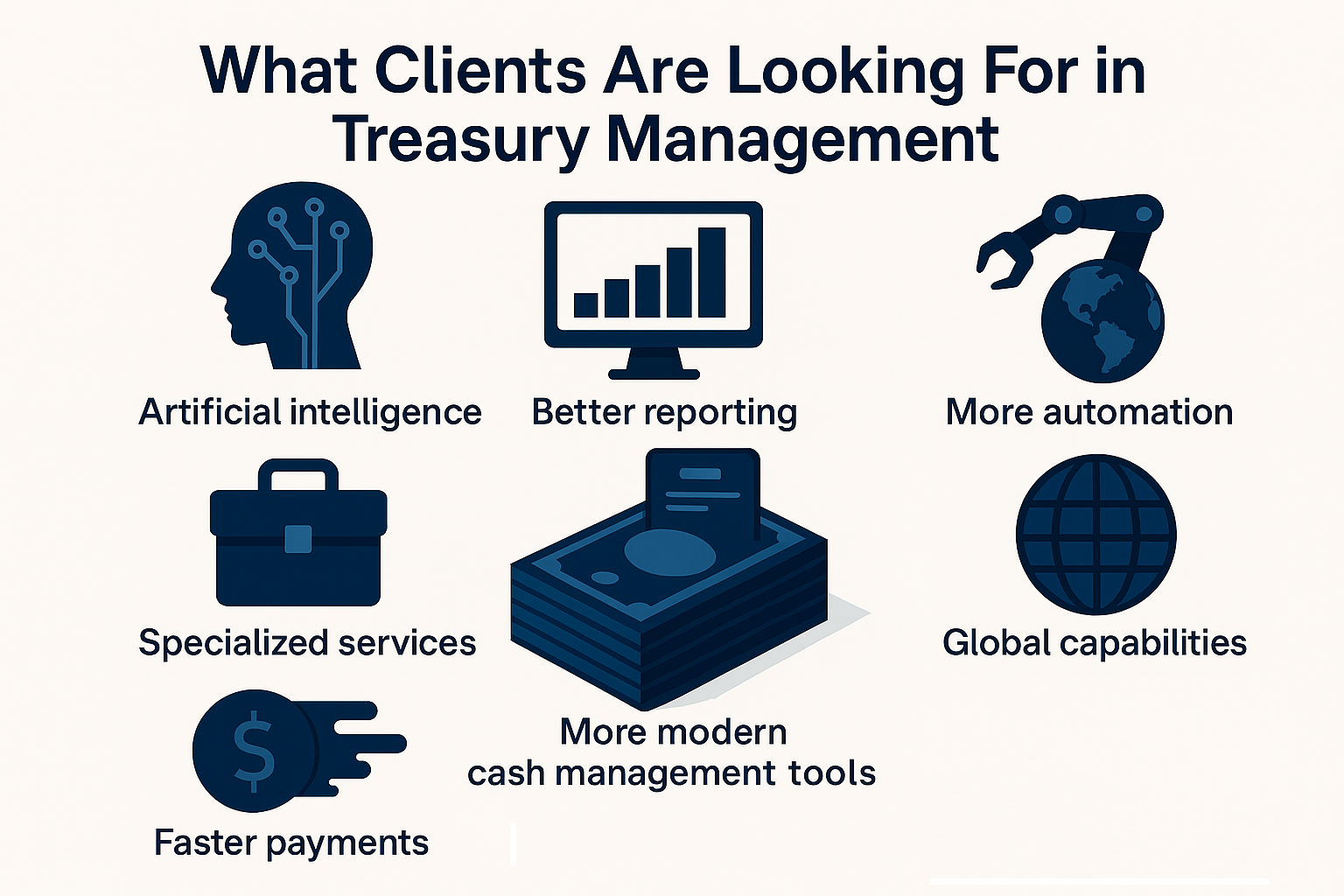
Why the shift? Clients are looking to leverage artificial intelligence to achieve better reporting, more automation, faster payments, foreign exchange capabilities, specialized services (fraud support as an example and enhanced cash management tools (alerts, forecasting, etc.).
Nearly half of companies expect their number of bank relationships to increase even further in the next two years. In a world where fintechs and large national banks push digital innovation aggressively, clients are spreading their bets—and consolidating with whoever delivers the best digital experience, not just the best rate.
Why Clients Switch Banks: It Is Us
The study confirms what many bankers already feel in their souls: the #1 reason companies switch financial institutions is the functionality of digital tools.
This is a critical point to understand if you are getting you treasury management system from your core provider. Companies are choosing their treasury management first and then opining on the bank. Despite all the time we spending worry about pricing, credit or branch networks, it’s the digital experience that attracts and retain clients.
Clients are looking for:
- Cash flow forecasting
- Budgeting and analytics
- Real-time payments
- User-friendly interfaces
- Seamless ERP integration
- Modern mobile tools
- Robust API capabilities
If your platform makes clients feel like they’ve time-traveled back to 2007, chances are they’re already open to moving to your competitors.
Communication: Clients Think Banks Aren’t Talking (or Listening)
Another issue is communication. While digital tools are a major gap, the report highlights a surprisingly human problem: banks aren’t communicating well with their business clients. Many companies say their FI don’t explain the tools and functionality that are available, don’t provide evidence that they understand the client’s industry, don’t provide advisory guidance on financial matters and don’t proactively recommend solutions.
This creates the saddest scenario in banking: an FI offers exactly what the client wants, and the client has no idea. Relationship managers and treasury sales officers are stretched thin, often reactive rather than proactive. Clients want strategic partners, but banks often show up as order takers.
And in 2026, being an order taker is a great way to lose the order so you never get to 2027 with the customer.
To solve this problem, banks need to understand that the most experienced relationship managers should be focused on about 10-40 high value clients depending on the size of the relationship. Meanwhile, less experienced bankers should cover 100 clients that just need someone to call occasionally or are just prepared to take orders. By triaging your clients in this manner, banks can more efficiently allocate resources.
Communication doesn’t take any technology, it just takes training and culture. Any bank can do it and those that do will find that they will have more engaged customers.
Specialization: The Differentiator Clients Will Pay For
One of the report’s clearest findings is that industry specialization drives loyalty. A full 85% of businesses want a dedicated account manager who understands their vertical. Banks do not pursue a niche industry specialization enough.
Clients in real estate don’t want the same things as clients in healthcare, manufacturing, transportation, or agriculture. Even if the underlying treasury products look similar, the workflows, regulatory concerns, and reporting needs differ significantly.
Banks that stand out do so by:
- Hiring RMs and treasury officers with industry expertise
- Tailoring digital experiences by vertical
- Wrapping products in marketing copy that resonates with a target industry
- Offering industry-specific integrations
- Creating curated bundles of services and capabilities
- Using fintech partners to fill niche gaps
Generalists may get in the door, but specialists win, and retain, the relationship.
Digital Banking Still Feels Hard
Even as banks have modernized their treasury management portals, 83% of businesses still believe their digital platform needs improvement. More than half of the respondents say they can’t access everything they need with a single login.
If you’ve ever tried to explain to a client why cash reporting, instant payments, and positive pay management are in three different menus, on three different systems, with three different passwords, then you understand the problem.
Here is the key to successful treasury management marketing – clients are buried in manual processes. Help the client automate and you can win the business. This means helping them reconcile among multiple banks, support getting rid of their Excel reports, allow them to build custom cash visibility reports with forecasting, and educate them on how to find and use the tools that you do have.
Excel remains the undefeated champion of cash management, not because clients love it, but because banks haven’t given them a viable alternative. In this age of generative and agentic AI, this is changing rapidly and banks in 2026, need to find a way to incorporate AI driven dashboards, reporting, forecasting and alerts.
What Treasury Management Clients Actually Want
Across the board, businesses crave:
Unified, real-time reporting: No more “previous business day” nonsense. If clients can track a package in real time, they expect the same from their money. As instant payments gain in popularity, banks need to figure out in 2026, how to deliver real-time reporting of real-time balances.
Cash flow forecasting that doesn’t require a PhD or ten CSV uploads: A full 70% of clients want better forecasting capabilities built directly into their bank’s platform.
Seamless ERP and accounting integration: About 90% say ERP integration is critically important. Clients want to bank inside NetSuite, Xero, SAP, QuickBooks, Sage, Freshbooks, Wave, Zoho, and other systems they already live in. The report’s central message is clear: banks must prioritize both their digital platforms and the platform’s ERP integrations.
Why? A great portal is ideal for treasury teams who need controls, workflows, reporting, and specialized tools. Great ERP integration is ideal for accountants and operators who just want to initiate payments or view balances without logging into the bank. If a bank forces clients to choose between them, it has already lost.
The real winners provide:
- A feature-rich portal
- Deep, reliable ERP connectors
- Robust APIs
- Straight-through processing
- Bi-directional data sync
Banking becomes more integrated, less visible, and more valuable.
A single banking portal with deep functionality: Nearly three-quarters of businesses said a unified portal isn’t a luxury, it’s a requirement.
Intelligent insights, not just pretty dashboards: Banks that can analyze the data and provide proactive recommendations will pull ahead. Gen AI is making this easier and more assessable. The core providers for treasury management have been slow to role cash management AI functionality out and its costing banks clients.
AI in Cash Management: The “Agentic” Future: The report highlights an important strategic shift: banks shouldn’t wait to build their own giant, monolithic AI strategy. They should leverage partners already embedding AI into digital banking platforms.
Real-world use cases include:
- Asking natural-language questions (“Show me all payments over $100k scheduled for next week”)
- Automatically generating and formatting reports
- Identifying anomalies or emerging risks
- Helping clients reconcile their transaction activity and post month end numbers quickly
- Streamlining data flows with ERP systems
- Creating conversational experiences for clients
Banks that take a partner-first approach, especially with LLM‑agnostic providers, can innovate faster and more safely.
Continual Digital Improvement (Not One Big “Transformation”): The study shows 76% of clients have noticed improvements in their digital channel, but banks can’t treat modernization as a one-and-done project. Continuous enhancement is the new norm. If there was ever a need for a dedicated product manager in banking, it would be for treasury management.
Banks with leading treasury management applications focus on:
- Constant UX improvements
- Reducing steps in key workflows
- Expanding APIs and integrations
- Adding embedded fintech capabilities
- Curating a marketplace of vetted partners
Clients don’t expect perfection; they expect progress. What is your bank ready to announce in 2026 and 2027?
Wining Treasury Management – What Banks Must Do Next
To remain a primary treasury management provider to your clients in a fragmented, digital-first marketplace, banks should focus on four strategic priorities:
- Build integrated, real-time cash management capabilities: Clients demand unified visibility and modern workflows.
- Close the reporting and forecasting gaps with embedded AI: Natural-language reporting and intelligent automation are no longer futuristic—they’re expected.
- Embrace both portal strength and ERP integration: Clients want powerful tools and invisible banking.
- Specialize by industry and partner intentionally with fintechs: Banks become curators: bringing vetted, trusted capabilities to clients rather than building everything from scratch.
Putting This into Action
Commercial clients aren’t asking for the moon, they’re just asking for real-time visibility, unified systems, intelligent insights, ERP integration, industry expertise, and AI‑enhanced reporting delivered through a beautifully designed portal that also talks to their accounting systems.
Okay, maybe that is a little like asking for the moon, but the banks that deliver it will win loyalty, deposits, fee income, and deeper relationships in an increasingly competitive landscape. This starts by looking at functionality your current vendor may already provide. If not, it may be switching platforms in the next two years. The important point to takeaway is that banks need a treasury management product manager and continuous investment in the single most important product a bank offers.
If 2025 was the year clients said, “We need more,” then 2026 is the year banks must answer, “We heard you, and we’re on it.”