
10 Lessons For Management from the 2026 ABA Bank Marketing Conference

For years, bank marketing conferences were largely about advertising channels, branding campaigns, social media, and creative tactics. This year, the 2026 ABA Bank Marketing Conferece was different. This year, the major themes centered on hyperscaling bank marketing by leveraging generative and agentic AI to fuel growth.
Whether the topic was deposits, branding, social media, analytics, generative search, customer acquisition, or organizational alignment, presenters kept returning to the same conclusion: marketing is a strategic growth driver, not a support function. This means bank CEOs should ensure their marketing officers have the training and resources to help shape strategy, messaging, product design, and sales.
The banks that understand this shift are likely to gain market share. The banks that don’t risk becoming increasingly invisible in a world where AI, fintechs, and changing customer behavior are rewriting how financial institutions are discovered and chosen.
For executive leadership teams, the conference offered a warning and an opportunity. The warning is that many community banks are still operating with growth playbooks designed for a world that no longer exists. The opportunity is that the competitive advantages available to community banks remain substantial if leaders are willing to modernize how they think about deposits, customer acquisition, technology, and brand differentiation.
Here are the ten biggest lessons executive leaders should take back to their institutions.
-
Marketing Isn’t an Expense; It Is a Growth Engine
The central lesson from Ally Akin of Capital Performance Group is that 2027 budgeting should start with a growth plan, not last year’s budget. For 2027, banks are investing more capital in channels that can be measured and drive product sales, rather than spending money on pure branding and events.
For the average community bank, the median marketing spend/non-interest expense is around 2.5%. That also equates to six basis points of assets. On a revenue basis, that is approximately 6% to 10% of revenue depending on how much balance sheet growth is desired.
In terms of staffing, Ally cited a Cornerstone survey that showed 1.55 marketing FTEs for every $1 billion in assets, while an ABA survey showed 1.15 FTEs per $1 billion. She detailed where banks are planning to spend money next year and the expected return from each channel (below).
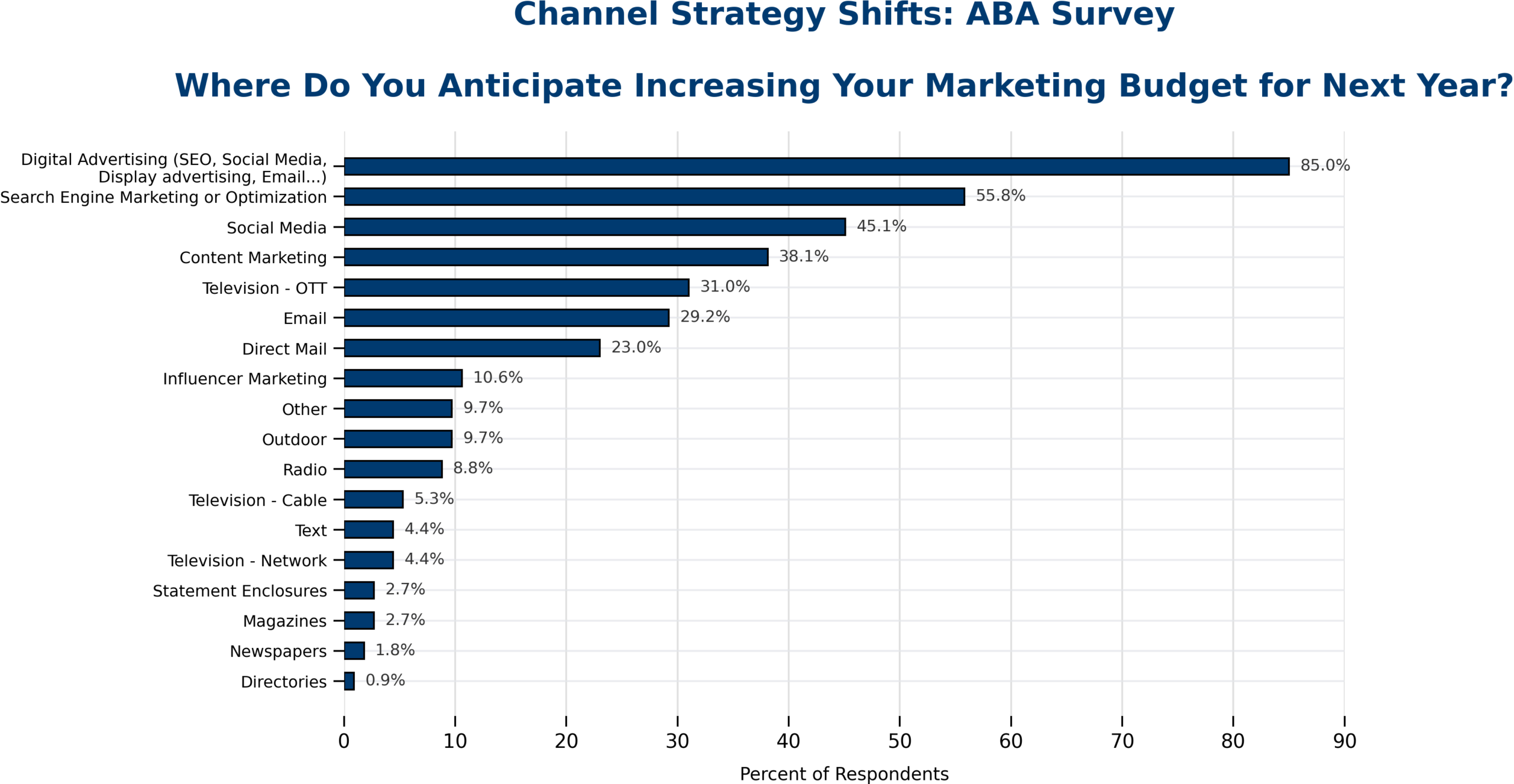
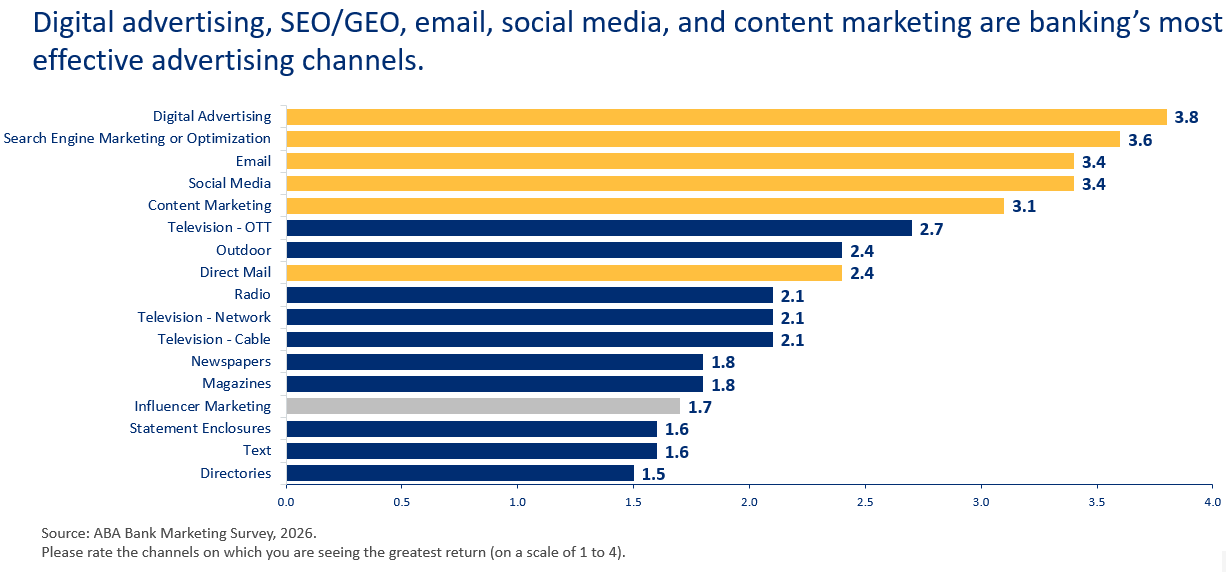
Among surveyed banks’ planned technology investments, 34.7% identified CRM platforms, 33.7% AI-powered marketing tools, 26.5% marketing automation, 26.5% analytics platforms, and 25.5% data-management platforms. Ally identified content creation, strategic planning, reporting and analysis, and operational efficiency as high-value AI applications.
Outside of the budget, there are deep discussions around marketing accountability.
Several presentations at the conference discussed how bank marketers must identify the intent/objective of a marketing effort before launch while also setting goals for the following metrics:
- The targeted customer segment
- The expected conversion rate
- The acquisition cost
- The projected customer value or profitability
- The business line and sales team accountable for follow-through
Bankers should rank product usage, sales activity, customer value and profitability ahead of conventional marketing measures such as impressions, reach, cost per lead, and media ROI. Specifically, a strong executive campaign scorecard should look like:
- New accounts and funded balances
- Primary relationship acquisition
- Cost per funded account
- Product activation and usage
- Relationship expansion
- Retention/attrition
- Revenue, margin, and customer lifetime value
Bank executives need to ensure that marketers play a role across the full customer journey, from initial engagement through onboarding, activation, usage, balance growth, expansion, and loyalty. This makes marketing a shared operating discipline rather than an isolated department. This also means that bank marketers need to play a larger role in product design and management.
9. Marketing Must Speak CFO
Several presentations at the ABA Bank Marketing Conference delivered a similar message: Marketing departments can no longer measure success with activities. They must measure outcomes.
Erica Starr, Chief Marketing Officer of Farmers & Merchants Bank, emphasized translating marketing activity into financial outcomes that CEOs and CFOs actually care about. Her presentation pushed marketers to stop discussing clicks and impressions and start connecting activities directly to deposits, revenue, pipelines, and profitability.
Similarly, Jessica Johnson and Brittany Mosley of Rosy Finch Method & Co. argued that both banks and agencies have become overly dependent on activity metrics while failing to connect investments to funded accounts and business outcomes.
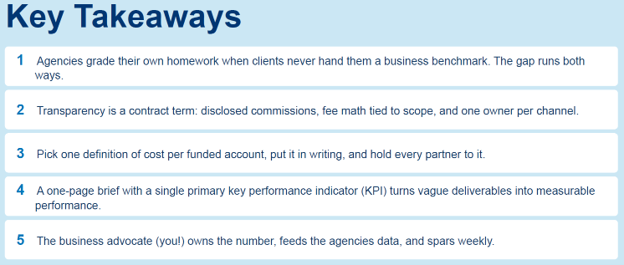
Worse, many banks fail to challenge the metrics their agencies suggest. This was a lightbulb moment for many bank marketers, as Jessica and Brittany showed how agencies set metrics such as impressions and clicks and then convince banks to spend more on advertising and creative. Bank business results are either nonexistent or do not flow back to the agency, so optimization comes down to guesswork.
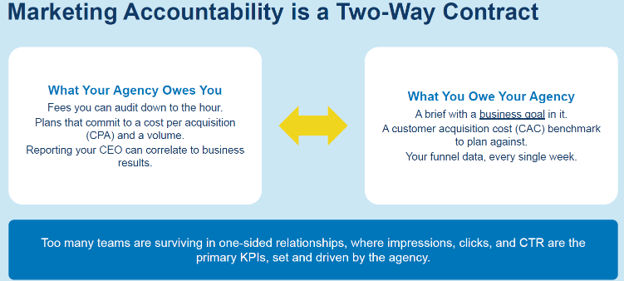
The takeaway was that every growth initiative should ultimately connect to a balance sheet or P&L outcome. If it doesn’t, it becomes increasingly difficult to justify future investment. Further, banks need to do their part by providing quality direction to their agencies while holding them accountable.
8. Brand Differentiation Is Performance
One of the most repeated observations throughout the conference was that most banks sound exactly alike. Amber Farley, Partner and EVP of Brand Development at FMS, presented research showing that consumers increasingly struggle to distinguish financial brands from one another. Generic claims around “relationships,” “community,” and “service” have become indistinguishable in the marketplace.
Her presentation argued that when customers cannot identify meaningful differences between institutions, decision-making increasingly defaults to rate, convenience, technology, and accessibility. Banks often talk about rate, product, technology, convenience, and service, yet customers want trust, confidence, guidance, belonging, and the feeling of being understood.
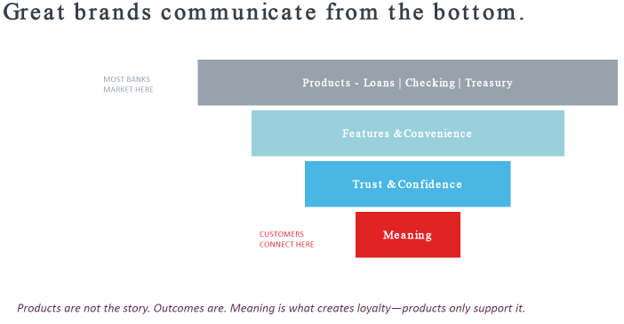
The result is that pricing pressure increases as does the cost of customer acquisition. A robust discussion was centered around the fact that you need a certain level of brand status that turns into trust before a product campaign can be effective.
For bank executives, the key lesson is that branding is no longer about awareness. Brand differentiation is increasingly influencing customer acquisition costs, deposit growth rates, market share expansion, and long-term franchise value.
7. Social Platforms Are Becoming Financial Discovery Platforms
Many bankers still think of social media as awareness marketing, but that view is strongly outdated.
Brenton Riley and Brianda Tamez of Q1Media argued that platforms like TikTok are becoming discovery engines where consumers actively seek financial education and guidance. Their research showed substantial engagement across virtually every adult demographic, not simply younger users.
Importantly, the strongest-performing content wasn’t promotional; it was educational, authentic, human, and local.
A complementary perspective came from Angela Connell, Natalie Bartholomew, James Bryant, and Zachary Hall, who demonstrated how hyperlocal content can become a powerful growth engine when it addresses topics communities genuinely care about.
Customers now discover financial institutions through content, often social content, long before they interact with products.
6. AI Is Officially Embedded in Bank Marketing Strategy
No topic received more attention at the conference than artificial intelligence. It was rightly included in almost every presentation. More importantly, AI discussions have evolved dramatically from previous years—from helping individual marketers save time with a single prompt to enabling enterprise applications that support branding, marketing compliance, and product design.
Steven Ramirez, CEO of Beyond the Arc, demonstrated how AI agent teams can automate audience research, content generation, compliance preparation, customer persona testing, brand voice management, and answer-engine visibility assessments. The productivity gains shown were significant, reducing marketing campaign development time by nearly half in some cases.
We discussed how banks can break a task down to a single agent, get that agent approved at the enterprise level and then deploy, or share, that agent across the organization.
Ben Udell conducted a two-hour workshop covering the basics of using a large language model to handle a range of basic marketing functions, and then presented an advanced class on vibe-coding marketing dashboards, landing pages, websites, and emails.
Ally Akins of Capital Performance Group showed AI-powered marketing tools among the highest-priority technology investments for financial institutions. Banks increasingly view AI as a strategic capability rather than a tactical tool.
True to the industry statistics, about 77% of banks had access to a frontier LLM (mostly Copilot) in the room.
The takeaway is that AI will likely amplify the productivity of institutions that adopt it effectively. The gap between AI-enabled organizations and traditional organizations may become one of the defining competitive differences of the next decade.
5. Creativity Is Becoming More Valuable Because AI Exists
While many sessions focused on AI, one of the most interesting counterarguments came from Emily Schwartz, Director of Financial Education at MidFirst Bank. Her presentation, “Sameness Is Expensive,” emphasized that creativity and innovation become more important as content becomes easier to produce.
Her core thesis was that institutions increasingly face a “sameness problem.” As AI makes content creation faster and more efficient, average marketing becomes cheaper and more abundant. The differentiator becomes originality.
This lesson extends far beyond marketing. Every business line faces pressure to differentiate. The institutions capable of solving customer problems in creative ways will maintain competitive advantages that technology alone cannot provide.
It is great that your bank is using AI; the competitive advantage will come from how your bank creates processes that inject originality.
4. Generative Search Is Now the Front Door to Banking
One of the most strategically important sessions focused on bank visibility and how many banks are getting lost in generative search.
Jessica Gardner’s presentation on AI SEO and Answer Engine Optimization (AEO) argued that customers increasingly ask ChatGPT, Claude, Perplexity, and Google’s AI platforms financial questions before they ever visit a bank website. When customers ask these systems about checking accounts, Treasury Management providers, or deposit products, AI increasingly narrows the field before the research process begins.
Her central argument was clear: Traditional SEO focused on rankings; generative search focuses on becoming the answer.
Banks that fail to optimize for AI-powered discovery risk becoming invisible during the earliest stages of customer consideration. Meanwhile, institutions that structure content for AI consumption can dramatically improve visibility, trust, and recommendation rates.
Jessica talked about making sure your bank knows what it wants to be known for among frontier LLMs. Having clear intent is critical to executing tactics that improve discoverability. Some banks want to be known for deposits, some for mortgages, and some for commercial loans. Whatever topic or topics are important to your bank, understand the questions potential customers ask first, and then design a strategy.
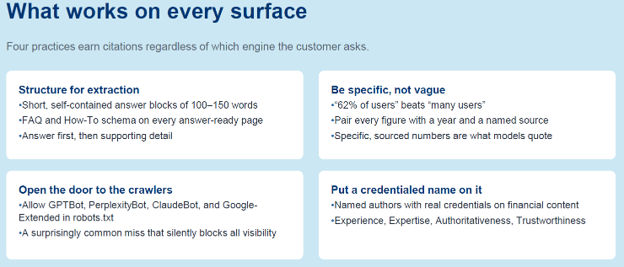
The next AEO tactic is to make sure product information is easy to extract. Here, ratings, customer social proof, descriptive headings, and an FAQ section are critical.
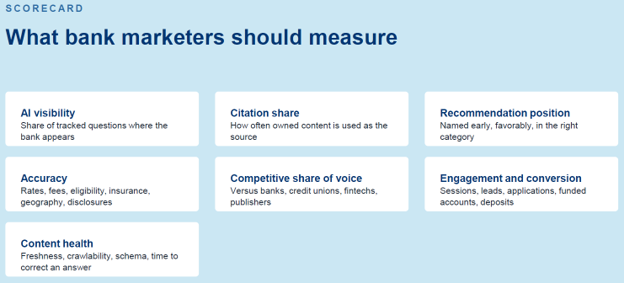
On average, it takes about seven days for banks to begin appearing in generative search results. To improve visibility, Jessica offered the following tips and suggested the metrics below to measure AEO effectiveness.
3. Organizational Alignment Is a Competitive Advantage
A critical lesson from the conference has nothing to do with marketing technology, AI, or branding. It involved organizational alignment.
Across presentations from Beyond the Arc, FMS, Farmers & Merchants Bank, Rosy Finch Method & Co., KlariVis, and Capital Performance Group, one theme consistently emerged: High-performing banks align growth efforts around common business outcomes.
Marketing understands growth strategy. Leadership understands customer acquisition economics. Operations and technology support execution. Compliance participates early. Data is available and usable. Results are measured. Everyone works from the same playbook.
The most successful institutions are not simply deploying better technology; they are creating better alignment.
2. Most Banks Are Sitting on Revenue They Already Own
One of the most compelling sessions came from Kim Snyder, CEO and Founder of KlariVis, and Amber Robinson, KlariVis Chief Revenue Officer. Their presentation challenged widespread assumptions in banking: that growth requires acquiring new customers and that you should invest in AI to become more efficient.
Using transaction-level data examples, they demonstrated how many institutions possess clear behavioral signals indicating unmet customer needs. These signals reveal wealth opportunities, lending opportunities, competitive account openings, treasury opportunities, and relationship expansion opportunities long before customers explicitly express them. By leveraging data, AI becomes a revenue growth driver.
Their argument was particularly notable because it extended far beyond marketing. Every line of business has access to customer signals from commercial banking to consumer lending. The institutions that learn how to identify and act upon these signals first will likely capture revenue that already exists within their customer base.
Kim and Amber’s suggested playbook is straightforward: understand the signal the data is sending, segment the targets, craft the outreach, deliver the message through the best channel, measure, and repeat. They walked through an example of analyzing payment data for all customers who transferred money into a brokerage account. They then built the logic and sent the message below. The results appear at the bottom.
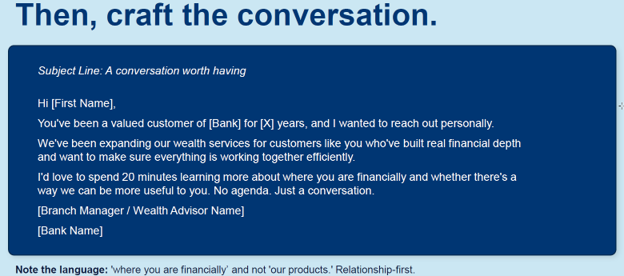
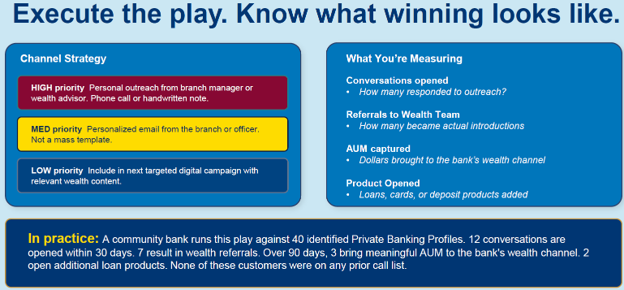
The institutions that can identify the right households, at the right time, with the right offer will have a significant advantage.
1. Quality Deposit Growth Is Relationship Primacy, Not Rates
One of the strongest themes throughout the conference was that many banks continue to confuse account acquisition with relationship acquisition. Multiple presenters argued that while promotional pricing can attract balances, it rarely creates durable relationships. Theresa Wendhausen of the American Bankers Association and Matt Allen of OptimaFI highlighted how banks can generate low-cost deposit growth by focusing on value, engagement, and relationship deepening rather than rate-driven promotions.
Similarly, Tom Stirling of Stirling Brandworks demonstrated that future growth will increasingly depend on winning primary banking relationships rather than simply winning individual accounts. He noted that direct deposit increasingly determines account primacy, making relationship ownership more important than account ownership.
The lesson for executives is simple: Deposits are a byproduct of relationship strength. Banks that continue competing primarily on rates may win balances. Banks that win primary relationships will likely keep them and be in a better position to have superior deposit performance over time.
Any bank should be able to grow deposits by 4% through passive efforts. With a focused sales effort, any bank should be able to grow deposits by 7%. However, growing deposits by 10% or more takes a disciplined and consistent approach to execution. Growing at 10% is not the result of a single promotion; it requires a series of successful marketing efforts taking place simultaneously, every day of the year.
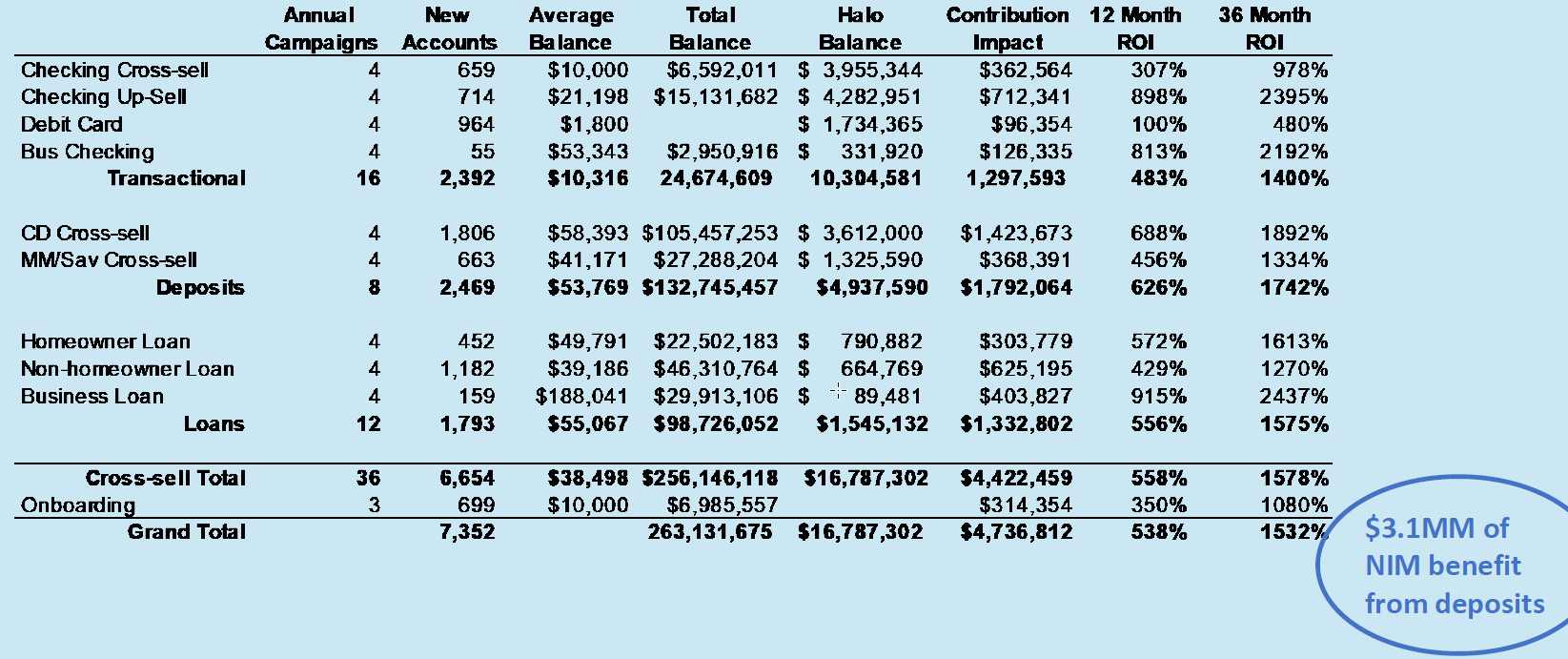
Several sessions demonstrated that deposit growth is increasingly becoming a measurable discipline rather than a promotional activity. Dan Marks, President of Growth Solutions at OptimaFI, emphasized viewing deposit franchise quality as a strategic asset directly tied to profitability, customer relationships, and long-term returns. His framework connected deposit composition, relationship growth, net interest margin, and capital allocation. The business case for his playbook is outlined below. A 1,532%, 3Y ROI should catch anyone’s attention.
Putting This Into Action
If there was one theme that connected nearly every session at the ABA Bank Marketing Conference, it was this: Growth is interdisciplinary. Artificial intelligence is reshaping execution. Generative search is reshaping discovery. Data is reshaping customer acquisition. Brand differentiation is reshaping competitiveness. Deposit growth is becoming more analytical. And executive teams are demanding measurable outcomes.
The institutions that thrive during the next decade will likely be those that embrace these realities early. Bank marketing is too valuable to remain a reactive activity. Bank marketers should help shape strategy, tactics, and products so that banks integrate marketing into every fiber of their organizations. Bank marketing, along with customer experience, should shape everything a bank does.
Save the date for next year in Orlando, Sept 13-15th, 2027!