
The Executive’s Checklist For Bank AI Search

As more prospective customers turn to AI for search, banks must ensure they appear in AI-generated results. To identify best practices, we analyzed top-performing banks and reverse-engineered their tactics, then distilled the findings into a practical primer and checklist for bank executives, product managers, and line-of-business leaders to use in conversations with their marketing teams. In this article, we show you the secrets to getting found for bank AI search.
How Bank AI Search is Not Google
While bank AI search shares some of the same algorithms as a traditional Google search, it is important to note that the overlap is less than 40%. Generative, or AI, search builds its own ranking system with OpenAI, Claude, Perplexity and others all doing it slightly differently. AI search visibility come not with the best search engine rank, but by producing the best answer to a prompt.
In other words, banks no longer rank for keywords but rank on how well a bank’s content addresses the question in a prompt. The model decides the vocabulary. Banks need to use AI to understand the questions potential customers are asking and then structure content to address those concepts, not keywords.
The Bank Leaders
It is no surprise that Bank of America, Wells Fargo, JPMorgan Chase rank at the top for AI search visibility, capturing the largest market share of AI-driven answers off user prompts. US Bank, Capital One, Citibank and Sofi also do an excellent job (below).
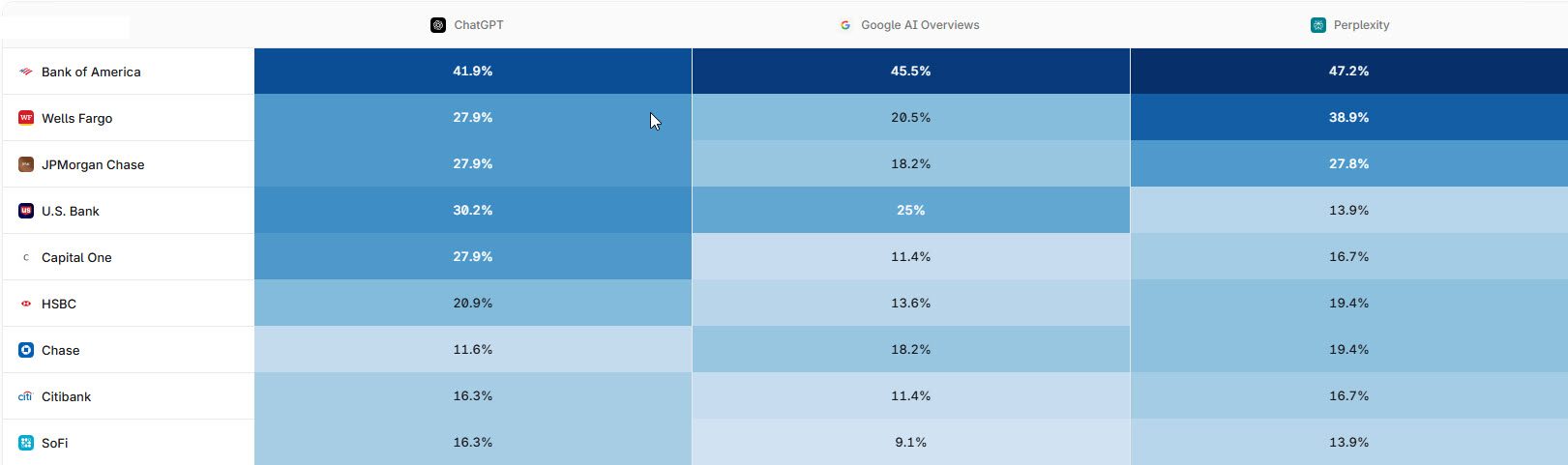
Individual banks scores can be used to calculate an composite Visibility Score:
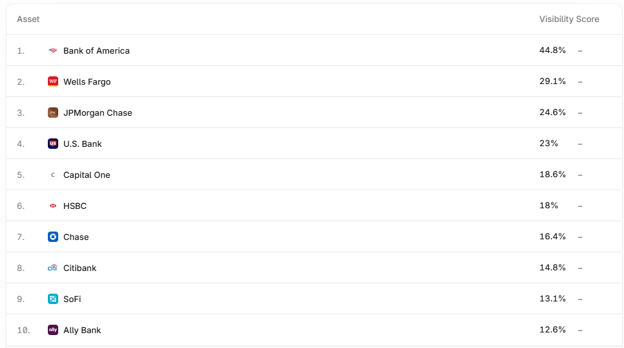
Profound Analysis as of July 5, 2026.
How to Dominate: 8 AI Engine Channels
To understand how the above banks rank higher than others, we have analyzed their tactics. The answer lies in how these generative AI frontier models determine the answers and authority. Much of the above rankings come from third party references.
AI visibility belongs to banks that can create content that satisfies the large language model’s scoring function for machine interpretability, trust, clarity, and specificity.
Here is a list of channels used by AI engines for citations and what tactics banks should consider for each one of them.
Reddit: Of all the social platforms, Reddit is often the heaviest weighted when it comes to authority and search citations. Unlike X (Twitter), Reddit comments are usually concise and well structured so that large language models can easily map, extract and cite data. To influence outcomes, banks can answer questions on Reddit by providing simple to understand direct answers to include at least one numerical data point or framework. Next, spend two to three sentences explaining the logic behind the answers and then end with a practical recommendation. This structure improves the odds of earning a citation for the bank.
YouTube: Of course, Reddit has just one source input. Close behind Reddit, YouTube is the second strongest signal for AI search. In fact, YouTube surpassed Reddit in Q1 2026 as the most frequently cited source in AI-generated answers, appearing in nearly 16% of responses according to several tracking studies. While AI engines do not watch videos, they do read the transcripts and metadata. That means banks should create videos as they are treated often better than a searchable text asset. Bank marketers should consider creating “pillar video” that covers a subject like treasury management in depth. Lead with the key premise such as how treasury management can help commercial customers optimize their cash balances, organize subpoints into key chapters, repeat the bank’s name and methodology often and then ensure your transcripts are accurate.
LinkedIn: LinkedIn has recently moved up in LLM’s rankings. According to Profound, LinkedIn moved from the 11th to the 5th most-cited ChatGPT domain earlier this year and now ranks as the top cited domain for professional queries across the six largest AI engines. Semrush also found that LinkedIn appears in 14.3% of ChatGPT answers. Banks should treat LinkedIn articles and company pages as serious citation assets by publishing clear, authoritative content that AI engines can easily reference.
Wikipedia: Most frontier models uses Wikipedia extensively as the foundational training material, accounting for a reported 26% to 48% of its top 10 citation share. Every bank looking to be found should have a Wikipedia page that they keep updated plus should include a description of their most popular products such as treasury management. Wikipedia isn’t a place to get promotional (as the page is likely to get deleted), but it is a place to get descriptive about the bank to include its history, specialties, and the communities that they serve.
Reviews: Banks should devote some energy around its reviews to include Google, Yelp, Nerdwallet, BankRate and app reviews. Banks with profiles on review sites are three-times more likely to appear in AI search rankings. Banks should claim and complete every relevant profile, then generate a steady flow of reviews, because the language customers use in those reviews becomes part of the bank’s AI citation footprint.
Quora: Like Reddit, Quora is often overlooked by banks yet play an important role in AI search. Google AI Overviews often cite Quora for informational queries. SE Ranking found that domains with substantial Quora content received four times more AI citations than other websites. Banks should use the same response structure as Reddit here: answer the question directly, support the answer with data or methodology, and explain the logic.
Press: Industry journalism accounts for 27% of all AI citations and rises to 49% for time-sensitive queries. That makes every press mention, contributed byline, and analyst quote a potential citation source. Banks should identify the three publications, such as the Wall Street Journal, Forbes, American Banker, S&P Global, plus others and make them a priority PR targets by pitching data-driven stories and offering expert commentary. A well-placed trade media quote can generate AI citations for years.
Organic Content: Our blog continues to be a big driver for SouthState when it comes to AI Search. AI Search quotes only about 15% of all websites visited. The difference between cited and not-cited sources is usually determined by structure rather than the quality of content. Growth Memo discovered that 44.2% of all LLM citations refer to the content of the first 30%. Make your claims strong, use definite language, add summaries, and ensure that the first sentence of every section is citable in its entirety.
Prioritize Your Topics and Build
You can start where you stand. Pick a topic and then generate content. It might be checking or commercial real estate lending (ranking below), treasury management or savings accounts. Get known for one banking product or business line and then expand.
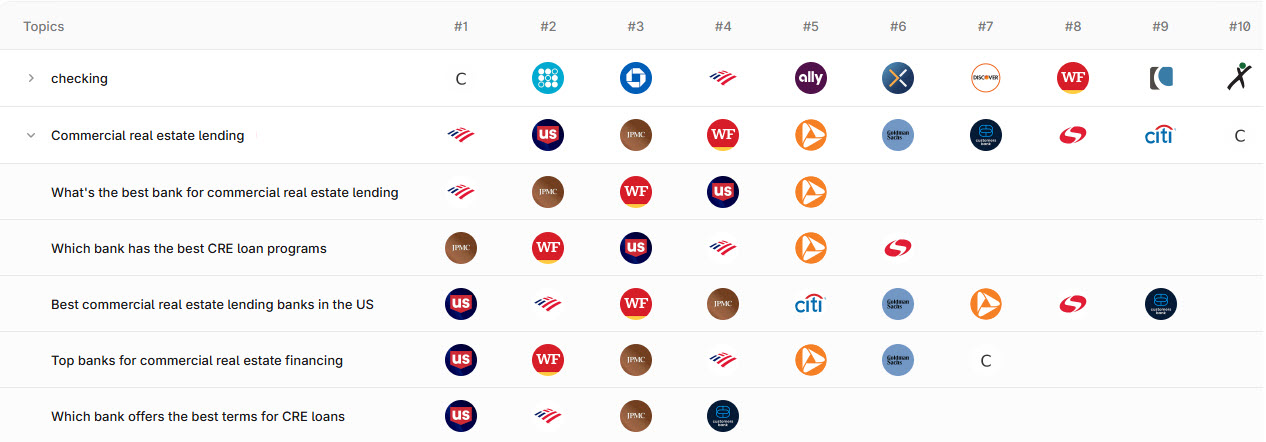
Profound Analysis as of July 5, 2026.
Putting These Bank AI Search Lessons Into Action
Banks that get noticed with AI search do so by not dominating one channel, but by creating loops and cross-references across several channels. This allows each asset to build a citation signal.
For instance, you can write a comment on Reddit, generating engagement. This answer can further develop into a blog post on the bank’s website. Afterward, this post can become a LinkedIn article enriched with insights. This content can be turned into a YouTube explainer video with a structured transcript, both of which can be pitched to trade press publications. Eventually, the coverage provided there can lead to a mention in Wikipedia.
As a result, every step will provide you with a citation on the platform where an AI engine independently evaluates it. The combination of several sources leads to a significant increase in citation value.
This is the loop of AI search equity.
Banks that start building “citation equity” today will reap the rewards in nine to 12 months. Being found on AI search not only offers an immediate competitive advantage of being found more easily by potential customers, but the effort build a competitive moat that will be increasingly difficult to replicate.