
What a F1 Pit Crew Can Teach Banking – Performance as a System

One reason why banks have efficiency ratios over 40% is because they install a bunch of actions – workflow, technology, and strategy, which assume that banks need to operate in silos. Commercial banking has one set of solutions, while retail has another. Banks keep data in 30+ various places, have 40+ different data models, and have multiple onboarding workflow depending on the product. In this article, we explore a way to make it better that is particularly germane as you evolve with AI and agents.
Lessons From Healthcare
For a decade, Great Ormond Street Hospital, a leading children’s hospital, wrestled with a problem that seemed maddeningly unsolvable. Despite highly trained clinicians, the latest in technology, and strong leadership, outcomes in a critical care process refused to improve. The hospital tried new protocols, invested in training, and brought in consultants steeped in healthcare best practices to help.
Nothing moved the needle. After a decade of failing to improve outcomes, a group of doctors got together and came up with a hairbrained scheme. They hired the Ferrari Formula 1 pit crew to observe the hospital’s protocols.
What happened next permanently changed how the hospital operated and, in the process, proved a powerful lesson for banking.
The Hospital Problem That Wouldn’t Go Away
The hospital was struggling with patient outcomes tied to a specific moment: handoffs. When critically ill children were transferred between teams – such as from surgery to intensive care – small delays, miscommunications, and inconsistencies compounded into measurable clinical risk. Everyone involved was competent. Everyone was well-intentioned.
Despite a group of competent professions, outcome improvement stalled. Children still died.
It turns out, it was not a knowledge problem. It wasn’t a talent problem. It was a coordination problem.
Healthcare, like banking, is full of highly skilled specialists operating in silos. Each team performs their role well, but the system often underperforms.
What a Pit Crew Can Offer
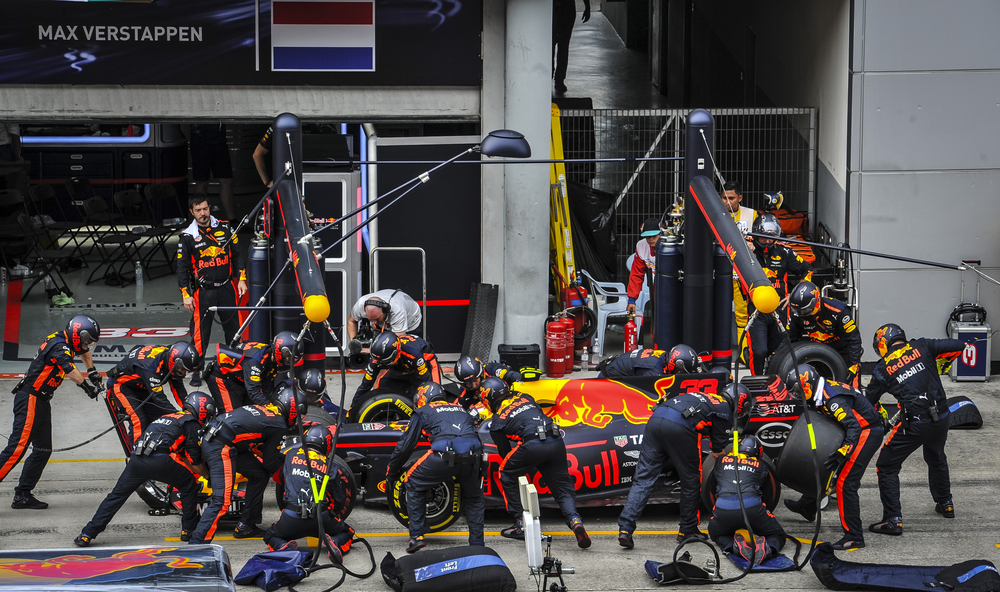
Formula 1 pit crews operate in one of the most pressured performance environments on earth. Every time a car pits or is “boxed,” 20+ specialist go to work. Every millisecond matters and there is zero tolerance for ambiguity. Decisions slow you down and cause errors. Any failure in a pit crew is immediately visible, tracked and can cost a race.
A pit crew doesn’t succeed because everyone is good at their job. They succeed because the team is perfectly orchestrated.
The Breakthrough: It Wasn’t About Working Harder
When Ferrari engineers studied the hospital’s various processes, they focused on six areas: the sequencing of actions, the timing, roles, information flow, the level of standardization and decision making.
They then mapped hospital handoffs the same way they map tire changes. The map uncovered something startling.
- Doctors and nurses were multitasking.
- Responsibilities overlapped.
- Critical information was repeated and sometimes missed.
- No one owned the “handoff” as a single orchestrated event.
Ferrari applied a few deceptively simple principles:
- Clear role ownership: Every action had one owner, no ambiguity.
- Standardized processes: Processes should be in the same sequence, every time, regardless of the personnel.
- Pre-commitment to decisions: No debating in the moment; decisions were made upstream before they took place.
- Clear areas of responsibility: Everyone knew when their role began and ended.
- Analyzed Actions: Every above average or below average outcome gets reviewed in an after-action meeting for constant improvement. Process improvement is then designed back into the system.
The result?
Fewer errors and improved patient outcomes. The hospital also started to increase the speed of the handoffs, which was a byproduct of the process.
After ten years of stalled progress, improvement happened in months.
The Lesson for Banking: Performance Is a System Property
This is the key insight banks often miss; performance can be designed into both bank culture and any system. Unfortunately, most bank systems arise organically and are not designed with intent for performance.
Better outcomes do not come from more experienced bankers or bankers with superior skills alone. They come from better orchestration. It is not enough to have a top performing lender but a top performing lender that has the tools, technology and process to gather deposits, generate a superior customer experience, limit risk, and fit into a superiorly designed system.
A bank can have all the smart bankers, experienced risk teams, technology, and products that it can manage but problems and inefficiencies persist. Banks lose customers, take risks they don’t get paid to take, credit management lags, fraud teams react after losses occur, the customer experience is fragmented and costs abound.
Banking’s Version of the “Handoff Problem”
In banking, handoffs are everywhere. Not only is the customer handed off between departments say treasury management and deposits, but various technologies and process interact between onboarding, risk, and finance.
The largest issue is that banks purchase technology within a silo. They buy a consumer loan origination system that is different from a commercial loan origination system. As a result, a business owner that need both a personal line of credit and a commercial real estate loan experiences two entirely different processes.
These processes not only don’t share data to make for a better customer experience, but they don’t share data to help marketing, sales, or customer service. Information is often locked in credit underwriting that never makes it to other banking functions.
Onboarding is even worse. Banks create an onboarding process driven by a vendor as opposed to picking a vendor that fits the onboarding process they want to create.
This is why few banks can create a federated onboarding or maintenance application. A new customer should be able to pick a variety of products and get a single application that includes all the products as opposed to having to open a commercial checking account, a personal checking account, treasury management, instant payments, and positive pay.
The same goes for account maintenance. It not uncommon for a name and address change to have to occur in more than a dozen places.
As a result of these three, and thousands of other processes within the bank, banks not only operate inefficiently, but they also act to the determent of the customer experience and often increase risk in the process.
Banks Often Compound Their Problem
On the surface, when budgets are made and goals are hit, bankers conclude that the function is going well. However, while a function like commercial lending might be meeting its targets, the system performs poorly. Loans may be gathered, but valuable deposits get missed.
Just like the hospital, banks often respond to missed deposit or other goals by purchasing more technology, adding more processes, hiring more bankers, or holding more meetings.
But the Ferrari pit crew lesson suggests a different approach.
Formula 1 Pit Crew Lessons for Bankers
- Take an Enterprise View of Functions
Start with the end in mind and then work backwards. If the goal is to have a consistent customer experience, lower fraud, and more efficiency, then functions like payments, fraud detection, identity, onboarding, account maintenance, data, AI, and a dozen other processes needs to be standardized.
Bank CIOs, CTOs, and product managers need to think in modular design. How can you create an architectural design and vendor choice that leverages the same functionality across the enterprise?
Create payment, fraud, identity, and onboarding functionality that can scale. ONLY choose vendors that can offer this type of approach.
- Optimize the Flow, Not the Function
Banks then need to optimize for workflow, not function. AI, faster underwriting, better fraud models, and the like are good, but customer outcomes and enterprise efficiency depend on end-to-end flow not department excellence. A superior fraud model that acts too late or does not cover all payment channels still loses money.
Once you have modular function, plug them in at the appropriate places that is conducive to the workflow and not how you did it with an analog process.
- Make Decision Rights Explicit
In Formula 1 racing, every action is thought through in painstaking detail. With every process, an overall owner is identified, and sub-owners are named. Each sub-process is clearly defined as to their goals and responsibilities. The goal and metrics of every process, to include tolerated risk, is stated upfront. The system is then designed backwards to meet those goals.
Any time a decision needs to be made, a decision tree is used with the possible outcomes clearly stated. The team understand what inputs are required, what inputs are “nice to haves” and what inputs are not needed.
Ambiguity kills speed and confidence.
- Standardize the Critical Moments
Not all bank processes can be standardized; however, every high-risk, high-frequency moments must be. If there is an exception process where 95% of exceptions are approved, something is wrong with the process. Credit deterioration metrics need to be prospective (forward looking) and clearly defined ahead of a credit event.
The same goes for fraud escalation paths. Too many banks have fraud or credit escalation paths where senior management is alerted but the process is not defined. As a result, escalations are managed in numerous ways, and decisions languish, risk increases.
In racing, there are certain thresholds and metrics that are monitored on the tire. When these are hit, the pit crew has well defined protocols to manage the tires. The car is pitted, and harder or softer tires are installed, a decision all previously laid out. Ferrari doesn’t improvise tire changes. Neither should banks improvise critical decisions.
- Orchestration Beats Intelligence
For all the talk around data and analytics, there is little conversation around the power of orchestration. Orchestration is where different processes come together and/or team members work together. Selling bundled products, cross-selling treasury management to derive lower loan rates, getting Wealth and Mortgage involved and coordinated marketing journeys are all examples of orchestration that drive profitability.
This is also where modern banking intersects with agentic AI. The next leap forward isn’t just smarter models or better data, its orchestration driven by agents that coordinate systems, triggers that initiate automation, dynamic routing, and a reduction of latency. AI will soon become the new pit crew conductor.
Putting This into Action
F1 pit crews know that it not only takes skilled employees, but employees that work together to achieve enterprise goals. Banks are operating under constant pressure from liquidity shocks to fraud attacks to changing customer expectations. Understanding how to react to each before they become a problem and designing systems that not only operate in concerto-like unison but constantly improve are the keys to a top performing bank.
The institutions that win won’t just be well-capitalized or technologically advanced. They’ll be well-orchestrated.
Design technology, processes, and culture in such a way so that there is clear responsibility, predetermined coordination, modular functions, accountability, standardization and an enterprise view of functions, and your bank will end up with a crew that performs as one.