
Why Deposits Drive Relationship ROA and ROE

Deposits are the franchise for most banks and are not a by-product of lending. Core deposits are the cheapest, most stable funding a bank can obtain, and they are the main reason a community bank can compete with larger institutions and nonbank lenders that fund themselves in the wholesale markets.
Yet most community banks still judge relationships one loan at a time. A credit is approved, priced and booked on its own spread, and any deposits that come with it are treated as a pleasant extra. That habit made little difference when deposits were plentiful and nearly free during the pandemic. In a higher-for-longer interest rate environment, deposits are key to profitability. A loan that looks thin on its own can be one of the bank’s best relationships once the deposits are counted, and a loan that looks fine on its own can quietly consume funding the bank must replace at market rates.
What Banks Are Doing Right Now
Third-quarter 2026 earnings calls show that the industry voting with its balance sheet. Banks such as Truist, First Horizon, ConnectOne, Columbia Banking System, Old National and others describe a shift toward relationship-driven business that brings deposits with it, and away from single-product lending funded by higher-cost money, and strong loan demand and stiff competition for deposits are forcing the choice.
The common thread is that banks are judging a loan by the deposits and fees it brings, not by its spread alone. Large banks can make that judgment with dedicated analytics teams. Community banks also need a way to do the same math.
How Fund Transfer Pricing Reveals The Value Of Deposits
Fund transfer pricing (FTP) splits the bank’s net interest margin into two sub-margins: one earned by originating assets and one earned by gathering funds. Loans are charged for the funding they use, and deposits are credited for the funding they provide, at a market-based transfer rate such as SOFR.
The FTP curve is the bank’s neutral point. A loan earns its margin above the curve: the loan rate minus the FTP rate. A deposit earns its margin below the curve: the FTP rate minus the deposit rate. To the bank, a basis point is a basis point. One dollar of loan priced 2.00% over the curve and one dollar of deposits priced 2.00% under it add the same spread income.

This is why deposits matter so much more today than they did when rates were near zero. When the curve sat at 0.25%, a free checking balance could earn the bank no more than 0.25%. At 4.00%, the same balance is worth sixteen times as much, and it needs almost no capital to earn it.
That gap rests on four structural advantages of deposits over loans:
- Less capital. Loans carry risk weights and require equity to absorb credit losses. Deposits are a liability with no credit risk to the bank, so the equity tied to a deposit relationship is minimal (but not zero). Margin earned with little capital produces outsized ROE.
- Less price sensitivity. Borrowers shop a loan rate aggressively, often against several banks, because the dollars are large and visible. Operating-account customers care more about service, treasury tools, and convenience, and rarely move a working account over a few basis points.
- More perceived value. Customers see deposit and treasury services as something they use every day: payments, payroll, fraud protection, online banking. A loan is often seen as a commodity, which makes it hard to charge for. Deposit services can also carry fee income.
- Less pricing transparency. Loan pricing is quoted against public benchmarks such as SOFR plus a spread, so it is easy to compare. Deposit pricing is bundled into tiered rates, earnings credits, account analysis, and fees, so clients compare it less directly. The bank’s obligation is still to price fairly; the point is that deposit pricing is less commoditized.
Same Loan, Different Deposits
We modeled RAROC pricing on a typical OO CRE loan. By adding a modest, realistic deposit package lifts the same $1 million loan from 3.4% to 9.6% regulatory ROE and from 0.44% to 1.23% ROA. The loan never changes – a $1 million owner-occupied CRE loan to a dental practice, priced at one-month SOFR plus 2.00%, with a 60-month term and 300-month amortization, run through the Loan Command relationship profitability model (outputs appear below).
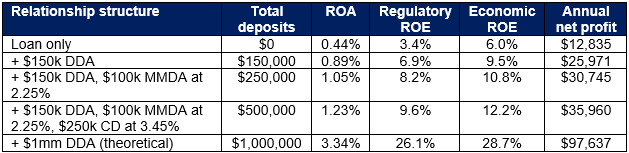
On its own, the loan earns a 3.4% regulatory ROE and 0.44% ROA, well below any bank’s cost of capital. A lender judged on the loan alone would either reprice it, likely losing the client, or decline it. The last row shows the theoretical self-funded loan, matching the loan dollar for dollar with noninterest-bearing DDA lifts regulatory ROE to 26.1%. Few borrowers will keep $1 million idle in checking against a $1 million loan. However, the other outputs show where the economics of the relationship live.
The middle rows are what a good RM can realistically expect in deposits. A $150,000 operating account alone doubles net profit and ROA. Adding a $100,000 money market account at 2.25% lifts ROA above 1%. Moving $250,000 of the practice’s reserves into a CD at 3.45%, a rate that is not cheap, still pushes regulatory ROE to 9.6% and economic ROE to 12.2%, rated “excellent” by the model.
Two points stand out. First, even rate-paying MMDA and CD balances add return, because they are priced below the bank’s marginal wholesale funding cost and carry almost no capital. Second, the loan’s own ROE stays at 3.4% in every scenario – nothing about the credit was assumed to have improved. A bank that only measures the loan would turn down a relationship that, fully measured, earns nearly three times the return.
Measure The Relationship Or Lose It
Banks that cannot price the benefit of deposits will lose their most profitable business to banks that can. The competitor that measures the full relationship knows the dental practice above is worth a 9.6% ROE with a reasonable deposit package. It can offer a sharper loan rate, win the operating account, and still beat its hurdle. The bank that measures only the loan sees a substandard return and either overprices it or passes.
Over time the pattern compounds and banks that cannot see deposit value win the clients who bring only a loan, and its competitors win the clients who bring loans, operating accounts, reserves, and fees. Most banks that end up funding growth with CDs and wholesale borrowings will underperform in the long term.
The tools are not complicated – a simple FTP framework, relationship-level ROA and ROE in the pricing model, and incentive pay tied to FTP-adjusted income are enough. Community banks that make that shift will keep their best clients.