
Post Fed – Higher For Longer, Building a More Resilient Bank

The FOMC chose not to move rates this week. Consumer and producer prices rose substantially above the Fed’s target in September 2026; both headline and core inflation climbed above expectation. The futures market reacted immediately, but what should be the takeaway for community banks? Not much. Bankers should avoid the temptation to treat each data release as a verdict on where rates are headed. The monthly numbers will swing but it is more important to understand the longer-term forces underneath them and how those forces could shape how a bank structures its balance sheet. Those forces are primarily shaped by the strong AI buildout and geopolitical disruption to the global and domestic energy infrastructure.
We are certain that inflation will not rise in a straight line and over the next few years, inflation prints, payrolls numbers, and GDP will move up and down, and the Fed will respond to each in due course. It is less important where these economic indicators land versus the preponderance of durable forces. A bank’s average asset is three to five years duration, average deposit three to seven years duration, average capital five to 15 years duration, and average business plan ten years and longer. So, forecasting next month’s or quarter’s interest rate is not helpful – instead a longer-term view is necessary. A bank that reprices its strategy on every monthly print will be whipsawed and a bank that asks what the durable and impactful long-term trends are can be better prepared.
Durable Force 1: AI Spending
The Fed’s main tool is making borrowing expensive enough that businesses and households spend less. The AI buildout does not play by those rules because AI is not sensitive to interest rates. AI businesses expect returns of 20% to 40% and a 25-basis-point hike, or four hikes, barely registers against those expectations.
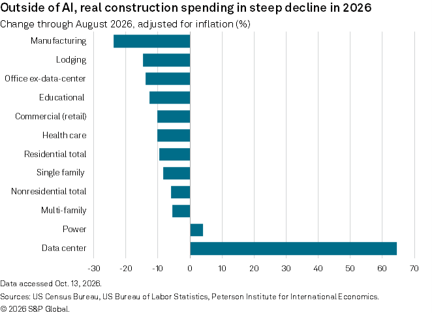
The scale is enormous as AI infrastructure financing is expected to total $10.3 trillion from 2025 to 2032, about 3.6% of GDP per year, larger relative to the economy than the railroad, electrification or highway booms. The AI buildout has also created a split Capex economy where data center construction is up about 65% through August 2026, while manufacturing, lodging, office, retail, health care and residential construction are all down (see graph below). The Fed keeps raising rates to cool total demand, but the hikes land on the rate-sensitive sectors that community banks lend to, while the largest source of demand keeps running despite the higher cost of borrowing. AI is also feeding prices directly: computer software, energy, and accessories prices keep rising. That means the Fed will likely need rates higher, for longer, to hit its target.
Durable Force 2: Geopolitics and Energy Costs
Energy is an input to almost everything: freight, fertilizer, plastics, pharmaceuticals, air travel. The Fed cannot control oil prices. The bigger issue is that the damage to the global petrochemical supply is structural, not a temporary spike. The current wars demonstrate how a $20k drone can wipe out millions of barrels of supply, and how easy it is for rogue actors to choke supply routes. Even after cessation of kinetic activity, the market has learned that disruption can be swift and easily orchestrated, so a risk premium must remain.
Importing countries are responding by paying for security over efficiency: redundant pipelines, storage, bypass routes and domestic supply. All of that is capital that must be recovered in prices for years. At home, the grid faces the same pressure as electricity prices rise well above the Fed’s 2% inflation target. AI data centers add to that demand and higher rates do not build pipelines or power plants faster.
Banks’ Funding
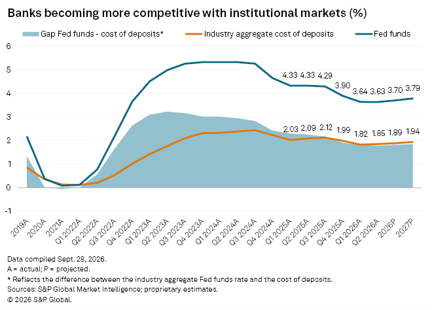
The September hike ended the brief deposit-cost relief banks enjoyed earlier this year. After falling in late 2025 and early 2026, the industry’s cost of deposits rose 3 basis points in the second quarter to 1.85%, and this increase predates the Fed’s first rate hike in September. The gap between fed funds and deposit costs has narrowed from 323 basis points in mid-2023 to 178 basis points, meaning depositors are capturing more of every rate move (see S&P Global graph below).
The repricing pressure is front-loaded: as of June 30, 86.5% of industry CDs were set to reprice within 12 months, and nearly 40% within 90 days. Banks marketing one-year CDs above 3.5% rose from 588 in March to 846 by late September, and more than 150 banks now advertise rates above 4% (according to S&P Global). S&P expects the gap in performance to widen between banks with granular, low-cost core deposits and those that depend on rate-sensitive funding.
Community Bank Playbook
A community bank booking 5-, 7- and 10-year fixed-rate loans on balance sheet today is making an uncompensated bet that these forces fade. Most of those loans carry soft or waived prepayment terms, so they prepay when rates fall and extend when rates rise. Three moves address the problem together.
- Build rate-insensitive deposits. Prioritize operating accounts, treasury management and full commercial relationships over promotional CDs. The best source is the commercial borrower who already depends on the bank.
- Generate floating-rate assets. Loan yields that reprice with funding costs protect the margin when deposit costs climb.
- Do not push rate risk onto borrowers. A floating-rate loan protects the bank but turns rate risk into credit risk when debt service coverage erodes.
The hedged loan reconciles all three. The borrower pays a fixed rate for the full term; the bank earns a floating rate, and the longer expected life of the hedged loan allows banks to cross-sell treasury management products and gather more client deposits.
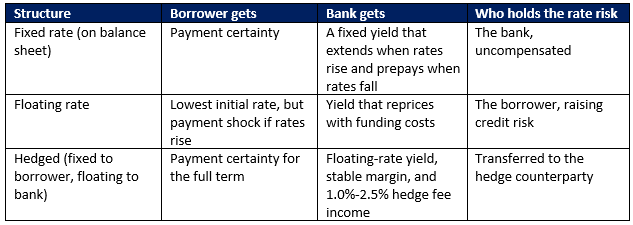
Good candidates for hedged loans are loans of roughly $1 million or more, fixed-rate requests of five years or longer, and borrowers who value payment certainty. Lenders should present fixed, floating and hedged options side by side. As we have previously stated, depending on size, market and balance sheet mix, hedged loans should make up 1% to 20% of total loans. A loan-documented program such as ARC keeps the conversation about a fixed-rate loan, not a derivative, and requires no new department. A borrower financing a long-term asset has three basic choices. Each one shifts interest rate risk to a different party, and only one gives both sides what they want.
Conclusion
No one can say whether the next CPI report will be hot or cool. But an AI boom that ignores rate hikes and an energy system rebuilding at a higher cost may keep pulling inflation and rates upward for years. Community banks that anchor their funding in core relationships and move part of their commercial book into hedged structures will not need to guess right.