
How to Price Fixed Rate Loans Without Prepayment Provisions

We are often asked by lenders about pricing differentials for fixed-rate commercial loans with and without prepayment provisions. For example, if a bank were to price a loan with a yield maintenance provision the loan would have a much longer expected life, and under most circumstances the bank would not have negative impact if rates were to increase or decrease. Conversely, if that same loan did not have an enforceable prepayment provision (or a prepayment provision with many carveouts) the bank will have negative impact if rates increase or decrease (depending on fixed or floating rate pricing). There is an equivalency or conversion that allows us to compare credit spreads for different prepayment provisions.
Why A Prepayment Provision Matters
First, let us review the four main reasons why prepayment provisions increase profitability for banks, as follows:
- Decrease the value of the option held by the borrower to repay the credit when interest rates or credit spreads are lower.
- Increase the lifetime value of the relationship.
- Increase cross-sell and upsell opportunities.
- Reduce negative selection bias in an economic downturn.
Some community banks will waive a prepayment provision under certain circumstances, such as the payment from internal cash flow, sale of the collateral, or an internal refinance. We understand why this strategy is deployed, but effectively, this negates much of the benefit of a prepayment provision.
The first benefit to a bank in obtaining a prepayment provision is the opportunity cost of committing to a credit and giving the borrower the unilateral right to prepay when changes in future interest rates or credit spreads make it more beneficial for a borrower to do so. For example, for a fixed-rate loan, if interest rates increase, the borrower is advantaged with a below-market loan rate and will extend duration thereby squeezing the bank’s NIM. Conversely if interest rates decline, the borrower is motivated to obtain a lower interest rate by refinancing the loan, again hurting the bank’s NIM. This is an example of a one-way floater loan – borrowers float down, but not up.
The Equivalency Formula for Prepayment Provisions
There is a way of measuring the value of this prepayment option held by the borrower. We can measure the cost of not having a prepayment provision using a capital market tool called an embedded prepayment option. The economic value of the option to prepay can be priced and measured using forward expected interest rates and the volatility surface of forward rates and credit spreads. We ran this model for loans from one to 20-year commitment and the results are shown in the graph below.
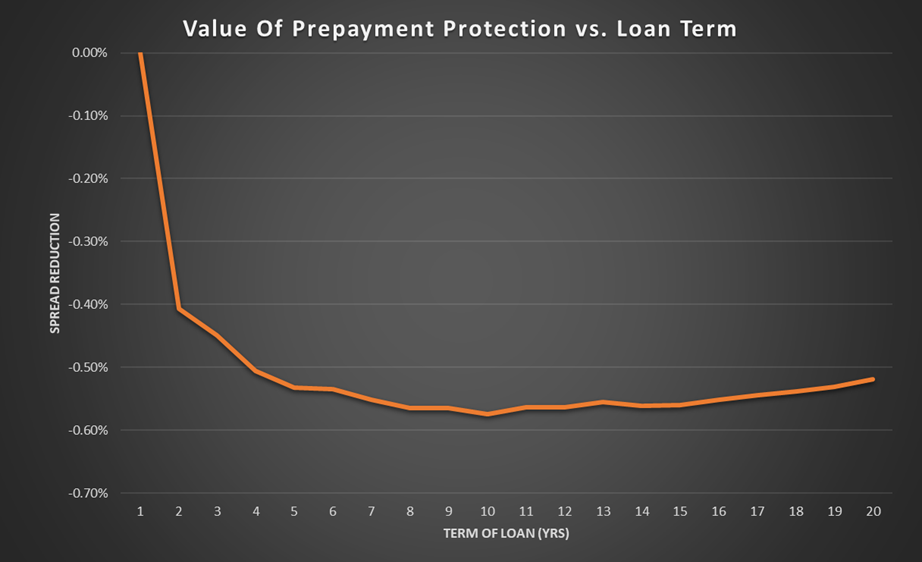
The graph shows the spread reduction for loans without prepayment protection versus those with a strong prepayment provision (such as a yield maintenance provision). For example, for a 20-year loan, a bank would be indifferent economically in offering a fixed rate loan at a credit spread of 2.50% with a yield maintenance provision (a strong prepayment provision) versus that same loan at a credit spread of 3.02% without a strong prepayment provision. This 52-basis points difference is the spread equivalent to compensate the bank for the lack of a prepayment provision. For a five-year loan, that credit spread indifference is 53 basis points. This equivalency applies to the economics of the loan only, and not any cross-sell opportunity for the bank.
Including a prepayment provision in a loan increases the economic value of that asset. A yield maintenance provision is not the only prepayment provision that affords the bank additional economic value. For example, including a declining balance prepay starting with the fixed rate term of the loan (for a five-year fixed rate, a 5,4,3,2,1 percent) and not waiving that provision for certain circumstances (internal cash flow, sale of the collateral, or an internal refinance) will achieve the similar economics for the lender.
Takeaways
The theory and reality of prepayment provisions are starkly different. Most banks cannot obtain strict prepayment provisions except when they hedge loans. However, prepayment provisions for commercial loans do increase profitability for community banks and being able to convert the value of those prepayment provisions to a loan spread is a valuable tool for lenders to consider when structuring and pricing commercial loans.
We believe that any prepayment provision is better than none. A prepayment provision that aligns with the borrower’s view of the market and one that allows the borrower to port the provision into future internal refinancings is also a strong marketing tool. Unfortunately, borrowers often negotiate away the prepayment provision since many bankers do not measure the ROA/ROE impact of a prepayment provision.
Our analysis shows that a strong prepayment provision is the credit spread equivalent of 54 basis points on average. This is a substantial amount of value that can be gained, or squandered, with the right commercial loan structure and term.