
A Framework for Inflationary Forces and Rate Predictions

On September 16th, the Federal Reserve raised the federal funds target range by 25 basis points to 3.75% to 4.00%, and the current short-term rate forecast is no longer a benign glide path lower. Futures markets now imply an effective Fed Funds rate of approximately 4.2% by December 2026 and roughly 4.7% by September 2027. In other words, both the market and the Fed are pointing to several rate hikes and an extended period of restrictive short-term rates, not a quick return to easing.
Every January, bankers and their clients sit through forecasts of where rates will be in twelve months, and every December they discover the forecast was wrong. This is not a criticism of forecasters but the flaw of forecasting itself. Point predictions about interest rates, inflation, or the economy require knowing the future, and no one does. The useful skill is not prediction but recognizing when a set of forces has become so lopsided that the range of plausible outcomes has narrowed and then positioning the balance sheet accordingly.
That is where we are today on inflation – we may not know what core PCE will print next quarter, but when we line up the forces pushing prices higher against the forces pushing them lower, the table is stacked heavily to one side, and has been getting more lopsided, not less.
The Forecasting Trap
In 2021, the Federal Reserve, most economic models, and a large share of the banking industry agreed that inflation would not sustainably exceed 2.0% and that the price pressure then emerging was transitory. We disagreed in print in April of that year, arguing that 4.0% annual inflation should be treated as the standard case and not the stress case, and we urged bankers to structure credit and asset duration for a higher-inflation, higher-rate world. Many banks went the other way, extending asset duration on the conviction that rates would never rise again. Some of those decisions are still on the books, and some of those bankers are still explaining them to their boards.
The lesson was not that the consensus forecast was wrong, because forecasts are wrong all the time. The lesson was that bankers made irreversible balance sheet commitments on the strength of a forecast instead of on the weight of the evidence. A five-year fixed-rate loan is a five-year bet and once booked cannot be re-underwritten because the outlook changed.
Alternative to Predictions
The alternative to prediction is not paralysis but disciplined, boring work of sorting the forces acting on prices and rates into two columns, weighing them by durability rather than by headline volume, and asking a simpler question: which side is winning, and is the gap widening or narrowing?
This approach has three advantages. It is falsifiable, because you can watch the columns shift over time. It is honest about uncertainty, because you are ranking probabilities rather than naming a number. And it produces banking decisions that survive being wrong at the margin, because you are structuring for a direction rather than a destination.
The Case Has Strengthened
In our article referenced above from January 2026, “Could the Next Move Be Up?” we laid out nine reasons the Fed’s next move was more likely to be a hike than another cut. The core of the argument was that the 2024–2025 easing cycle did not actually ease. The Fed cut 175 basis points beginning in September 2024, and long rates went up, with the 10-year yield rising 85 basis points to the time of this article as term premium did the opposite of what the policy rate was supposed to accomplish. The bond market was telling the Fed that cuts were not producing sustainably lower financing costs, only more inflation risk.
But the case for higher inflation and interest rates have strengthened since December 2025 when the Fed last cut interest rates. The neutral rate itself appears to have drifted higher on the back of persistent deficits and the AI and data center investment boom, which by most estimates accounted for 75% to 85% of U.S. private domestic demand growth.
Ranking inflationary vs. disinflationary forces below leads us to an obvious conclusion.
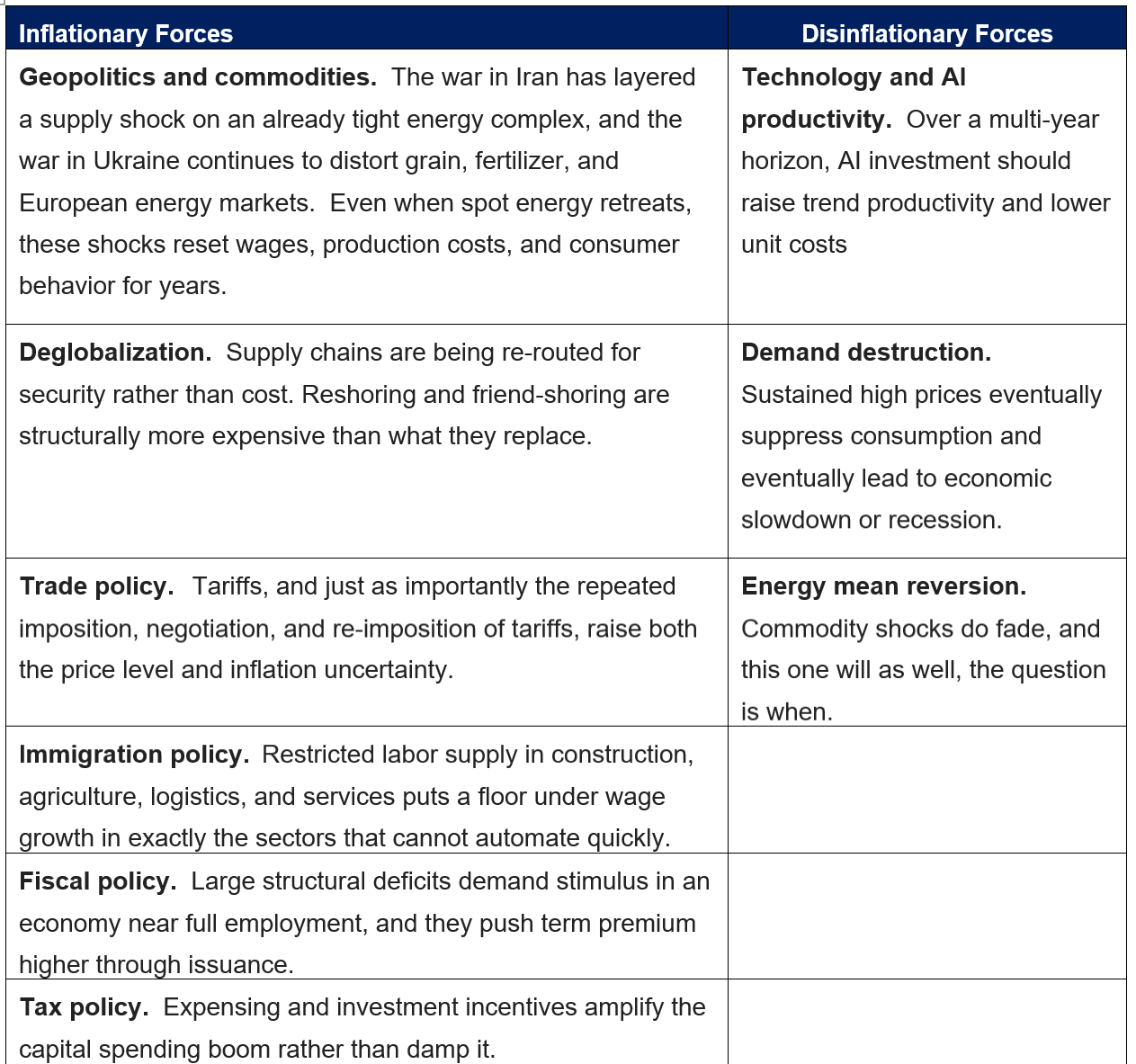
The left column is larger, and more importantly it is structural and more durable. Wars, supply chain reconfiguration, deficits, and labor supply operate on multi-year timelines and do not reverse because a data print disappoints. The right column is mostly cyclical or slow. AI productivity gains are real but arrive after the capital spending inflation. Recession is the only fast-acting disinflationary force on the list and is a perpetual economic risk.
The comforting counterargument, that the Treasury cannot afford higher rates so the Fed will be compelled to cut, gets the causality backward. The market sets the cost of the debt, not the Fed, which controls only the short end. Creditors will price sovereign risk as they see it, and cutting rates into rising inflation expectations raises debt premiums rather than lowering them. Historically, the fastest way governments shrink debt is through inflation, not through low nominal rates. Average inflation of 4.2% from 1946 to 1955 cut the debt-to-GDP ratio by nearly 40% in a decade. Inflating away fixed nominal obligations works, and the interest rate consequence arrives on the other side.
Inflationary Forces in Summary
No one can tell you where the funds rate will be in December, but the market is currently forecasting a high probability of four rate hikes through 2027 based on inflationary forces. The question that bankers need to ask is which direction the weight of evidence points, and on that the answer is not close. Monetary, fiscal, trade, immigration, and tax policy are all pushing the same way. Two active wars and a multi-year commodity setup are pushing the same way. Deglobalization and a capital spending boom are pushing the same way. The disinflationary column is thinner, slower, and more cyclical.
The trends point to an extended period of elevated inflation and higher-for-longer interest rates. Banks do not need to predict that outcome to protect against it. They need to minimize fixed-rate lending, price real yields rather than nominal ones, keep loan duration short, and stress ALM assumptions against rate paths that looked perfectly ordinary before 2020.