
Talking to Commercial Customers: Political Pressure Is Not a Rate Forecast

The Fed started its tightening cycle this week, after the latest CPI report showed inflation is running at stronger than expected 3.4% annualized rate. The President called for the Fed to cut rates, resting on a simple syllogism: the United States is a stronger credit than it was, and stronger credits pay lower rates, so the U.S. should have “the LOWEST RATE of any country in the World.” He linked that view to a proposal to further restrict trade if the Fed does not comply.
For community bank clients, the temptation is to read political pressure as a rate forecast and position accordingly. Wait for rates to be lower rather than to lock in today’s loan rates and take longer-dated CDs before cuts arrive. That would be a mistake, for reasons that have nothing to do with politics but everything to do with how the yield curve is built and what dictates the level of interest rates.
Do Not Confuse Credit Risk with Monetary Policy
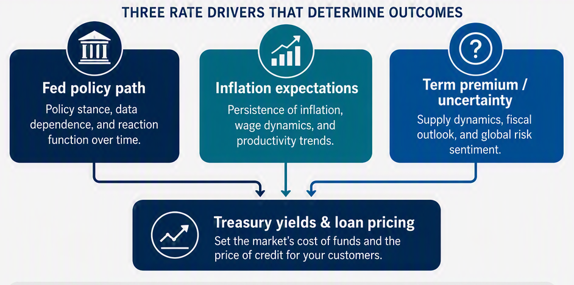
A sovereign yield is roughly the expected path of the policy rate, plus compensation for inflation, plus a term premium (a catchall phrase that includes compensation for uncertainty in policy). For an issuer that borrows in the currency it prints, default risk is a rounding error inside that number. The Treasury market is not pricing the odds the US fails to pay; it is pricing what the Fed will do and what inflation will be while you wait, and how public policy on trade, labor, environment, taxation, and fiscal spending may alter a holder’s appetite for US bonds.
Presidential Influence Over Rates is Indirect
The Truth Social post treats “the rate” as a single lever sitting on the Resolute Desk – but there is no such lever, at either end of the curve. The short end belongs to the FOMC – twelve voters consisting of seven governors serving staggered fourteen-year terms, the New York Fed president, and four reserve bank presidents who rotate annually. A president appoints governors as seats open and names the chair, subject to Senate confirmation. That is the entirety of the formal influence, and it operates on a timeline measured in years, not news cycles.
The long end belongs to no one at all but is market driven. The ten-year yield is the market’s average expected short rate over ten years plus a term premium (again this is compensation investors demand for holding duration instead of rolling bills and is highly driven by durability of public policy – more certainty lowers the term premium). If the Fed were to ease while inflation runs at 3.4%, the inflation compensation component of that ten-year rise, and the term premium rises with it, because uncertainty about the central bank’s reaction function increases.
The Market’s Rate Forecast is Expecting the Opposite
The Federal Reserve this week has adopted a decidedly hawkish stance on short-term interest rates, culminating in a unanimous 25-basis-point interest rate hike at the September 16, 2026, FOMC meeting. This marks the central bank’s first rate increase since July 2023, lifting the benchmark federal funds target range to 3.75%–4.00%. Interest rates moved sharply upward as the yield curve flattened. The curve remains upward sloping, and the front end is priced above the policy rate, meaning the market’s embedded forecast is tightening, not easing. As of today, the market-implied odds has one more rate hike built in this year and another early next year.
The Trade Logic is Difficult to Reconcile
The post asserts that the Supreme Court “strongly acknowledged” an absolute presidential right to stop trading with deficit countries. The February 20 decision in Learning Resources, Inc. v. Trump is closer to the opposite, and the distinction is worth understanding because it bears directly on the inflation path.
The legal claim is uncertain. The recent Supreme Court reasoning on emergency trade authority suggests that broad unilateral restrictions on imports would face immediate challenge, especially if structured as a sweeping halt to trade with deficit countries. Even apart from the legal issue, the economic effect would likely be inflationary rather than disinflationary, which undercuts the argument for lower rates.
The Post Increases the Probability of a Rate Hike
Here is an important irony for bankers to explain to clients. If the objective was a lower funds rate, the post is counterproductive. Kevin Warsh is a new chair who has spent his first months establishing that he will return inflation to 2%, telling the Jackson Hole audience that underlying inflation is not slowing. He inherits a committee that has held rates through five meetings with three members dissenting in favor of a hike. His central asset is the market’s belief that the Fed’s reaction function is driven by data rather than by the White House. That belief is what keeps the ten-year anchored.
A public demand to cut with an explicit threat attached and a call for the Board to “be patriots” converts the September decision into a test of that independence. Cut now and the move could get interpreted as yielding to political pressure undermining the credibility Warsh needs. Hold or hike and the Fed demonstrates that pressure does not work, which is worth something on its own. The asymmetry is unhelpful for anyone hoping for easier policy, and central bankers under political pressure have historically leaned into demonstrating independence rather than away from it.
How Clients and Banks Should Position Instead
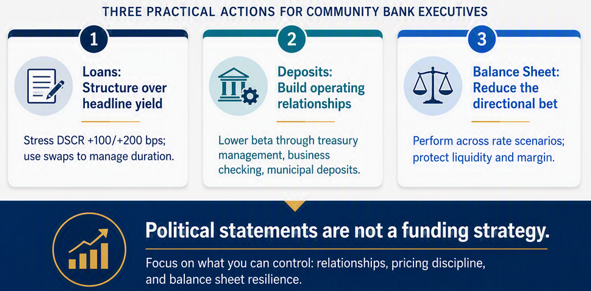
Loans. Favor structure over headline yield. The ten-year fixed loan is only 8 basis points more expensive than the five-year fixed. Commercial loans should be underwritten to exit rates rather than current short-term rates. Stress DSCR at +100 and +200. If you have a back-to-back swap capability, use it to give borrowers the fixed rate they want without warehousing the duration yourself.
Watch the composition of that jobs number for credit signal. The 162,000 gain came against a 12-month average of just 31,000, and the strength was concentrated in food services and local government education while information shed 23,000 jobs. Beneath a good headline is a labor market that has been soft for a year, with white-collar displacement showing up in the data. That argues for caution on consumer and office-adjacent exposures regardless of what the Fed does.
Deposits. Core operating relationships – business checking, treasury management, and municipal deposits – are the answer regardless of rate paths, and the only durable way to lower beta. Quantify your exception-pricing book explicitly because the squeaky-wheel repricing is where cost of funds leaks. Keep contingent liquidity lines tested and live.
Conclusion
There is a serious case for easier policy, but that is a case grounded in weakness, not the strength argument the President made, and it would call for tighter credit underwriting rather than looser. Either way, the discipline is the same: shrink the size of the directional bet. Position the balance sheet to perform across a range of outcomes rather than to win on one.
The President cannot explicitly set loan rates, cannot explicitly set deposit rates, and cannot explicitly set the ten-year Treasury that prices most of the U.S. economy. Inflation expectations and term premium do that, and both can rise when markets perceive political pressure on monetary policy. Political statements about the overnight rate are not a forecast, and they are a poor foundation for a five-year loan.