
Stress Testing Your Bank for Agentic Deposit Risk [Free Tool]

Given the popularity of Muse, Instinct, Dots, ChatGPT, and other third-party agents, these tools have the capacity to alter deposit performance. These AI agents can continuously compare rates, fees, deposit insurance, bank safety and make strong recommendations including preparing account opening applications. Eventually, these agents will help a customer act. In this article, we examine what it might mean for bank liquidity, and how a bank might proactively decide a strategy. We provide a free stress test tool to start to analyze the potential agentic deposit risk impact.
When analyzing agents in financial services, the right response is neither alarm nor dismissal. Banks, like JP Morgan Chase, PNC and others may choose to block agents from using their site. However, some banks are leaning in and looking to harness agentic commerce to attract new deposits.
As we look at both strategies, we also provide a high-level agentic deposit risk stress test that ask the questions – If deposits moved faster than our normal assumptions, what would our reported liquidity position look like?
The Agentic Strategic Decision
While it is too soon to have an opinion on what a fully formed third-party agent direction, in our opinion, around agentic financial services, it is not too early to start exploring. Already these bots can connect through Plaid while they also analyze your transactions and survey the bank’s terms and conditions to provide frequent recommendations.
While many customers know they are not getting the best interest rate at their bank, these tools are not only constant reminders of underperformance but are excellent at quantifying the impact. For one of our accounts as an example, it calculated a 93% APR-equivalent charge of all the fees this bank was charging. This is enough to make any service-oriented customer consider moving their money to another bank.
In the future, we will modify the model to take into account the upside (we are still figuring out what exactly this looks like). For today’s article, we are going to look at how agents may potentially impact liquidity.
About The Agentic Deposit Risk Tool
The agent stress test tool uses bank regulatory filing data to apply hypothetical deposit-run scenarios against reported liquidity resources. It helps an executive see the size and timing of a potential funding gap, the possible need for borrowing and the assumptions driving the result. Because the underlying data comes from quarterly Call Reports, the analysis is transparent and comparable across thousands of FDIC-insured banks.
It is not a forecast. It does not know the stability of individual relationships, the current availability of collateral, intraday cash positioning, unused borrowing capacity, or the operational details in your contingency funding plan. Think of it as a fast-screening exercise that can be useful for prompting better questions. This tool is not a replacement for internal liquidity stress testing, ALCO analysis or regulatory reporting.
How to Run Your Bank
If you are interested in seeing how agents could impact your bank’s liquidity, we have built a tool for banks to us. Here is how to get the most out of the tool:
- Input the desired institution up on top. Search by bank name and confirm the legal bank entity, location and identifier.
- Start with the standard scenario. Review the assumed deposit outflow, the starting liquidity resources and the resulting surplus or shortfall. Resist the temptation to focus only on the final number.
- Read the components. Identify what the model counts as immediately available cash and what it assumes must be funded. A reported liquidity gap is best treated as a question about timing and usability. The output is not a solvency conclusion.
- Change the assumptions. Run a range of outflows rather than one dramatic case. Compare a manageable event, a severe event and a reverse stress that identifies the point at which available liquidity is exhausted.
- Run peers, not just yourself. Select banks with similar funding models, markets and balance-sheet profiles. Peer results can reveal whether an apparent vulnerability is institution-specific or common to the business model.
- Consider bringing the output into ALCO. Use the result to challenge funding assumptions, collateral readiness, borrowing-line access, escalation triggers and communication plans.
- Set a plan: In many cases, banks have a surprisingly short time to react. This can be measured in hours. If an event such as deteriorating credit, a cyberattack or other negative news, and customers used agents to move money, would the bank be ready with a press release, tactical plan to include when to shut down outgoing payments, and where it would go first for additional liquidity?
What JPMorgan Teaches Us About Agentic Deposit Risk
JPMorgan Chase Bank, N.A., is a useful demonstration because they are in one of the best balance sheet positions to handle agentic balance movement. While they may block agents to start, our prediction is like AI, and tokenization, they will likely reverse their position and lean in with a large capital investment. For JPM, their balance sheet construction limits fragility. A large, modeled outflow can coexist with a highly diversified franchise, extensive market access and substantial contingent funding capabilities. The productive question is not, “Will this bank experience a run?” It is, “What does the scenario highlight risk that can be further mitigated?”
For this analysis, we put the bottom line upfront. In JPM’s case, they could handle an agentic outflow of funds on the first day. Many banks can’t.
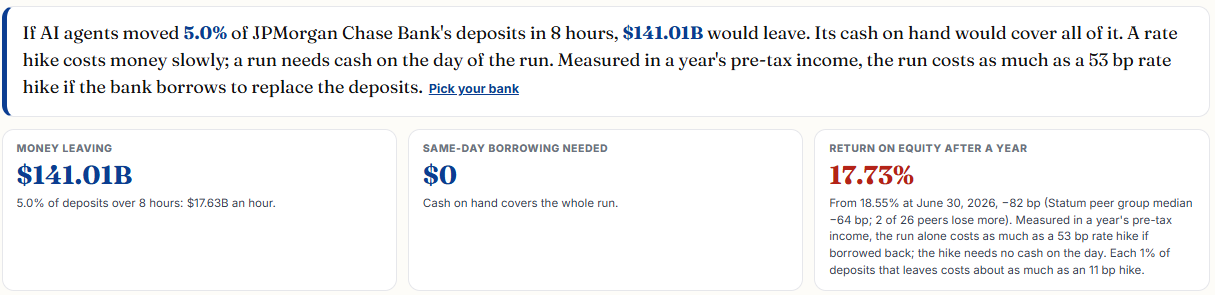
In our example case, it is interesting to compare your bank with JPM to see how their liquidity and deposit structure helps them survive an agent-assisted run.
The Historical Context
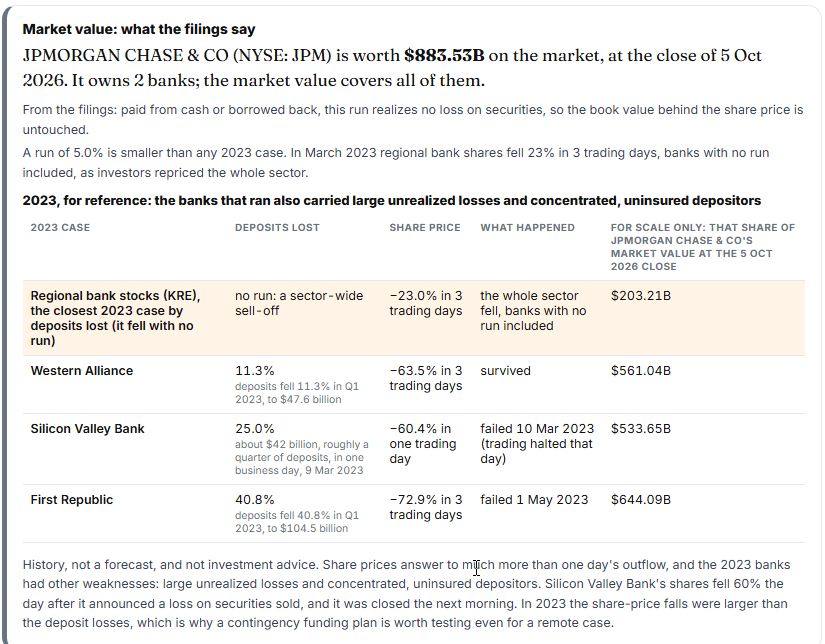
We then place a potential outflow in historic context so that you can compare your potential scenario with the past to see how other banks handled it without the agentic deposit risk aspect.
Next, you can look at your bank compared to your peers and then we compute the impact of what the additional cost of replacement funds does to return on equity.
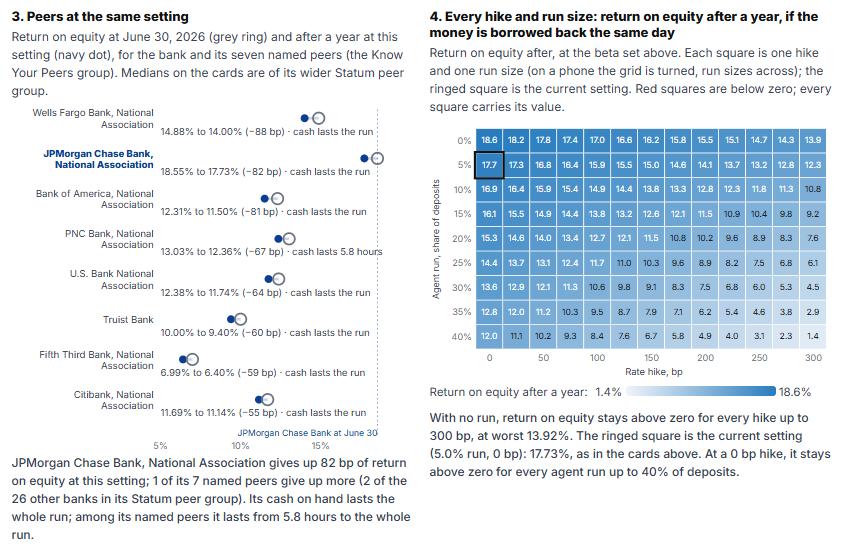
Apply the same discipline to your own bank. A community bank may have a smaller absolute gap but more concentrated deposit relationships or fewer same-day funding options. Conversely, reported liquidity may understate relationship stability or secured borrowing capacity that is operationally ready. The value lies in reconciling the public-data view with what management knows and can prove.
Questions Executives Should Ask
- Liquidity: How much of our available liquidity can be mobilized the same day?
- Householding Impact on Beta: Which deposits could move together because they share an owner, adviser, platform, industry or information source?
- Deposit Structure and Payment Management: Do bank executives have a clear picture on what deposits are most likely to move out? Can the bank quickly message those safety sensitive customers, particularly those above the FDIC insured limit?
- Crisis Identification: What event triggers executive escalation, and who has authority to act outside normal committee cycles?
- Reaction Time: Can our customer, employee, board and regulatory communications keep pace with faster digital behavior?
- Prep: How is your team going to manage social media, the press and the technical management of agents in a time of crisis? Is your IT team ready to block the bots that are already collecting information on your website now? What AI is needed to help the executive team make faster decisions? What data is required to drive the model?
Putting This Into Action
The best use of this agent stress test tool is not to produce a frightening chart. It is to create a disciplined management conversation before speed matters. Run your bank. Run several assumptions. Run credible peers. Then reconcile the public-data result to your internal liquidity position and contingency funding plan.
Silicon Valley Bank, First Republic and other occurred due to the confluence of unhedged fixed rate positions on their balance sheet, their deposit structure, short-sellers and social media. Now, add agentic advisory and action to the mix and outflows could happen potentially sooner.
AI compresses the decision cycle for depositors, but it can also improve the decision cycle for banks. The Agentic Run Stress Test is a first step into a practical, no-cost way to find the next question your liquidity program should answer.
The tool featured in this article lives in our free portal, next to the resources, dashboards, and calculators that over a thousand community banks use to make sharper decisions.You've read the article. Now use the tool.