
AI-Noise And How To Prevent Bank Vendors From Driving Your Strategy

The banking market is flooded with core providers and platform vendors promising transformative results. Bank executives are awash in vendor pitches from a variety of sources, particularly now around AI-driven solutions. The challenge is that many banks rely on their major core or digital bank vendors for their products and take on the strategy of those vendors. It doesn’t have to be like that, and we will explore how to change the paradigm.
The Problem is About Strategy Not Technology
The major trap bankers fall into is they go out looking for a product or technology solution to fill a void, but the problem is often a void in strategy.
This problem is more acute than ever with many bankers being swamped with AI and agentic solutions.
Any technology or product solution should start with an anchor on the bank’s strategic goals and with reference to their business model. Without anchoring their product or technology decisions to their business strategy, bank executives risk investing in technologies or products that serve vendor interests more than enterprise needs, resulting in fragmented systems and underutilized or fragmented adoption.
In addition to succumbing to major vendors for their strategy, this problem also comes to the surface starkly when a banker goes to a banking, fintech or technology conference and comes back with a collection of “shinny objects” the implementation of which result in a bunch of reactionary investments that lead to wasted spend, confused goals, unfilled promises and debilitating innovation drag.
Fixing The Problem with Bank Vendors
To fix this problem, we start with an understanding of making sure your strategy is not from the perspective of the bank, but from the perspective of its shareholders, employees and customers. We detailed this perspective here in an article titled Why Banking Strategy Should Be Simple But Difficult and in our banking cube framework.
Once you are aligned on our seven concepts to design your banking strategy around, we next move on to ensuring product or technology investment delivers sustainable business value. To do that, bank executives must anchor decisions on organizational priorities rather than vendor narratives.
One tool we find helpful is mapping the investments on an “opportunity radar” (below) that visually lays out each investment and where it fits within the bank.
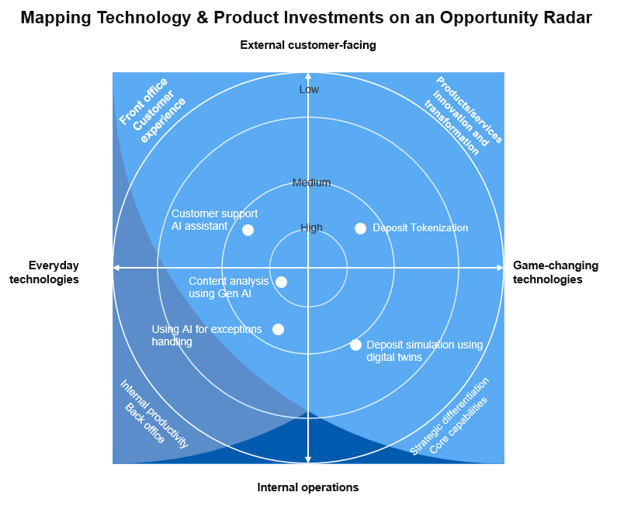
Bankers must also understand not just the immediate challenge, but the system they are trying to influence. We give a deposit example HERE of looking at bank challenges through the lens of the entire system.
Next, we suggest taking the following actions:
- Prioritize Outcomes: Define and fund product and technology investment based on measurable business objectives, not on features.
- Think Like A Portfolio Manager: Allocate product and technology budgets across four bank investment portfolios: competitive differentiation, efficient operations, risk and compliance, and innovation.
- Invest Capital Where It Is Loved: Capital should flow to where it is welcomed, supported and nourished. This means assigning any investment to a banker with a track record of being able to execute a vision with an excess risk-adjusted return. If it is vague about who is expected to drive the return with this new investment, think twice as you may already be destined for failure.
- Audit Existing Investments: Conduct audits to uncover existing underused product and technology features, redundant tools, and opportunities for better adoption. Many banks are not getting enough out of their existing investments and often have some capabilities that will help close, or at least test, strategy gaps.
- Define: Clarify what specific strategies a new product, service or technology supports and define measurable outcomes BEFORE advancing discussions with vendors.
Investing in Strategy, Not Hype
We love the potential of digital assets. However, your bank may not have the customer base or use case to make this worth the investment.
The pace of bank innovation has increased, and AI has accelerated these cycles dramatically. Terms like “AI-powered” and “digital transformation” are often used in vendor marketing material or demos but rarely give bankers clarity into how these solutions support their business strategy or support a set of known use cases.
The constant noise from vendors promising AI-driven breakthroughs can make it difficult to focus on what the outcomes that move shareholder return and total satisfaction (customer and employee).
Bankers should start every product or technology discussion with a specific, measurable business outcome. Avoid broad goals like “enhance profitability” and instead, specify quantified outcomes, such as “increase product profitability by 15% by implementing machine learning models to identify and adjust for seasonal trends.”
To further bypass the hype of bank vendors, bankers should apply four questions before advancing product or technology discussions:
- Does this solution directly address a high-priority business challenge identified by our bank, rather than one defined by the vendor?
- Can the vendor provide evidence of measurable business outcomes achieved in production environments at financial institution similar to ours?
- If there is not a track record of similar institutions, does the vendor have sufficient new technology to warrant the risk of being one of the first? How can you reduce risk by going into a pilot?
- What is the expected time frame for realizing tangible business outcomes, and which party is contractually accountable for delivering these outcomes? Is there a vendor risk share available?
Only with a clear outcome do product and technology discussions shift from comparing features to assessing the impact of these features on the organizational priorities.
Be a Portfolio Manager
Effective product or technology investments are critical for banks that seek to drive operational excellence and manage risk while driving innovation. However, without disciplined capital allocation, product and technology budgets can be diluted across projects that lack strategic alignment or measurable impact. Bankers can get focused on products that don’t “move the needle.”
To ensure investments deliver meaningful value, bankers should consider thinking about their strategic investments across four distinct areas. Using this framework will help maintain enterprise focus and clarity on bank priorities while limiting undue influence from vendor-influenced initiatives.
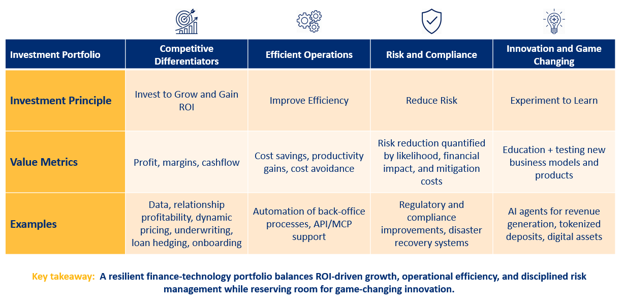
- Portfolio 1: Competitive differentiators (30% to 40% capital allocation) – These are product and technology investments such as analytics or AI-driven customer experiences that drive growth, revenue, and market differentiation, where strategic value outweighs cost.
- Portfolio 2: Efficient operations (25% to 30%) – These are technology investments and process improvement initiatives directed toward automation, process optimization, and core system upgrades that deliver cost savings and operational efficiency.
- Portfolio 3: Risk and compliance (20% to 25%) – These include product and technology investments in cybersecurity, regulatory technology, fraud detection, and systems to ensure loss mitigation plus compliance with evolving regulations.
- Portfolio 4: Innovation and game changers (10% to 15%) – These include product and technology investments in transformative, high-risk initiatives (e.g., AI, tokenized deposits, stablecoin, digital assets), with stage-gated funding focused on breakthrough potential and rapid decision making.
The ideal split of investment for each portfolio depends on the bank’s strategic priorities, market position, and risk appetite. For example, banking-as-a-Service oriented banks may want to increase investments in the risk and compliance portfolio. Conversely, banks with strong loan growth may want to allocate more to deposit competitive differentiators and innovation.
Applying a portfolio view helps bankers avoid overindexing on vendor hype. This can occur both during the initial sales process and when selecting solutions. This approach also ensures foundational enterprise systems such as onboarding platforms and CRMs get the support needed for business continuity and operations.
Audit Existing Assets
The rapid pace of AI has further complicated the adoption gap. Vendors continuously inject new AI capabilities into existing products, creating an environment where bankers may have access to more AI tools than it realizes. Many of these might overlap. Copilot agents, as an example, overlap with Salesforce agents which overlap with agents from some of the banking platforms. This can lead to a bloated stack with redundant or conflicting capabilities.
To avoid being steered by vendor agendas, bankers should require their teams to audit their current product and technology stack before approving any new investments. This should be done with an enterprise view as many solutions that are already employed by retail might be able to help commercial customers.
This audit effort should consistently uncover three things:
- Duplicate functionality across tools and products – for example, having both instant payments and Zelle.
- Underused features (such as AI) in existing platforms that could support the strategy of other departments.
- Redundant software resulting from vendors’ aggressive renewal practices.
Bankers should include existing bank vendors in the audit by asking which features are available, which capabilities are underused, and how current tools can better advance business objectives. This holds vendors accountable for helping maximize existing investments and positions them as strategic partners rather than simply sales representatives.
Putting This Into Action
In the end, banks that lead with strategy, not vendor narratives, will be better positioned to turn product and technology investments into measurable business value. By defining outcomes first, managing investments as a portfolio, auditing existing capabilities, and holding bank vendors accountable for results, bankers can reduce innovation noise, avoid wasted spend, and focus capital on the initiatives that strengthen performance, manage risk, and create lasting value for customers, employees, and shareholders.